Newsweek/Getty

By Newsweek Editors
0
Share
Newsweek is a Trust Project member
See more of our trusted coverage when you search.Prefer Newsweek on Googleto see more of our trusted coverage when you search.
Supreme Leader Ali Khamenei, dozens of senior officials, and the top tier of Iran's military command dispatched within 48 hours. The operation came less than a year after Trump declared Iran's nuclear program "completely and totally obliterated" following last June's 12-day war, a claim the IAEA had been quietly contradicting ever since.
At least six Americans are dead, the Strait of Hormuz is effectively closed, Iran has struck U.S. bases across the Gulf, and Congress, notified "shortly before" the bombs fell, faces a war powers vote with long odds of passage.
With no obvious successor to Khamenei and a country in chaos, Trump is still looking for a rationale of war to stick.
Read More on Opinion
Marco Rubio ⬇
Pressed to explain the "imminent threat" that justified the war, the Secretary of State on Monday told reporters the danger was Israel’s coming attack on Iran, and Iran’s predictable retaliation against U.S. forces, so America struck first.
Hours later, Trump told reporters Israel hadn't forced his hand, so Rubio tried to square the circle on Capitol Hill. "This had to happen anyway," he said, arguing the U.S. simply "was not going to get hit first." The nation's top diplomat has become the public face of a rationale his boss can’t keep straight.
General Dan Caine ⬆
The Joint Chiefs chairman spent weeks privately warning Trump that a military campaign against Iran carried significant risks and could become a prolonged conflict, earning him the label "reluctant warrior" among senior officials.
He was overruled, and has since described an opening 24 hours that hit more than 1,000 targets, established local air superiority, and left Iran "without the ability to see, coordinate or respond effectively." The best argument for listening to your generals is a general who executes brilliantly even when he loses the argument.
Thomas Massie ⬇
The Kentucky Republican co-authored a war powers resolution with California Democrat Representative Ro Khanna before the bombs fell, calling the strikes unconstitutional and "not America First." The resolution is almost certain to fail. Being constitutionally correct and completely powerless is becoming his brand.
Hakeem Jeffries ⬆
The House minority leader has found the one Democratic talking point that requires no spin: he keeps pressing that Trump "made the representation that Iran's nuclear program was completely and totally obliterated last year as a result of actions that the administration has taken." After months of struggling to land a punch, Jeffries is finally fighting Trump with Trump's own words.
Masih Alinejad ⬆
Iran's regime dispatched assassins to the journalist and activist’s Brooklyn home in 2022. She posted a video tearing up and saying "I want to run, I want to shout" after Khamenei was confirmed dead. The man who ordered her murder is gone; she's watching from New York. Not every up arrow requires explanation.
Delcy Rodríguez ⬆
She denounced Maduro's capture as a "kidnapping," then freed political prisoners, handed Trump Venezuelan oil, and started calling him a "friend." Trump told reporters: "Venezuela was so incredible because we did the attack, and we kept government totally intact. And we have Delcy, who's been very good."
He then described Venezuela as "the perfect scenario" for what he hopes comes next in Tehran. From Maduro loyalist to Trump’s poster child is a career arc that Machiavelli would respect.
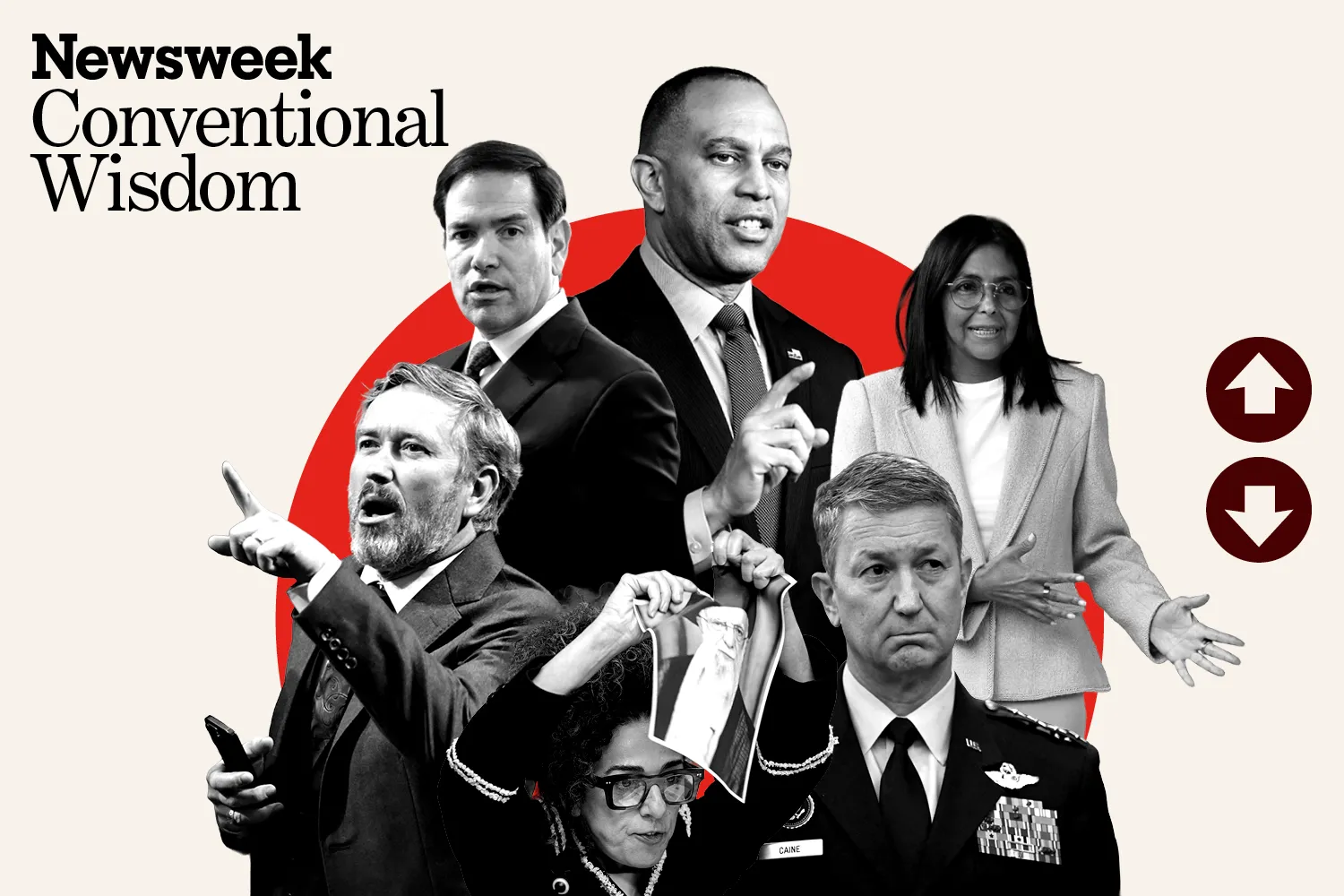
Originally a staple of Newsweek's print edition, Conventional Wisdom used arrows to track whose stock was rising or falling in the political circus. We're reviving it in the digital age because the problem it lampooned (hyperbole and partisan certainty masquerading as insight) has only intensified.
CW assigns arrows (up, down, or sideways) to the figures and forces shaping current events. The arrows don't predict the future or claim special insight. They capture the prevailing winds of the moment, uncluttered by tribal howling. In an era when partisan media reinforces rather than questions assumptions, CW operates from the center, skeptical of left and right alike, committed to puncturing inflated reputations and recognizing overlooked truths.
Do you agree with our editors on which way the political winds are blowing? Send us a message here.
Hey gang, Carlo Versano here. I hope you enjoyed this article. As Newsweek's Director of Politics and Culture and editor of the 1600 newsletter, I'm keen to hear what you think. Now, Newsweek is offering a new service to allow you to communicate directly with me in the form of a text message chat. You can sign up and get a direct line to me, as well as the reporters who work for me. You can shape our coverage.
As a Newsweek member, we're offering this service to you for free. You can sign up below, or read more about how it works here. Let's talk!
View 0 Comments
Submit Correction
View Editorial & AI Guidelines