Newsweek/Getty

By Newsweek Editors
0
Share
Newsweek is a Trust Project member
See more of our trusted coverage when you search.Prefer Newsweek on Googleto see more of our trusted coverage when you search.
Oil crossed $100 a barrel in Asian markets Sunday night for the first time since Russia invaded Ukraine in February 2022, then exploded past $119 at the New York open Monday morning as traders finally absorbed what a closed Strait of Hormuz actually means.
Then came the whiplash: President Donald Trump, spooked by the prospect of an unprecedented energy crisis, told CBS News the war was "very complete, pretty much" and called it a "short-term excursion", which sent crude tumbling nearly $30, while Iran's officials said they were ready for a long war. Markets ended Monday somewhere between panic and bewilderment, which felt about right: They ticked back up to around $90 a barrel early Tuesday after Trump said: "We have won in many ways but not enough."
On every trade there's a winner and loser. Here’s how the price gyrations are already reverberating.
Read More on Opinion
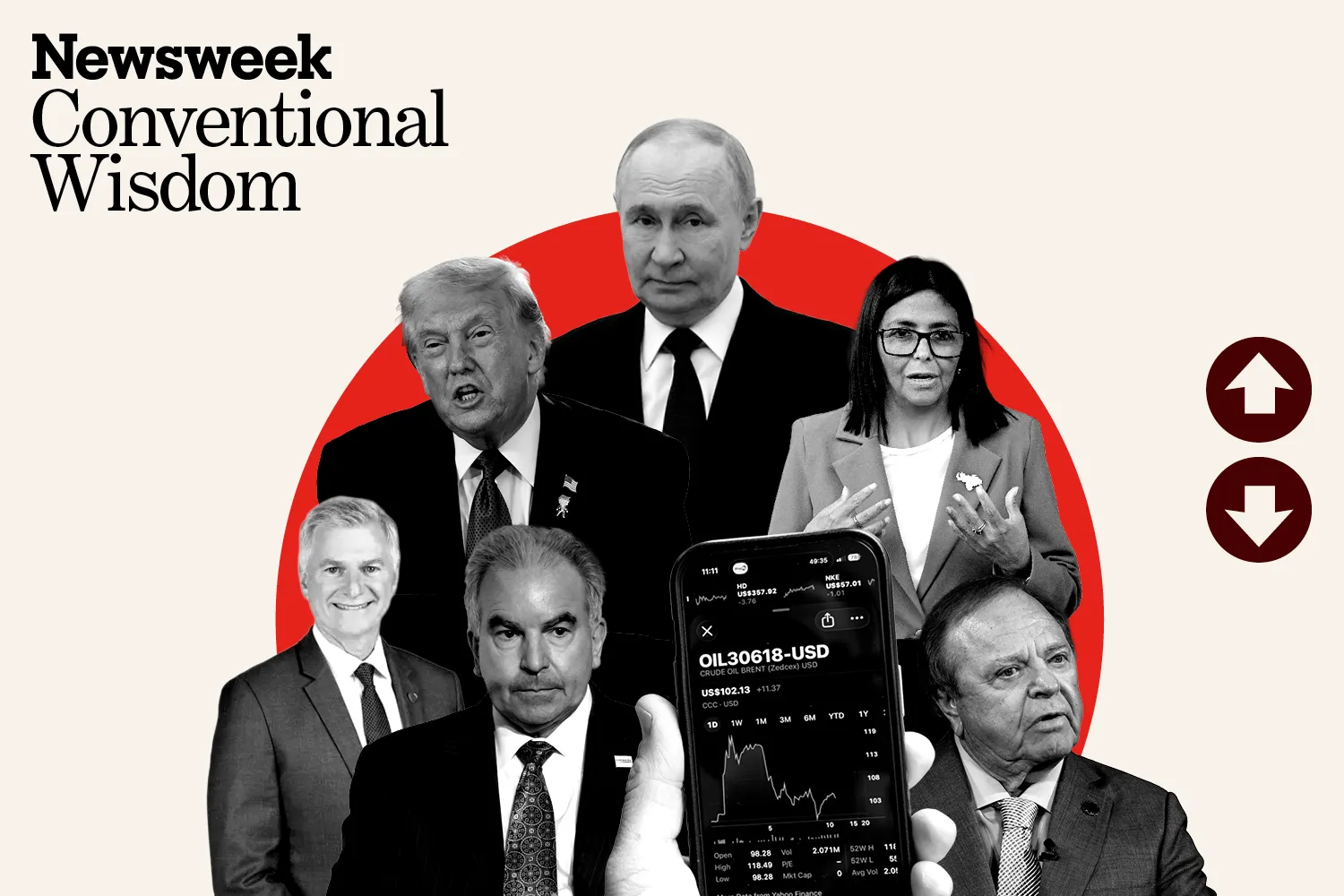
Donald Trump ⬇
Last week he demanded Iran's "unconditional surrender," vowed to "go forward more determined than ever to achieve ultimate victory," and called $3.50 gas "a very small price to pay." By Monday morning, with oil above $119, he had reversed course entirely, while his own defense secretary had retweeted "We Have Only Just Begun to Fight" that same morning. The leader of the free world is now the most volatile variable in the oil market.
Vladimir Putin ⬆
Got a phone call from Trump on Monday as oil crested triple figures. Was the likely beneficiary of Trump’s pledge to lift "oil-related sanctions" even though Russia was credited by U.S. officials for feeding Iran the locations of American warships, apparently without consequence. The "gas station with nukes" is collecting on every pump, with the pumps paid for by the country shooting at its customer.
Delcy Rodríguez ⬆
Venezuela sits on the world's largest proven oil reserves, and Trump personally handed her the presidency in January. With the Strait of Hormuz squeezed shut and Middle Eastern barrels stranded in storage, the woman Trump calls "a terrific person" just became the most important oil executive on the planet. Four years ago she was a DEA priority target.
Harold Hamm ⬆
The Oklahoma fracking billionaire known as the king of shale watched his industry get hobbled for two years as oil languished below the $65–70 break-even threshold. Even after Monday's wild ride, crude is sitting around $88, comfortably above where the fracking business needs it. He didn't start a war. He just had to wait for one.
Jack Fusco ⬆
The CEO of Cheniere Energy, America's largest LNG exporter, ships every molecule out of the Gulf Coast, not one transits the Strait of Hormuz. Qatar, the world's second-largest LNG exporter, just declared force majeure after Iranian drones hit its facilities. Europe and Asia are now lining up for American gas. Geography is destiny.
Bob Jordan ⬇
The Southwest CEO killed the airline's legendary fuel hedging program last March as part of a cost-cutting drive, a program that had saved the company $3.5 billion over a decade and $1.2 billion during the Russia oil spike alone. Cutting the cost-saver to save costs is the kind of logic that works great until it doesn't.
Originally a staple of Newsweek's print edition, Conventional Wisdom used arrows to track whose stock was rising or falling in the political circus. We're reviving it in the digital age because the problem it lampooned—hyperbole and partisan certainty masquerading as insight—has only intensified.
CW assigns arrows—up, down, or sideways—to the figures and forces shaping current events. The arrows don't predict the future or claim special insight. They capture the prevailing winds of the moment, uncluttered by tribal howling. In an era when partisan media reinforces rather than questions assumptions, CW operates from the center—skeptical of left and right alike, committed to puncturing inflated reputations and recognizing overlooked truths.
Do you agree with our editors on which way the political winds are blowing? Send us a message here.
Hey gang, Carlo Versano here. I hope you enjoyed this article. As Newsweek's Director of Politics and Culture and editor of the 1600 newsletter, I'm keen to hear what you think. Now, Newsweek is offering a new service to allow you to communicate directly with me in the form of a text message chat. You can sign up and get a direct line to me, as well as the reporters who work for me. You can shape our coverage.
As a Newsweek member, we're offering this service to you for free. You can sign up below, or read more about how it works here. Let's talk!
View 0 Comments
Submit Correction
View Editorial & AI Guidelines