...

By Kevin Powell
Writer
0
Share
Newsweek is a Trust Project member
See more of our trusted coverage when you search.Prefer Newsweek on Googleto see more of our trusted coverage when you search.
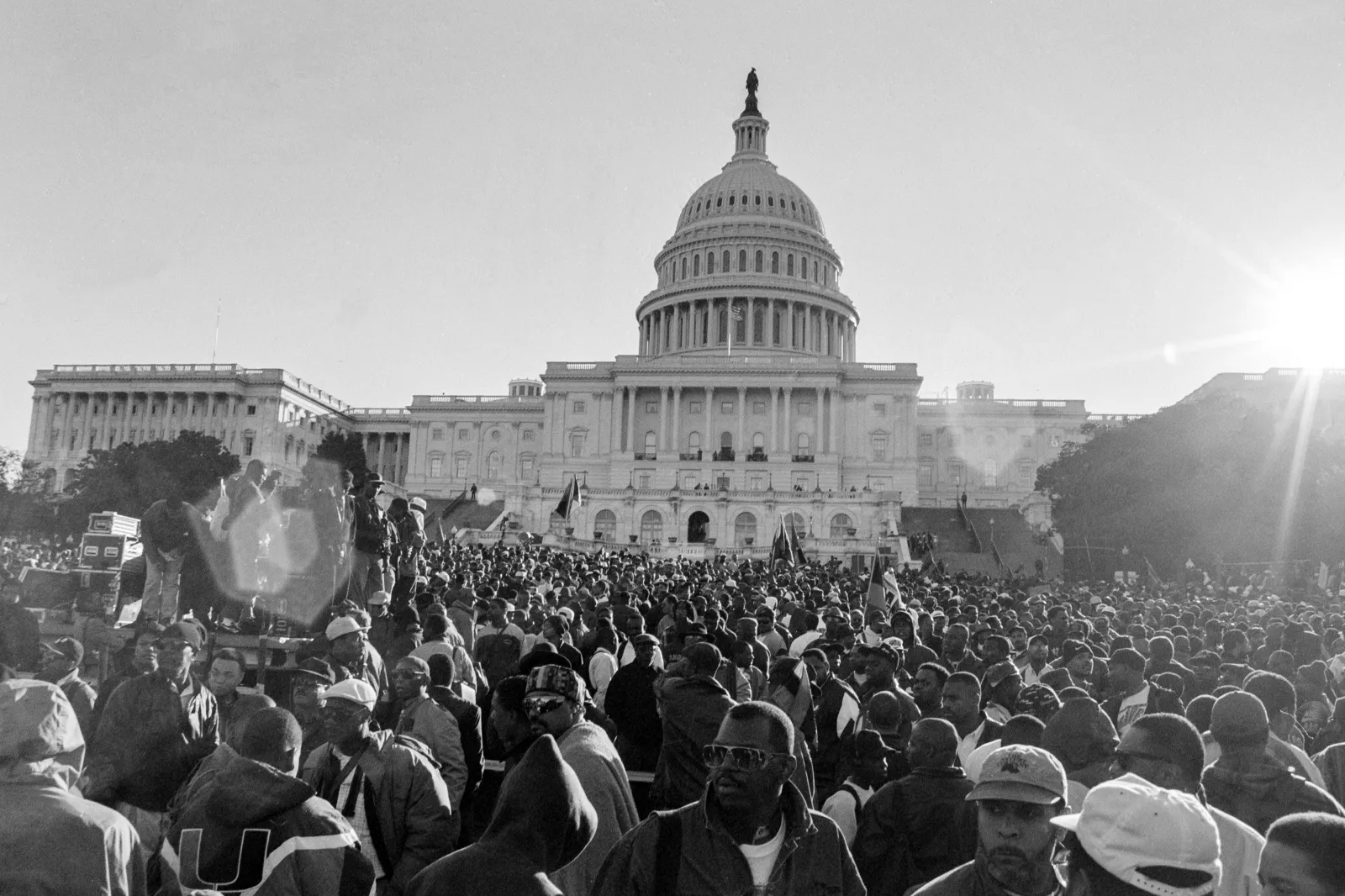
For us Black males in America, the year 1995 was not just a number or the occurrence of a historic gathering hailed as the Million Man March. It was a momentous turning point, in a surplus of ways, for who we were—or wildly debated to be—in the saga of this nation.
That year D’Angelo, an extraordinary singer and multi-instrumentalist declared the heir to Stevie Wonder and Prince, premiered his groundbreaking first album, Brown Sugar. President Bill Clinton’s crime bill, which came to disproportionately affect us with increased incarceration and criminal records, was passed in 1994, but devastating effects began to stick in ’95.
...
Read More on Opinion
That year, too, Michael Jordan, arguably the greatest basketball player ever, un-retired, unleashing a global response predicting our current obsessions with celebrity, and Black men as brands, not whole beings.
The O.J. Simpson murder trial happened, and it riveted and further ruptured America. O.J., once an icon on par with M.J., would remain a pariah the rest of his existence, residing, precariously, in Black-manhood purgatory.
And Tupac Shakur, who I interviewed multiple times for Quincy Jones’ Vibe magazine, would be famously released from jail days before the Million Man March in Washington, D.C.

...
This was our America. And this is our America since, which saw D’Angelo not only emerge as a transformative, multi-Grammy-winning sound garden, but also a tear-jerking tale, on repeat, of addiction, fractured relationships, and shaky self-esteem akin to hero-predecessors Marvin Gaye and Sly Stone.
Ironically, on the morning of D’Angelo’s death I was in Richmond, Virginia, where he was born as Michael Eugene Archer. I was bombarded with texts of his end. I was already juggling raw emotions. As with major American cities I’ve visited, there were depressing legions of homeless Black males sleeping on the ground with or without cardboard or a blanket, or standing semi-bent on a street corner, talking, aloud, to themselves.
Since 1995, Black males like me have survived, but many of us, like D’Angelo, like the sprawling un-housed Black male population there in Richmond and throughout America, have not, casualties of wars we often do not know are being waged from outside, from within. I travel with survivor’s guilt as a Black man: How have I been spared when countless have not?

...
This is precisely why I attended the Million Man March in 1995. I habitually relish Black-male bonding in a society that forever seems hostile to my very existence. I was there because I am perpetually searching for answers—and healing—to make me feel like the man I still struggle to be, as if I am in the endless loop of an August Wilson or Tarell Alvin McCraney play; and I was there in spite of my not agreeing with its vision fully, or the sexist, derogatory language about Black women, or the absence of legit follow-up tied to the landmark rally.

...
Except for individual efforts in a few U.S. locales, there has been nothing but memories about the Million Man March. It was a moment, not a movement, the way D’Angelo’s creative path was a series of moments, and now he is in our memories.
But what recollections: D’Angelo was that uncommon blend of rule-erasing rock star aesthetics and reclusiveness, hip-hop swagger, gospel-baked roots, R&B traditionalism, bluesman love affairs, country road vocab, and jazzy melodic moodiness. Yes, only two additional albums in 30 years since his 1995 debut, with a 14-year gap between the second and third, but an impenetrable recipe for everyone from Beyoncé to Kendrick Lamar.
Both in his music and personal journey D’Angelo was a one-person Million Man March, alive and present to decode who he truly was, what he could be, but also terribly wounded and conflicted, per his hyper-vulnerable lyrics, about how to maneuver in a space that has shamelessly reduced him—us—to one-dimensional stereotypes, sideshows, or worse, permanent poster boys for bad behavior, real or alleged.

...
If others are complex then so are we, which was part of the point of the Million Man March, of the art of D’Angelo. Between 1995 and today I have watched our culture go from the splendid explorations and self-sacrifices of a D’Angelo to some of the most vile and harmful depictions of Black men and Black boys—in music, on TV, in film, in video games, on social media, via podcasts—unseen since minstrel shows and blackface were birthed way back in 1800s slavery-saturated America.
D'Angelo, the child of a Pentecostal preacher-father, fought mightily against these traps even as he was slap-boxing with Jesus. He died, only 51, after a private battle with pancreatic cancer, survived by two sons and a daughter. As fate would have it, D’Angelo passed this same week as the 30th anniversary of the Million Man March.
I recall walking, then running, to get to the Million Man March, at that brisk break of dawn in ’95. Just as I recall walking, then running, to what would be D’Angelo’s final album, Black Messiah, in 2014—11 disturbingly long years ago.
I could barely understand his vocally distorted sketches of pain on Black Messiah, but I came to grasp D’Angelo as I came to grasp the reasons for the Million Man March. I was overwhelmed with emotions that October day in 1995, and I am overwhelmed with emotions on this October day in 2025, 30 years and yet another dead-too-young Black man later.
Kevin Powell is a Grammy-nominated poet, humanitarian, author of 16 books, filmmaker, public speaker, and frequent contributor to Newsweek*. He lives in New York City. You can find him on social media platforms by typing poetkevinpowell.*
The views expressed in this article are the writer's own.
View 0 Comments
Submit Correction
View Editorial & AI Guidelines