...

By Hugh Cameron
Reporter
0
Share
Newsweek is a Trust Project member
See more of our trusted coverage when you search.Prefer Newsweek on Googleto see more of our trusted coverage when you search.
The Pentagon's newest missile has drawn comparisons with Russia's recently deployed Oreshnik, the two emerging as key contenders in the hypersonic arms race and fueling debates over their capabilities and strategic impact.
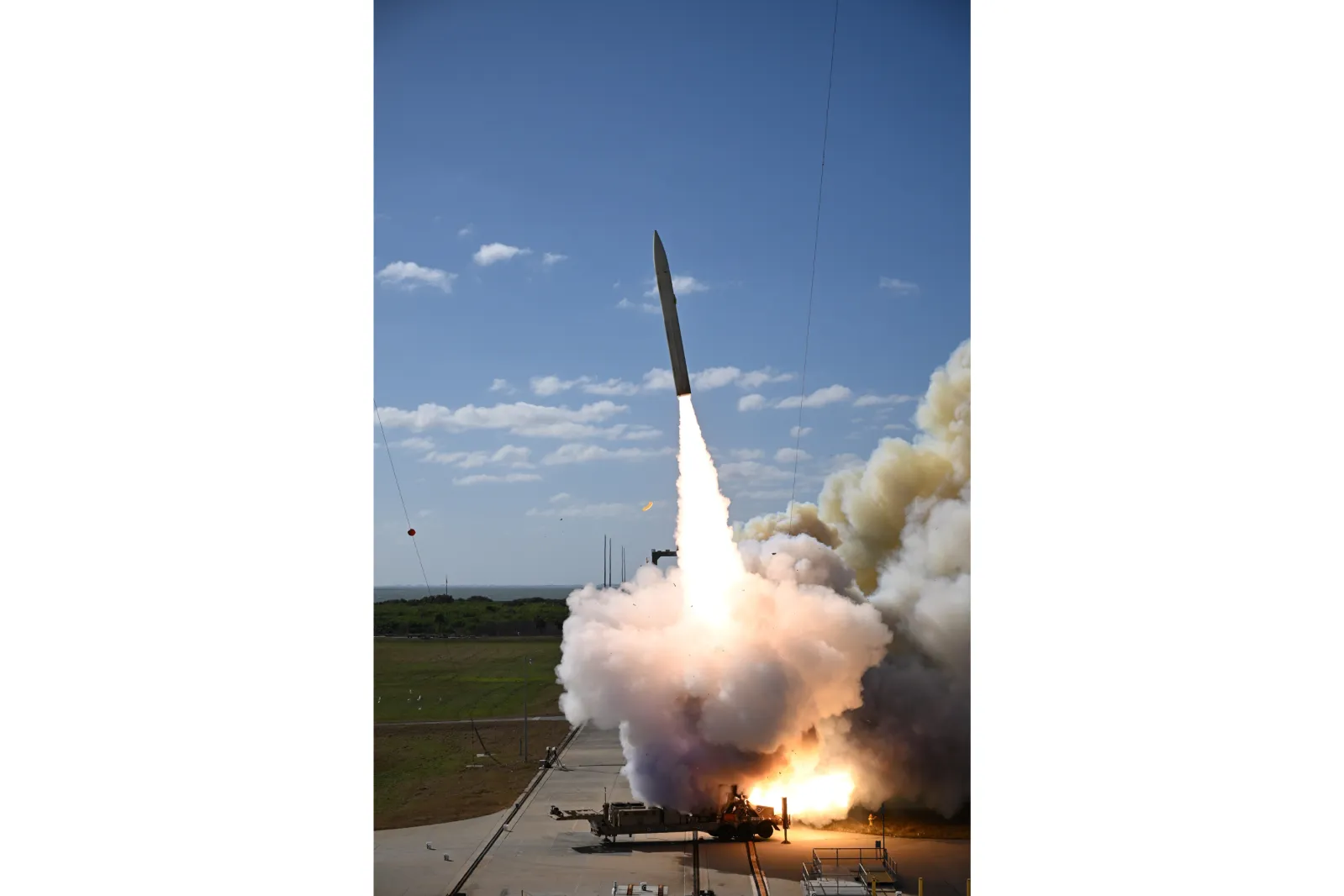
The United States completed a test launch of its Long-Range Hypersonic Weapon from Cape Canaveral Space Force Station in Florida, the Department of Defense confirmed on Thursday.
"This test marks an important milestone in the development of one of our most advanced weapons systems," Secretary of the Navy Carlos Del Toro said following the end-to-end flight test, which came after years of delays and setbacks.
Read More on U.S.
Dubbed the Dark Eagle, Del Toro said that integrating the new weapon into the U.S. arsenal will help "ensure we remain the world's preeminent fighting force."
...
Some have considered the unveiling of the Dark Eagle as America's answer to Russia's Oreshnik (or "hazel tree"), the hypersonic, nuclear-capable missile that struck a Ukrainian military-industrial facility in Dnipro on November 21.
Use of the new, Oreshnik raised particular concerns among Ukraine's allies, as the Dnipro strike came only a few days after Russian President Vladimir Putin signed into law the country's new, more permissive guidelines on the use of nuclear weapons.
On Wednesday, Deputy Pentagon press secretary Sabrina Singh warned Russia could deploy the weapon again "in the coming days."
What is the Dark Eagle Hypersonic Missile?
Dark Eagle is an intermediate-range medium-range missile system being developed for use by the U.S. Army.
Land-based and truck-launched, the "transformational" hypersonic weapon will "deliver unmatched capability to meet joint warfighting needs," said Vice Admiral Johnny Wolfe Jr., director of the U.S. Navy's Strategic Systems Programs.
The missile component of the Dark Eagle has reportedly been developed by Lockheed Martin and Northrop Grumman, according to a recent Congressional Research Service report on the weapon.
While the Defense Department said the latest test will inform when the Dark Eagle can enter service, it is unclear when this may be. In 2021, officials said they were "very, very confident" the weapon could be fielded by 2023, though no date for its deployment has yet been announced.
Newsweek reached out to the Department of Defense via email for comment.
How does it compare with the Oreshnik?
Russia has expressed serious confidence in its hypersonic missile, Putin going so far as to say that the development of the Oreshnik puts his country "on the verge of virtually eliminating the need to employ nuclear weapons."
"No countermeasures currently exist against such weapons," Putin said, following the first use of the Oreshnik on November 21. "These missiles strike targets at a speed of Mach 10—2.5 to 3 kilometers per second."

...
Ukraine reported that the missile reached a top speed of over 11 Mach before hitting its target in Dnipro, equivalent to around 8,400 miles per hour or 2.3 miles per second.
Meanwhile, The Dark Eagle can travel "well over 3,800 miles per hour," the U.S. Army said, as cited in a recent Congressional Research Service report. "They can reach the top of the Earth's atmosphere and remain just beyond the range of air and missile defense systems until they are ready to strike, and by then it's too late to react."
However, the Dark Eagle may be capable of reaching up to Mach 17—equal to 13,044 miles per hour or 17 times the speed of sound, according to the Bulletin of Atomic Scientists.
The Dark Eagle also boasts a range of 1,725 miles, compared to the Oreshnik's reported 3,418-mile range. However, one Russian military expert was quoted by the pro-Kremlin newspaper Izvestiya as saying that the Oreshnik's actual range likely fell between 1,550 and 3,100 miles.
It is unclear whether the Dark Eagle is nuclear-capable like its Russian counterpart. According to a recent report prepared for Congress by advanced technology expert Kelly Sayler, "most U.S. hypersonic weapons, in contrast to those in Russia and China, are not being designed for use with a nuclear warhead."
Both countries have asserted their hypersonic weapons' superiority and their invulnerability to enemy defenses.
"Modern air defense systems, including those being developed by the Americans in Europe, cannot intercept such missiles," Putin said following the strike on Dnipro in November.
The U.S. Defense Department, meanwhile, said that its hypersonic system's "combination of speed, range, maneuverability, and altitude" make it a near-impossible target to shoot down, enabling "highly survivable and rapid defeat of time-critical and heavily-defended targets."
"The responsiveness, maneuverability and survivability of hypersonic weapons is unmatched by traditional strike capabilities for precision targeting, especially in anti-access/area denial environments," said Lieutenant General Robert A. Rasch, director of Hypersonics, Directed Energy, Space and Rapid Acquisitions for the Army's Rapid Capabilities and Critical Technologies Office.
Do you have a story we should be covering? Do you have any questions about this article? Contact LiveNews@newsweek.com.
View 0 Comments
Submit Correction
View Editorial & AI Guidelines