...

By Alia Shoaib
Reporter
0
Share
Newsweek is a Trust Project member
See more of our trusted coverage when you search.Prefer Newsweek on Googleto see more of our trusted coverage when you search.
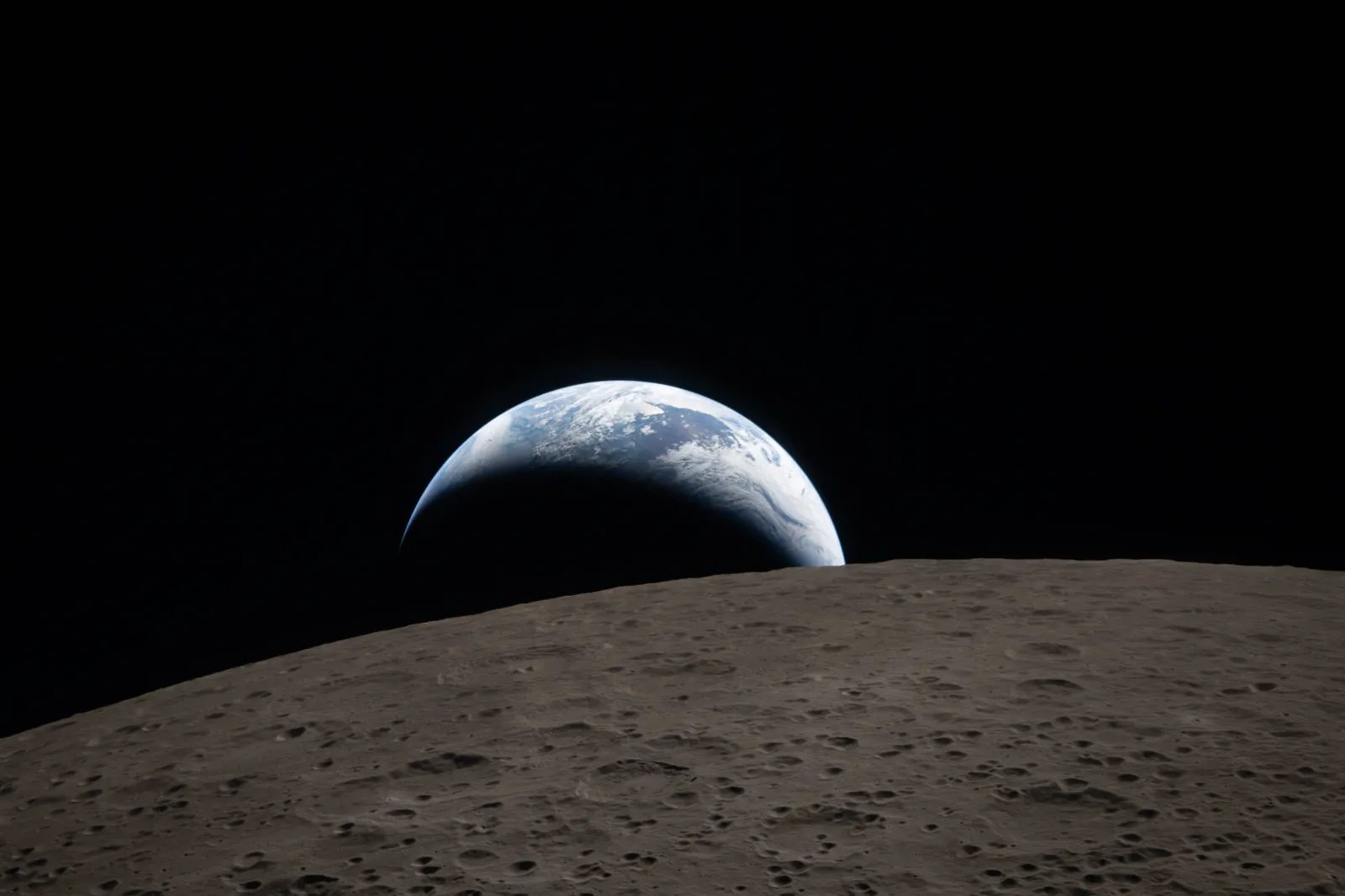
NASA has shared new images of the moon from its Artemis II mission and said its crew has become "the first to see the far side with human eyes."
The space agency’s description sparked some confusion, with observers questioning how the Apollo astronauts, who orbited the moon decades ago, did not see the far side.
The reason why the Artemis II crew has been the first to reach this milestone is to do with the timing and design of the Apollo missions, which kept the moon landing sites and orbit paths in sunlight, leaving the far side mostly in shadow and not visible to the naked eye.
Read More on News
Why It Matters
Artemis II marks the first human mission to the vicinity of the Moon since NASA’s Apollo program ended in 1972. The mission allowed astronauts to directly observe the far side of the moon illuminated with their own eyes for the first time. It also marks a significant step in NASA’s testing of spacecraft systems and procedures for future missions, paving the way for Artemis III lunar landings and longer-term plans for crewed missions to Mars.
What To Know
The Artemis II crew are on their way back to Earth after conducting a lunar fly-by, following a slingshot path around the moon. During the mission, the astronauts spent about seven hours observing the moon from their spacecraft, turning the lights off inside and recording detailed observations including photographs and video.
From Earth, only the near side of the moon is ever visible due to a process called tidal locking, in which the moon’s rotation and orbit are synchronized—the "near side" always faces Earth, while the "far side" always points away.
But observers were left confused by NASA’s declaration that the Artemis II crew are the first humans to see the far side of the moon with their own eyes, given the nine historic crewed Apollo missions that flew in the moon’s vicinity.
X user Bohemian Capitalist joked: "What about the Apollo astronauts? Did they close their eyes?"
Another user Paul Russell said: "I don't get the 'first to see the far side with human eyes' thing. The manned Apollo missions made 164 orbits of the Moon (according to Google) so those astronauts must have seen the far side. Or am I missing something?"
The reason that previous Apollo astronauts did not technically "see" the far side is because they generally flew over it when it was in darkness.
"When the Apollo missions launched, they prioritized launching into windows where the near side was illuminated because that’s where the missions landed," Dr. Kelsey Young, lead for NASA’s Science Mission Directorate, said at a news conference on Saturday. "The far side was not illuminated at the time when they were in orbit."
In the famed Apollo 13 mission, technical errors forced the crew to abort their planned lunar landing and take a slingshot path around the moon, a similar path to the one Artemis II has taken. However, during that mission, the far side was largely in darkness during their closest approach.
Artemis II, by contrast, passed over the far side while it was illuminated by the sun, allowing the crew to become the first humans to see it lit up directly with their own eyes.
...
The Artemis II mission also set a record for the furthest humans have ever traveled from Earth, reaching 252,756 miles and surpassing Apollo 13’s previous record by 4,101 miles. The greater distance also offered the crew a more-complete view of the moon’s surface.
The mission also achieved other milestones. Its crew—commander Reid Wiseman, pilot Victor Glover, and mission specialists Christina Koch and Jeremy Hansen—includes the first woman, the first person of color, and the first Canadian to travel to the moon’s vicinity.
What People Are Saying
NASA wrote on X on Monday: "A new photo captures the Moon's near side on the right (the side we see from Earth, identifiable by its dark splotches) and its far side on the left. The Artemis II crew are the first to see the far side with human eyes."
Commander Reid Wiseman said in a phone call with President Donald Trump: "I have to tell you, as we came around the near side of the moon, seeing all the sights that we've seen from Earth for all of our lives but we're seeing them from a different perspective, and then we started to get a glimpse of the far side and we saw sites, Orientale, sights that no human has ever seen before, not even on Apollo, and that was amazing for us."
What Happens Next
The Artemis II crew is due to splashdown in the Pacific Ocean near San Diego at approximately 8:07 p.m. EDT on April 10.
View 0 Comments
Submit Correction
View Editorial & AI Guidelines