...

By Aristos Georgiou
Science and Health Reporter
0
Share
Newsweek is a Trust Project member
See more of our trusted coverage when you search.Prefer Newsweek on Googleto see more of our trusted coverage when you search.
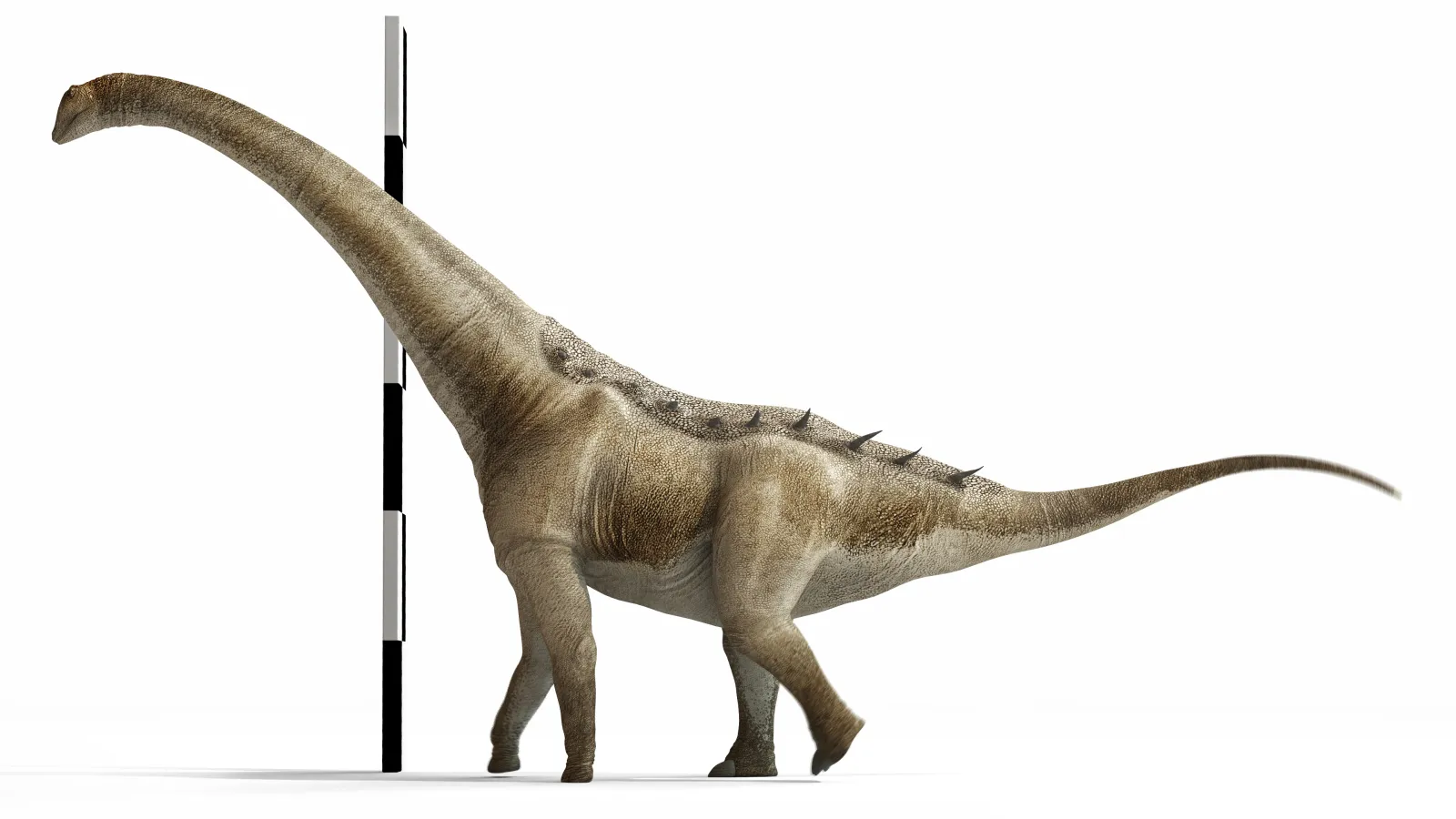
Paleontologists have identified a new species of dinosaur that represents one of the "last giants" to have roamed Europe before the catastrophic mass extinction event 66 million years ago.
The previously unknown dinosaur, named Qunkasaura pintiquiniestra, was identified based on fossils found at site of Lo Hueco site near the city of Cuenca, Spain.
The creature, described in a study published in the journal Communications Biology, is a type of sauropod—a group of herbivorous dinosaurs with very long necks, long tails, small heads and four thick legs, which boasted among them some of the largest animals to ever roam the Earth on land. The new species belongs to a sauropod subgroup known as the titanosaurs.
Read More on Science
Qunkasaura lived around 73 million years ago on the shores of what is now the Mediterranean Sea and at that time was the Tethys Sea—a prehistoric ocean.
...
This sauropod measured approximately 65 feet in length and weighed more than 15 tons, study author Francisco Ortega with Spain's National University of Distance Education (UNED) told Spanish newspaper El Mundo.
The description of Qunkasaura was based on one of the most complete sauropod skeletons ever found in Europe, which included several vertebrae, as well as elements of the pelvic girdle and limbs.
So far, researchers have identified one specimen of Qunkasaura, an adult that had not yet developed fully, but they believe at least two individuals are present among the recovered remains.
The Qunkasaura fossils were among thousands excavated in 2007 during the construction of a high-speed rail line between the Spanish capital Madrid and the Levante region in the east of the country. These remains represent one of the most significant collections of Late Cretaceous (around 100–66 million years ago) fossil vertebrates in Europe.
"During the end of the Cretaceous, Europe was a huge archipelago. Qunkasaura lived in the Ibero-Armorican island, which includes Portugal, Spain and the south of France. This sauropod lived near-coast continental muddy floodplain crossed by distributary sandy channels, exposed intermittently to brackish or marine and freshwater flooding," study lead author Pedro Mocho, a postdoctoral researcher with the University of Lisbon, told Newsweek.
One of the most notable features of Lo Hueco's fossil record is the abundance of large partial skeletons of sauropod dinosaurs, which are rare in the rest of Europe.
Qunkasaura is among "the last giants" that inhabited Europe before the extinction of all non-avian dinosaurs around 66 million years ago, Ortega said.
Do you have an animal or nature story to share with Newsweek? Do you have a question about paleontology Let us know via science@newsweek.com.
Update 09/30/24, 10:38 a.m. ET: This article was updated to include additional comment from Pedro Mocho.
References
Mocho, P., Escaso, F., Marcos-Fernández, F., Páramo, A., Sanz, J. L., Vidal, D., & Ortega, F. (2024). A Spanish saltasauroid titanosaur reveals Europe as a melting pot of endemic and immigrant sauropods in the Late Cretaceous. Communications Biology, 7(1), 1–10. https://doi.org/10.1038/s42003-024-06653-0
View 0 Comments
Submit Correction
View Editorial & AI Guidelines