...

By Hugh Cameron
Reporter
0
Share
Newsweek is a Trust Project member
See more of our trusted coverage when you search.Prefer Newsweek on Googleto see more of our trusted coverage when you search.
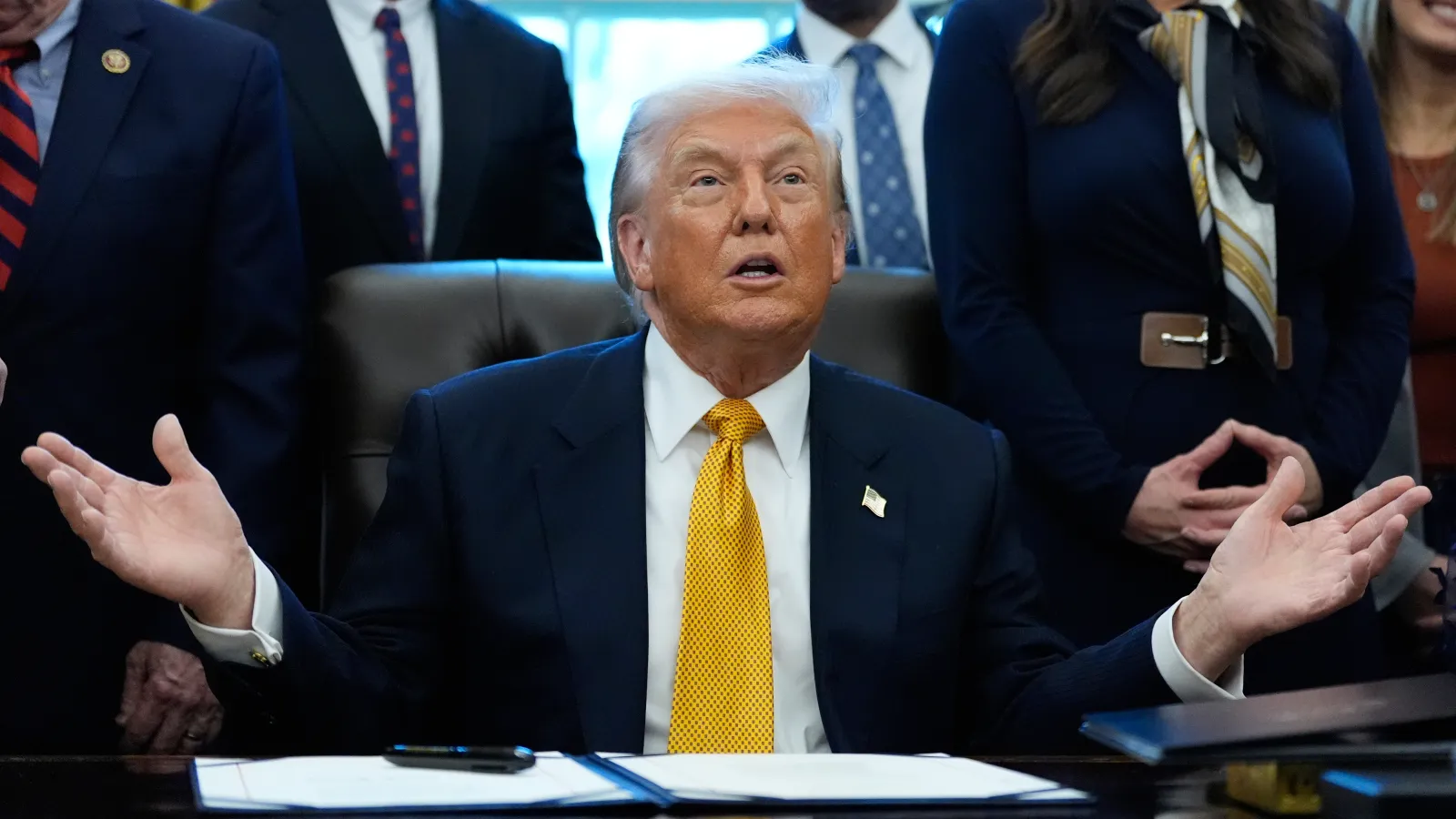
President Donald Trump purchased up to $1 million worth of Victoria's Secret-issued corporate bonds last month, and recent weeks saw him make several other transactions potentially totaling over $100 million.
According to a financial disclosure report filed with the U.S. Office of Government Ethics on January 14, the president made the purchase in mid-December.
Why It Matters
U.S. executive branch officials, including presidents themselves, are permitted to buy and sell securities provided these transactions are transparent and remain within the federal guidelines, such as those outlined in the 2012 STOCK Act, which requires all trades to be publicly reported within a few weeks.
Read More on News
Such rules are intended to curb conflicts of interest and prevent lawmakers—who may wield potentially market-moving insider information—from benefiting financially from their positions, motivations that have been behind recent efforts to limit or ban congressional stock trading altogether.
What To Know
The filing signed by the president covers the period between mid-November and mid-December, during which Trump made two sales and 189 purchases covering various types of securities and investments.
All told, and assuming each transaction value was at the high-end of its reported range, the total sum of purchases over the period could amount to $160 million, thanks to several multimillion-dollar buys and many more totaling six figures.
The Victoria's Secret bonds, of which Trump purchased between $250,000 and $500,000 on December 12 and December 16, look to be standard, publicly registered corporate bonds with an annual interest rate of 4.6 percent. The bonds are due in July 2029.
...
Bipartisan efforts are underway to prohibit stock trading among legislators, with a new bill introduced on Thursday by Democratic Senator Kirsten Gillibrand of New York and Republican Senator Ashley Moody of Florida. Entitled the Restore Trust in Congress Act, the legislation would give current members of Congress 180 days to divest their stock holdings, while newly elected members would have 90 days from the date they are sworn in. However, the legislation exempts the president and vice president.
Gillibrand said the president "should be held to the same standard" but described her bill as "a good place to start," the Associated Press reported.
The senators said their bill was a companion to one introduced in the House by Democratic Representative Seth Magaziner of Rhode Island and Republican Representative Chip Roy of Texas in September. In December, Republican Representative Anna Paulina Luna of Florida filed a discharge petition to bypass House Republican leadership and force a vote on the measure, which had secured 80 of the required 218 signatures as of Friday morning.
However, some Democratic lawmakers have come out in opposition given the legislations' carve-outs for the executive branch. House Minority Leader Hakeem Jeffries, a New York Democrat, called the GOP-backed proposal "riddled with loopholes," arguing that any meaningful ban would apply to the president as well as members of Congress.
"If we're going to prohibit stock trading related to people who occupy positions of significance in their federal government, of course the president and the vice president should be included," he said at a news conference on Thursday.
What People Are Saying
Senators Ashley Moody and Kirsten Gillibrand said in a joint statement on Thursday: "It is fundamental to our Republic that members of Congress are focused on our nation and its citizens' well-being, not how they may financially profit from their positions. That is why we are proud to introduce this commonsense bill to ban members of Congress from owning or trading individual stocks. We will continue to fight tirelessly to make sure it becomes law."
Tage Rai, a professor at the University of California's Rady School of Management, told Newsweek: "In our own work we find that when American citizens learn about insider trading by congressmembers they not only lose faith in Congress, they become less willing to follow the law themselves. This is one of many findings that suggest that institutional corruption can break down democratic functioning. Historically, much of that research was conducted by looking at other countries with weaker democracies and rule of law, but increasingly, we are seeing these links between corruption and breakdowns in trust and law-abiding behavior in the United States."
House Minority Leader Hakeem Jeffries, speaking to reporters regarding the House bill, said on Thursday: "The so-called stock ban bill is riddled with loopholes that you can drive a flying palace through. That's ridiculous. It's pretending to do something that is not taking place. And the American people are correctly demanding that Congress take decisive action as it relates to banning congressional stock trading, so there can be some confidence that their representatives in the People's House are conducting themselves solely with the public interest in mind, not their own personal interests."
What Happens Next
In addition to the two bills under consideration in both chambers, a separate, less stringent measure—the Stop Insider Trading Act—has received the backing of House Speaker Mike Johnson and was advanced by the House Administration Committee on Wednesday.
In a polarized era, the center is dismissed as bland. At Newsweek, ours is different: The Courageous Center—it's not "both sides," it's sharp, challenging and alive with ideas. We follow facts, not factions. If that sounds like the kind of journalism you want to see thrive, we need you.
When you become a Newsweek Member, you support a mission to keep the center strong and vibrant. Members enjoy: Ad-free browsing, exclusive content and editor conversations. Help keep the center courageous. Join today.


View 0 Comments
Submit Correction
View Editorial & AI Guidelines