Getty Images. Newsweek/Illustration

By Andrew Stanton
Reporter
0
Share
Newsweek is a Trust Project member
See more of our trusted coverage when you search.Prefer Newsweek on Googleto see more of our trusted coverage when you search.
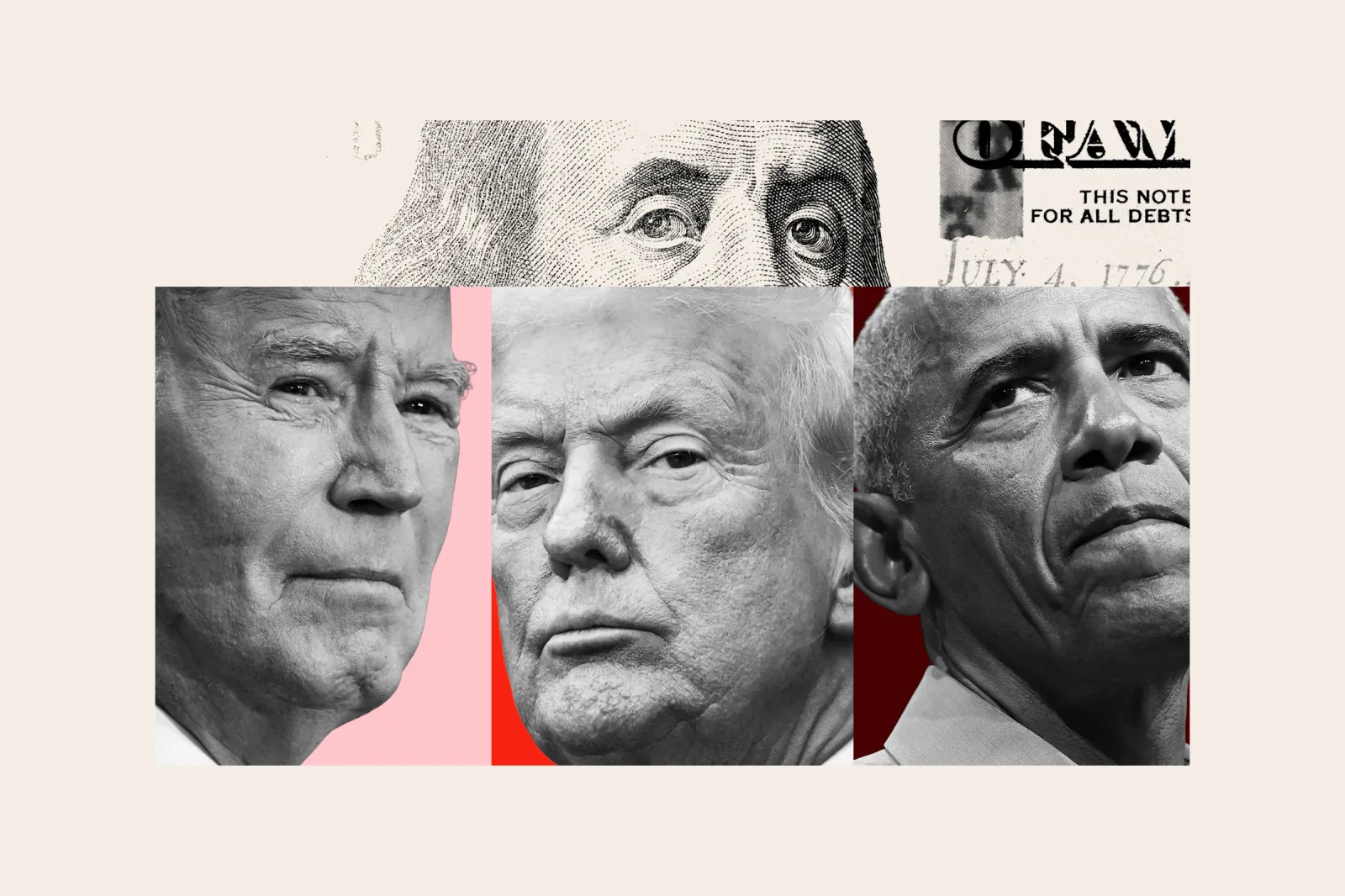
Nearly one year into President Donald Trump’s second term in office, the economy looms over his approval rating as many voters remain deeply concerned about inflation and the cost of living—concerns also faced by his predecessors. On Tuesday, a new report found that GDP increased by a higher percentage in the third quarter compared to other recent presidents.
Newsweek reached out to the White House for comment via email.
Why It Matters
The state of the economy has long been a primary metric of a president's success. While many factors, many of which are beyond the control of any individual, shape economic well-being, voters look to presidents to set fiscal policies that strengthen the economy.
Read More on News
Affordability has emerged as a key challenge for Trump during his second term in office and is at the heart of recent Democratic attacks on the administration. Critics argue he has done little to bring down prices over the past year, a key promise he made on the campaign trail. Trump, however, has maintained that he inherited a poor economy from President Joe Biden and has been working to fix it. Voters’ perception of the economy is on track to be a significant challenge for Republicans ahead of the 2026 midterms, when Democrats are optimistic about their chances of taking control of Congress.
What to Know
There are numerous metrics that can be used to determine the success of the economy.
GDP
The gross domestic product (GDP) increased by 4.3 percent in the third quarter of 2025, according to a report released Tuesday by the Bureau of Economic Analysis. The Associated Press described the numbers as "surprisingly strong." The report found that the increase is driven by consumer spending, exports and government spending that were offset by a decrease in investment.
It marks higher GDP growth compared to the third quarter of recent first-year presidents.
In 2021, the GDP increased 3.3 percent in the third quarter; that number was 3.2 percent in 2017, Trump’s first term in office. In 2019, the third quarter saw GDP growth of 1.4 percent.
Inflation
During a recent address, the president said that the country is poised for an "economic boom, the likes of which the world has never seen," touting his administration’s record on bringing down inflation.
Getty Images. Newsweek/Illustration
It is true that inflation is lower compared to the time of former President Joe Biden. As of November 2025, the U.S. inflation rate was 2.7 percent, compared to 6.8 percent in November 2021, when the country was continuing to deal with the economic fallout caused by the COVID-19 pandemic.
On the other hand, inflation was lower at the same point in Trump’s first term and during former President Barack Obama’s first term—2.2 percent in 2017 and 1.8 percent in 2009, according to the Bureau of Labor Statistics.
Ethan Kaplan, a professor of economics at the University of Maryland, told Newsweek that presidents’ policies typically don’t shape the economy in their first year. The economy they inherited and other external factors may have more to do with it. For instance, when Obama took office, he was facing the onset of the Great Recession, he noted.
"There was nothing he could have done to have an extremely rapid recovery," he said.
When Biden took office, the country was beginning to recover from the COVID-19 pandemic, which caused high inflation and unemployment.
That’s true in some ways with Trump, he said, noting that while unemployment has begun to rise, there were signs that it was beginning under the Biden administration.
"Trump inherited an economy that was going down and in the first months continued to go down, but started to rise around March or April. I think a little bit of that has to do with things outside of Trump’s control. The one thing is that there’s been a really large surge in energy demand from data centers that are being constructed and the use of AI," he said. Most of the effects of Trump’s tariffs will likely be felt in the long-run, Kaplan said, noting that he believes they won’t be "as devastating" for the U.S. in the short-term but will have negative effects in the long-term such as less domestic innovation.
Trade
Trump has made the trade balance a cornerstone of his administration. He has implemented tariffs on imported goods aimed at reducing the trade deficit and bringing jobs back to the U.S., though critics say these tariffs are being passed on to consumers and contributing to higher prices.
The trade deficit has narrowed significantly from January to September—about 144 percent, according to data from the Federal Reserve of St. Louis. The deficit currently sits at about $52.8 billion. That is lower compared to the same point in Biden’s term, when the deficit was at about $75 billion, an increase of 16 percent compared to January 2021, per the Federal Reserve of St. Louis.
In Trump’s first term, the trade deficit sat at about $41.6 billion in September. It was about $35.2 billion at the same point in Obama’s time in office. The deficit declined 10 percent in the first nine months of Obama’s term and a bit less than 5 percent during the first nine months of Trump’s first term.
Unemployment Rate
The unemployment rate in November was 4.6 percent. This compares to 4.2 percent in both November 2017 and 2021, and 9.9 percent in November 2009, according to the Federal Reserve of St. Louis.
Housing
Housing costs have continued to increase across each administration, according to the Federal Reserve of St. Louis. As of the second quarter of 2025, the latest available data, the average housing cost in the U.S. was $410,800. It was $367,800 at the same point in Biden’s presidency and $318,200 at the same point in Trump’s first term.
In Obama’s presidency, the average housing price was $220,900 in the second quarter of his first year in office, on the heels of the Great Recession.
Gas Prices
Gas prices also remain a key marker of affordability. According to the St. Louis Fed, the price of gas averaged $3.228 per gallon in November, compared to $3.482 per gallon during Biden’s first November. In November 2017, the price of gas was an average $2.548 per gallon; in November 2009, it was $2.660 per gallon.
Stock Market
Trump has pointed at the stock market as a metric of economic success.
As of December 19, it closed at 48,134.89. The Dow Jones was up 14 percent as of Friday, a more modest increase compared to the 17 percent increase by the same point in 2021 or 25 percent in Trump’s first term in 2017. In 2009, as the nation continued dealing with the Great Recession, the Dow Jones saw an 18 percent increase by December 18.
Consumer sentiment is down, according to the University of Michigan. In November, it sat at 51—compared to 67.4 during Biden’s first year, 98.5 in Trump’s first year of his first term in office at 67.4 during Obama’s first year.
What People Are Saying
White House spokesperson Kush Desai wrote in a statement to Newsweek: "There is no comparison here. Joe Biden presided over a generational inflation and affordability crisis that was entirely of his own making. And while Biden downplayed and ignored this reality, President Trump has been focused on turning the page on the Biden economic disaster since Day One—with inflation cooled and real wages up, the Administration continues to focus on delivering more economic relief for the American people."
CNN data analyst Harry Enten wrote in a November 10 post to X: "Oy vey! Breaking records you don't wanna break: November has the worst ever consumer sentiment of current conditions since 1951. ~80% of pure independents disapprove of Trump on the economy. This holds & the GOP is likely waving adios to their House & maybe Senate majorities."
What Happens Next
How the economy changes over the coming months will have critical political implications for Republicans hoping to mitigate midterm losses. The economy remains a key metric voters will use to determine their approval of the president.
Update 12/23/25 9:15 a.m. ET: This article was updated with additional information.
The news cycle is loud. Algorithms push us to extremes. In the middle—where facts, ideas and progress live—there's a void. At Newsweek, we fill it with fearless, fair and fiercely independent journalism.
Common ground isn't just possible—it's essential. Our readers reflect America's diversity, united by a desire for thoughtful, unbiased news. Independent ratings confirm our approach: NewsGuard gives us 100/100 for reliability, and AllSides places us firmly in the political center.
In a polarized era, the center is dismissed as bland. Ours is different: The Courageous Center—it's not "both sides," it's sharp, challenging and alive with ideas. We follow facts, not factions. If that sounds like the kind of journalism you want to see thrive, we need you.
When you become a Newsweek Member, you support a mission to keep the center strong and vibrant. Members enjoy:
Help keep the center courageous. Join today.


View 0 Comments
Submit Correction
View Editorial & AI Guidelines