...



By Brendan Cole, Toby Meyjes, and John Feng
0
Share
Newsweek is a Trust Project member
See more of our trusted coverage when you search.Prefer Newsweek on Googleto see more of our trusted coverage when you search.
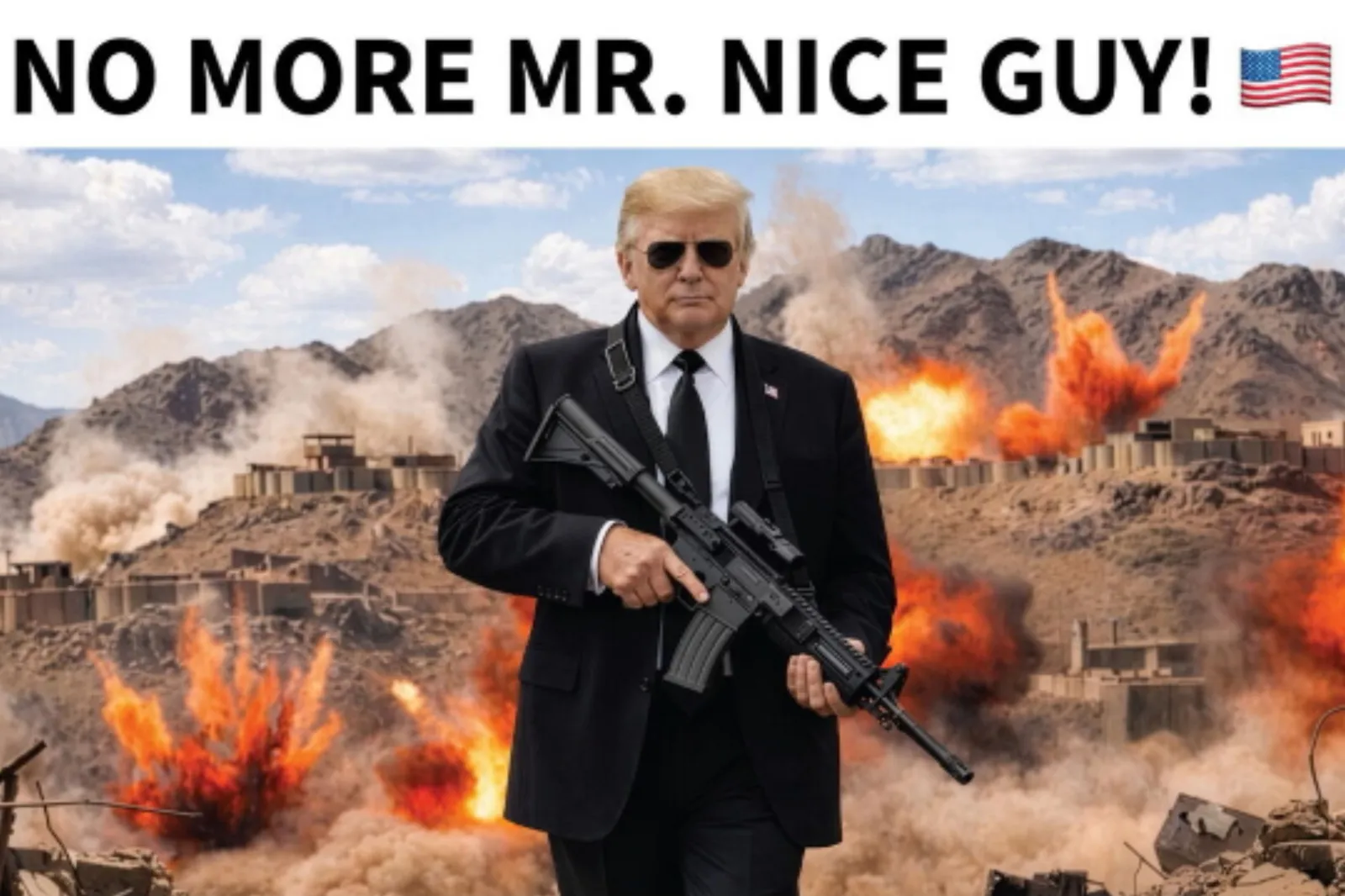
President Donald Trump has shared a seemingly AI-generated image of himself holding an assault rifle with the caption "No More Mr. Nice Guy" as he warned Iran it "better get smart" over a deal to end the war.
Negotiations between Washington and Tehran have stalled with Trump, who has vowed to prevent Iran from building an atomic weapon, reportedly rejecting a proposal from Iran to end its blockade of the Strait of Hormuz but deal with its nuclear program later.
The president wants Iran's nuclear threat eliminated in any deal, U.S. officials have said, but Tehran has refused to negotiate the end of its nuclear program—meanwhile, the Strait of Hormuz remains closed, prolonging worldwide fears of more economic hardship to come.
Read More
Donald Trump Warns Iran ‘No More Mr. Nice Guy’ After Ship Attacks4 min read

The Democrats Need to ’86’ James Comey6 min read

Donald Trump Just Tried His Trademark Handshake on King Charles5 min read

In a post on Truth Social early Wednesday morning, Trump shared the picture and wrote: "Iran can’t get their act together. They don’t know how to sign a non-nuclear deal. They better get smart soon!" This follows reports of Iran’s latest proposal to end the conflict, which marked its 60th day on Wednesday.
...
Iran’s negotiating position, revealed on April 26, focuses on reopening the Strait of Hormuz, according to U.S. media reports.
Tehran has offered to reopen the critical waterway if the U.S. lifts its naval blockade on Iranian ports and ends the war. However, this offer would be conditional on discussions over Iran’s nuclear activities be delayed until after the war ends.
White House officials told media on Monday that Trump was dissatisfied with Iran’s proposal for not addressing its nuclear program, which is the key bone of contention between both sides.
Iran’s blocking of the strait has caused turmoil in global energy markets but Tehran still wants to exert control over the waterway after the war by charging tolls on vessels passing through it, according to The New York Times and Wall Street Journal.
Washington opposes this move with Secretary of State Marco Rubio telling Fox News on Monday the U.S. cannot tolerate Iran deciding who uses an international waterway or charging for access.
Trump Touts Tehran Infighting
Last week, Trump said that infighting within the regime in Tehran was a reason behind his extension of the ceasefire Washington and Tehran agreed to on April 7.
Trump's post on Wednesday taking aim at Iranian leadership follows his previous comments about how the internal conflict between “hardliners” and “moderates” meant that Iran was “having a very hard time figuring out who their leader is.”
"The president refuses to accept that threats and pressure will not conjure Iranian capitulation. He can blame it on fictional Iranian factionalism but the main culprit is Trump’s own rhetoric and approach," Ali Vaez, Iran project director at the International Crisis Group, told Newsweek Wednesday.
In analysis on Tuesday, the Institute for the Study of War (ISW) said that the Islamic Revolutionary Guards Corps (IRGC) Commander Major General Ahmad Vahidi was Iran's "current decisionmaker" and that its latest proposal to the U.S. shows he believes Iran is winning the war.
Vahidi and his inner circle likely ordered his team not to discuss nuclear issues with the U.S. in Islamabad and looks to get U.S. concessions, such as an end to the blockade, without offering any serious concessions in response, the ISW said.
If the U.S. lifts it blockade and ends the war, Vahidi would have little incentive to offer concessions on the nuclear program, the think tank said, adding that its proposal “represents an Iranian effort to end the war on Tehran’s terms.”
Amid reports that the U.S. would continue its blockade of Iran, oil prices climbed on Wednesday, with the price of Brent crude—the global benchmark—hitting $111.78 a barrel in early trading, marking an eighth straight day of gains.
The Wall Street Journal, citing unnamed U.S. officials, said Trump had instructed aides to prepare for a prolonged blockade of Iranian ports.
As American forces continue to operate the blockade of Iranian maritime trade, US Central Command said more than 20 vessels remain moored or anchored at Chabahar port in the Islamic Republic.
CENTCOM said this showed how the U.S. was cutting off trade going into and coming out of Iran and was continuing to intercept and redirect vessels.
Trump told a White House state dinner for King Charles III that Iran would never be allowed to obtain a nuclear weapon, adding that the British monarch agreed with his position.
“We have militarily defeated that particular opponent and we're never going to let that opponent ever—Charles agrees with me even more than I do—will never let that opponent get nuclear weapon,” he said.
The Iran War in Numbers After 60 Days
April 29 marked the 60th day since joint U.S. and Israeli strikes were launched on Iran and the conflict has expanded far beyond its initial flashpoints, sucking in Lebanon and the Gulf states.
Analysis by monitoring group Armed Conflict Location & Event Data (ACLED) shared with Newsweek says there were at least 1,434 reported fatalities in the Islamic Republic due to U.S. and Israeli strikes.
It also said the Islamic Republic has launched at least 1,596 airstrikes and/or missiles in the two months. In Israel where Iran has launched strikes, there have been at least 20 reported fatalities, 527 drones or missiles strikes received or intercepted, according to ACLED.
In Lebanon, where Israel has responded to Hezbollah attacks in support of Iran from March 2, there have been at least 2,745 air or drone strikes, 67 armed clashes between Israel Defense Forces (IDF) and the Tehran-backed group and at least 1,600 reported fatalities, ACLED said.
Among the Gulf states, at least nine ports and three airports have been hit in strikes with at least 68 events targeting energy infrastructure, according to ACLED.
Clionadh Raleigh, ACLED CEO, said the Strait of Hormuz has shifted from a safety net to a chokepoint, and the idea of the Gulf as a stable business and tourist haven has been dismantled.
“All the way through, it’s been defined by threats, red lines, and ‘final warnings’ that keep shifting—a war of spikes, not steady escalation, where violence peaks even as pauses are announced," Raleigh said in a statement.
...
US Blockade Contains Iran's Ships
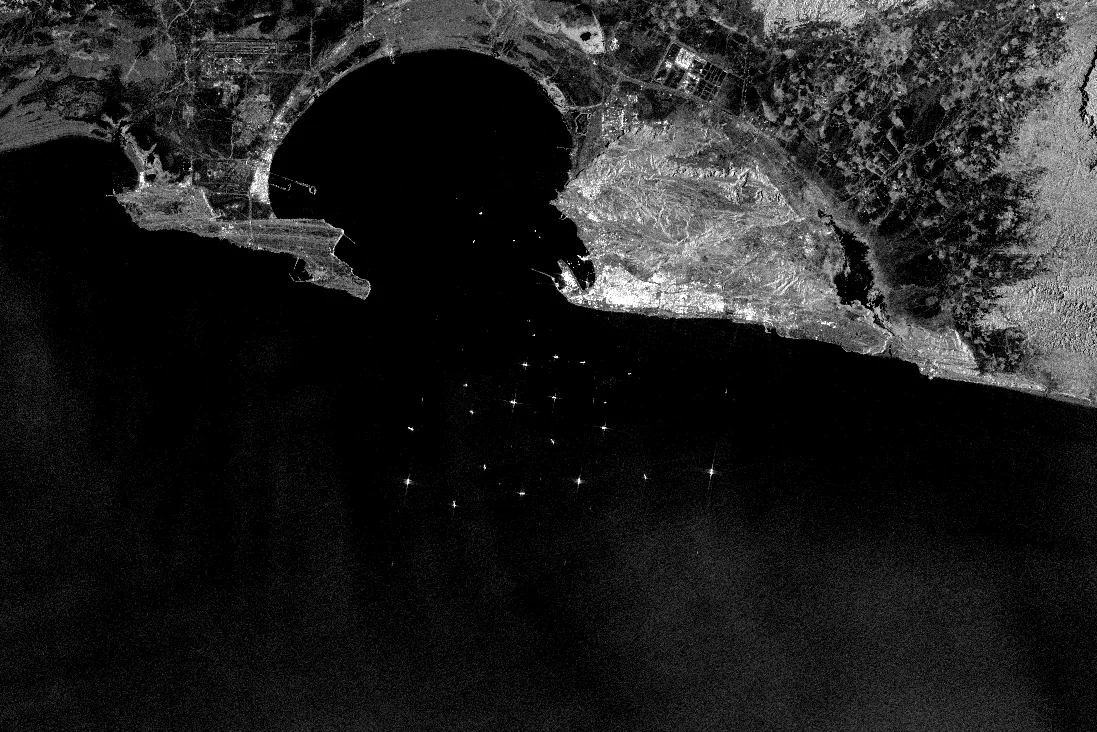
U.S. Navy warships have turned around an unknown number of Iranian ships in the Gulf of Oman and confined them to anchor off Iran’s port of Chabahar east of the Strait of Hormuz, according to recent satellite imagery.
On Sunday, a photograph taken by the Sentinel-1 satellites of the European Space Agency’s Copernicus Earth observation program showed a cluster of vessels including oil-laden tankers loitering offshore.
Chabahar is the same port where one week ago the U.S. Central Command said it had turned around the Iranian-flagged crude carriers Hero II and Hedy, although the precise date of the interdictions was not disclosed.
The deepwater port is near the U.S. blockade line, which extends from the Iran-Pakistan border in the north to Ras al Hadd in eastern Oman in the south.
The imagery shows that Iran is continuing to load crude onto its tankers—primarily at the Kharg Island export hub in the Persian Gulf—but the oil has not been making it past the U.S. blockade area, which has been extended from the Middle East to the waters of Asia.
The external pressure is forcing Iran to use more of its onshore and floating storage capacity, which could run up by the middle of May, forcing Iran to curb oil production and accept losses in hundreds of millions of dollars in revenue from its main buyer—China.
The U.S. has intercepted at least 11 tankers connected to Iran’s heavily sanctioned oil trade, according to Newsweek’s analysis of publicly available information. CENTCOM said on Tuesday that it had redirected 39 vessels.
“The U.S. blockade has more than halved Iranian crude shipments reaching Asia over the past 10 days, with further declines expected into May. This is one of the clearest indicators to date of pressure on Iran’s shipping logistics chain, which supports oil flows worth billions of dollars to the Iranian regime,” maritime intelligence firm Windward said in its April 28 report.
View 0 Comments
Submit Correction
View Editorial & AI Guidelines