...

By Ellie Cook
Senior Defense Reporter
0
Share
Newsweek is a Trust Project member
See more of our trusted coverage when you search.Prefer Newsweek on Googleto see more of our trusted coverage when you search.
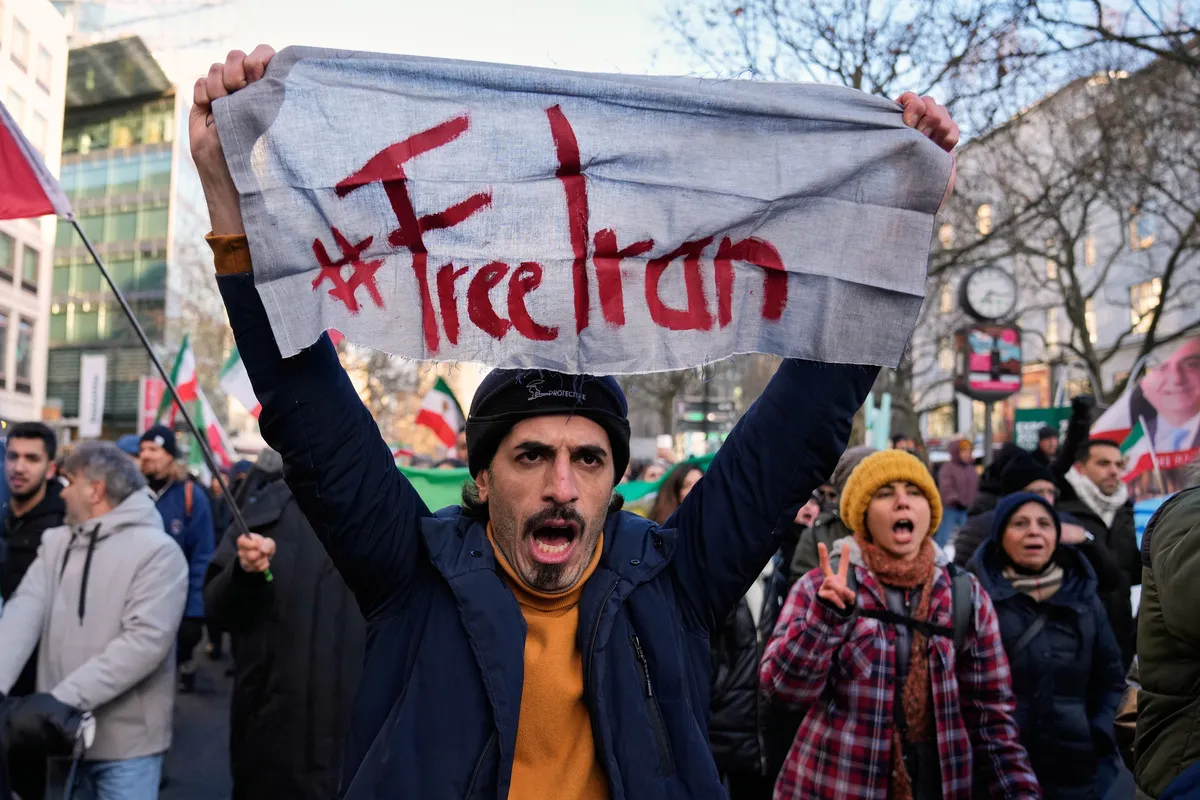
At least 538 people have died in Iran’s sweeping anti-government protests, according to a U.S.-based human rights group, as unrest heads into its third week and tensions with the U.S. escalate.
Of those killed, 490 were protesters and 48 were members of the security forces, the Human Rights Activists News Agency (HRANA) said Sunday. More than 10,670 people have been arrested, the group said, and warned the real toll could be higher as it continues to verify reports.
The Associated Press said it could not independently confirm the figures due to a nationwide internet blackout that has lasted more than 60 hours, severely limiting outside access to information. Iranian authorities have not released any official casualty numbers.
Read More on World
Why It Matters
Protests over Iran's staggering economy have ripped across the country, hitting two weeks of unrest this weekend and ballooning to become one of the biggest challenges—if not the most powerful display of defiance—to Iran's rulers since clerics came to power during the country's 1979 Islamic Revolution. The theocratic regime was first ruled by Ayatollah Ruhollah Khomeini before the current leader, Ayatollah Ali Khamenei, took over a decade later.
The unrest comes as Tehran still reels from last summer’s brief but destructive war with Israel, which left parts of its air defense network crippled after U.S. strikes on nuclear sites.
...
What To Know
"Iran is looking at FREEDOM, perhaps like never before," Trump said in a post to his Truth Social platform on Saturday. "The USA stands ready to help!!!"
Iranian authorities have blamed the U.S. for encouraging protesters, branded as violent rioters and terrorists. The speaker of Iran's parliament said on Sunday that if the U.S. attacked Iran, all U.S. military bases and assets in the region would be "legitimate targets."
Authorities on Thursday cut off internet access and other communications have been disrupted. Netblocks, an online portal tracking internet connectivity, said late on Saturday U.S. time that the internet blackout had surpassed 60 hours and those in the country were able to connect to about 1 percent of their usual access.
This has "significantly limited" observers outside Iranian borders' ability to verify information, the HRANA said, adding that nearly 100 cities saw demonstrations on Thursday.
The regime in Tehran is still contending with the aftermath of its brief but destructive war with Israel in June 2025, which ended shortly after the U.S. attacked multiple Iranian nuclear sites. Many of Iran's air defenses were knocked out in the summer.
Iran's prosecutor general, Mohammad Movahedi Azad, said on Saturday protesters would be considered "enemies of God." This carries the death penalty in Iran.
The Iranian military said in its own statement on Saturday that it would “firmly safeguard national interests, strategic infrastructure, and public property."
Trump has warned Iranian authorities to not turn to force to quell the protests reverberating across the country. "You better not start shooting because we’ll start shooting too," Trump said on Friday.
Trump officials have discussed how the U.S. could attack Iran if needed, The Wall Street Journal reported. One U.S. official told the newspaper that one of the options on the table was a large-scale airstrike on multiple military targets in the country, although another anonymous official said no decision had been reached.
The president has also been presented with an option to strike non-military sites in Iran, The New York Times reported.
“I’ve made the statement very strongly that if they start killing people like they have in the past, we will get involved,” Trump said on Friday. “We’ll be hitting them very hard where it hurts."
Reza Pahlavi, the exiled son of Iran's last shah—or king—who was overthrown in 1979, urged protesters to "not abandon the streets."
"In particular, President Trump, as the leader of the free world, has carefully observed your indescribable bravery and has announced that he is ready to help you," Pahlavi said on X.
A protester on Saturday ripped down the Iranian flag from outside Tehran's embassy in London. "It takes real courage to speak up in an authoritarian system, especially for young women, but it should not require courage just to make your voice heard," British Foreign Secretary Yvette Cooper said on Saturday.
What People Are Saying
Iranian President, Masoud Pezeshkian, said in remarks reported by state media on Saturday: “Believing that the Islamic Republic of Iran is like other countries, the U.S. is pursuing the same measures by encouraging certain individuals to create chaos and riots."
"Do not play games with President Trump," the U.S. State Department posted on X on Saturday. "When he says he'll do something, he means it."
"To all who are sacrificing in Iran, God bless," Republican Senator Lindsey Graham of South Carolina said in a post to X. "Help is on the way."
What Happens Next
It is unclear how long the protests and internet shutdown will last. The scale of unrest, combined with severe crackdowns, has raised international concern and puts Tehran under growing scrutiny as the demonstrations persist.
Update, 1/11/2026, 9:33 a.m. ET: This article and headline were updated with a revised death toll.
Update, 1/11/2026, 11:51 a.m. ET: This article and headline were updated with a revised death toll.
The news cycle is loud. Algorithms push us to extremes. In the middle—where facts, ideas and progress live—there's a void. At Newsweek, we fill it with fearless, fair and fiercely independent journalism.
Common ground isn't just possible—it's essential. Our readers reflect America's diversity, united by a desire for thoughtful, unbiased news. Independent ratings confirm our approach: NewsGuard gives us 100/100 for reliability, and AllSides places us firmly in the political center.
In a polarized era, the center is dismissed as bland. Ours is different: The Courageous Center—it's not "both sides," it's sharp, challenging and alive with ideas. We follow facts, not factions. If that sounds like the kind of journalism you want to see thrive, we need you.
When you become a Newsweek Member, you support a mission to keep the center strong and vibrant. Members enjoy:
Help keep the center courageous. Join today.


View 0 Comments
Submit Correction
View Editorial & AI Guidelines