10
Loading video...


By Gabe Whisnant and Sonam Sheth
0
Share
Newsweek is a Trust Project member
See more of our trusted coverage when you search.Prefer Newsweek on Googleto see more of our trusted coverage when you search.
President Donald Trump on Wednesday announced sweeping new trade barriers that included a 10 percent baseline tariff on all imports and significantly higher rates on goods from dozens of countries running trade surpluses with the U.S.
Why It Matters
The implementation of the tariffs, many of which were higher than even many economists were expecting, has the potential to dramatically reshape the world economy and risks igniting an international trade war as the U.S.'s allies and rivals alike have threatened to retaliate with their own round of "reciprocal" tariffs.
Read More on U.S.
The president has argued slapping tariffs on other countries will restore American manufacturing jobs, but economists and experts have warned that American consumers will end up shouldering the burden by being forced to pay higher prices for everyday goods.
Trump's back-and-forth on tariffs since he took office in January has also introduced increased volatility in global markets, which risks plunging the U.S. economy into a recession.
What To Know
Trump unveiled a list of more than 180 countries and territories he said would be hit with tariffs.
The president said there will be a "baseline" tariff of 10% on all imports.
Some nations will face higher "discounted reciprocal tariffs" which he said are at half the rate those countries currently charge the U.S.
Trump did not say how the White House arrived at its calculations, but the administration later clarified in a post that it calculated each country's tariff rate using a formula based on dividing the U.S.'s trade deficit with a foreign country by that country's exports.
The White House halved that number to arrive at Trump's "discounted reciprocal" tariff for each country.
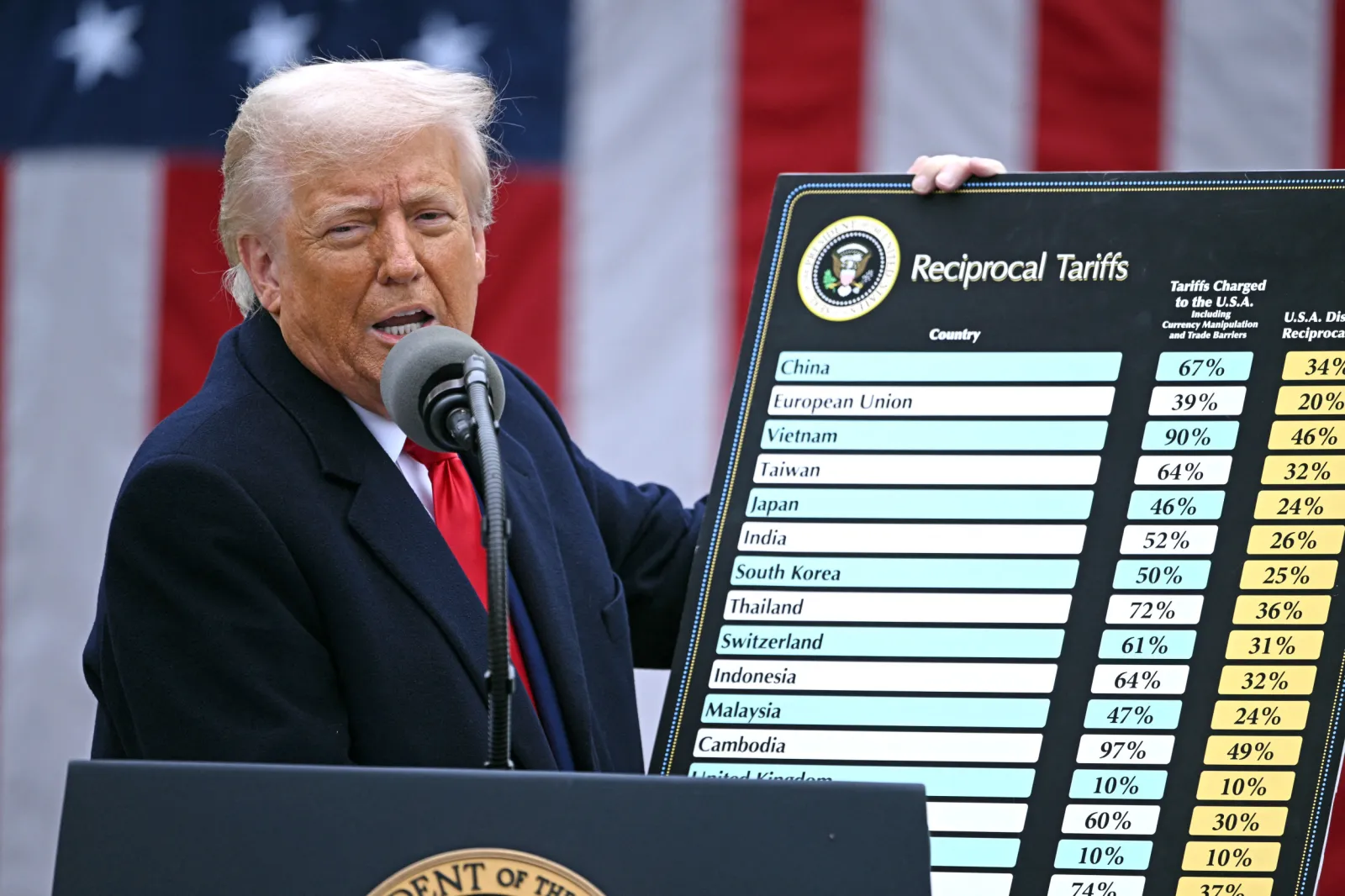
According to a chart Trump held up while making Wednesday's announcement, the U.S. will impose a 34% tariff on Chinese imports; 20% on goods from the European Union; 25% on South Korean products; 24% on Japanese imports; and 32% on goods from Taiwan.
The chart also included India, Israel, Brazil, Singapore, Thailand, Switzerland, Malaysia, Cambodia and the UK.
In China's case, White House press secretary Karoline Leavitt told CNN the 34% reciprocal tariff that was announced is in addition to a 20% tariff on Chinese goods that is already in effect.
Russia, Canada and Mexico were not on the charts the president held up.
A White House official told NOTUS that Russia was not on the list because the U.S. does not trade with Russia amid its war against Ukraine. The official said Canada and Mexico were omitted because tariffs the U.S. previously imposed on both countries remain in effect.
...
Trump reiterated his long-standing complaints during his announcement about the post-World War II trading system, saying in part, "Our country has been looted, pillaged, raped, plundered" by foreign nations.
The president opened the announcement, which he billed as "liberation day," by saying the it was a "declaration of economic independence."
Invoking the 1977 International Emergency Economic Powers Act, Trump declared a national economic emergency to unilaterally implement the tariffs, which his administration estimates could generate hundreds of billions of dollars annually.
"This has gone on for over 50 years," Trump said. "Taxpayers have been ripped off. But it is not going to happen anymore."
The president's executive order noted, however, that a slew of goods will not be subject to tariffs: steel, aluminum, autos and auto parts that are already subject to previously imposed tariffs, copper, pharmaceuticals, semiconductors, lumber, bullion, energy and some minerals that aren't available in the U.S. and "all articles that may become subject" to future tariffs.
What People Are Saying
Justin Wolfers, a professor at the University of Michigan, wrote on X, formerly Twitter: "Trump says these tariffs will raise roughly $6 trillion. Assuming that's over a 10-year window, that's $600 billion per year. There are 134 million households, so this is about $5,000 per household per year. And it's like a sales tax, so it's a flat tax. A huge hit to the budgets of working- and middle-class Americans.
Mark Zandi, the chief economist at Moody's Analytics, told Newsweek: "The bulk of tariffs are borne by American consumers in the form of higher prices ... A combination of the tariffs and the retaliation will weigh heavily on the economy and in many scenarios may push us into a recession."
What Happens Next
A 25% tariff on "all foreign-made automobiles" will take effect on April 3. The 10% "baseline" tariffs will take effect on April 5 and the reciprocal tariffs will kick in on April 9.
Reporting by the Associated Press contributed to this story.
Update 04/02/25 11:07 p.m. ET: This story has been updated with additional information.
View 0 Comments
Submit Correction
View Editorial & AI Guidelines