...

By Andrew Stanton
Reporter
0
Share
Newsweek is a Trust Project member
See more of our trusted coverage when you search.Prefer Newsweek on Googleto see more of our trusted coverage when you search.
President Donald Trump slammed the Supreme Court's ruling striking down his sweeping tariffs as a "disgrace" on Friday, reported CNN.
The president's remarks came during a meeting with governors at the White House, CNN reported, citing two sources who were familiar with the matter. He also said he has a backup plan in mind, according to the report.
Why It Matters
The Supreme Court’s ruling limited Trump’s authority to impose tariffs without Congressional authority, placing restrictions on the scope of presidential authority.
Read More on News
Supreme Court Strikes Down Tariffs: What to Know
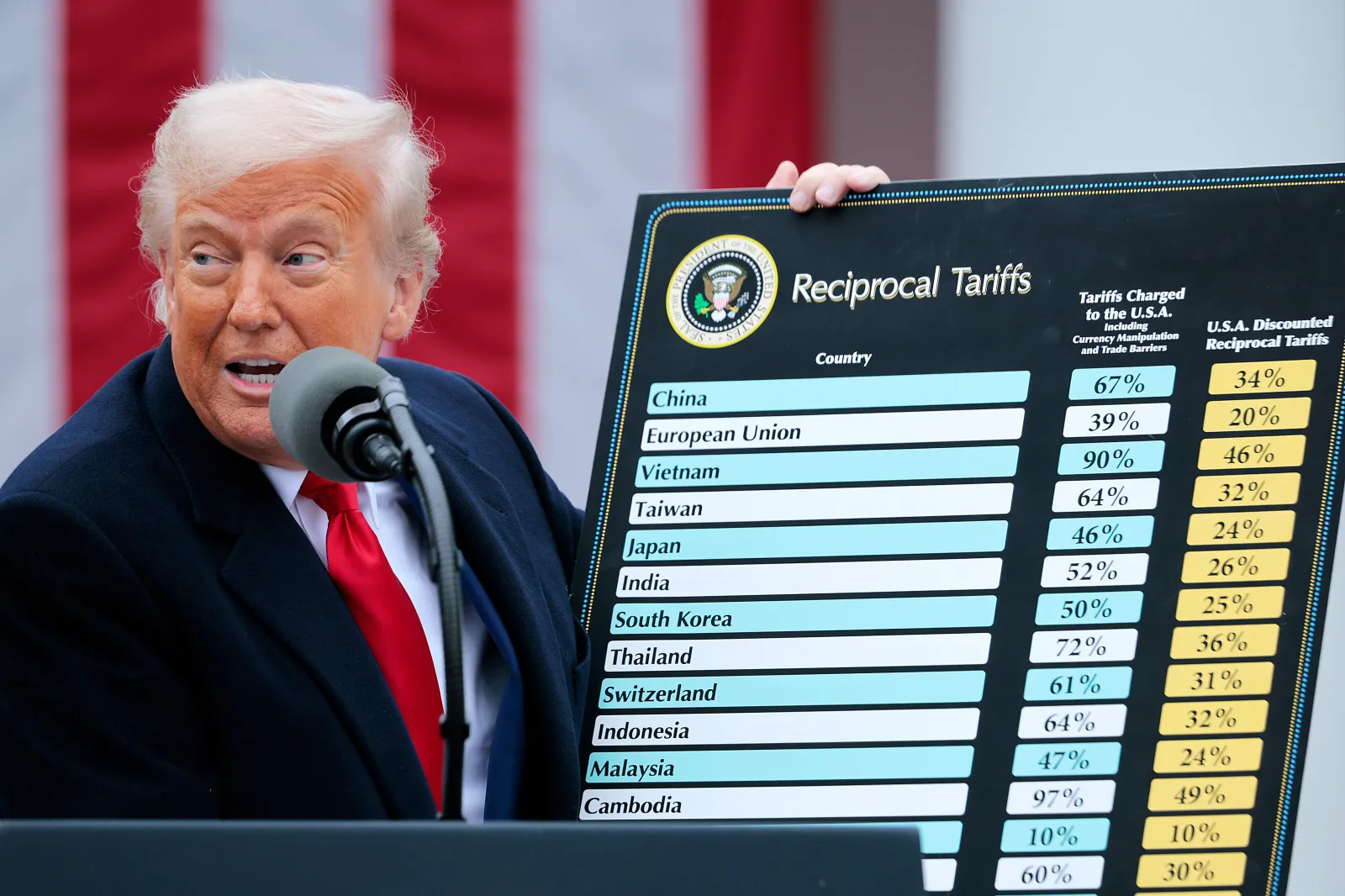
Trump has sought to impose sweeping tariffs against dozens of countries last year. Trump and his supporters said the tariffs would help close the trade deficit while bringing manufacturing jobs back to the United States, delivering a long-term economic boost to the country. Critics, however, argued that companies would simply pass the tariffs on to consumers, leading to higher prices for Americans.
The tariffs also faced legal questions about whether Trump had the authority to impose the tariffs under the International Emergency Economic Powers Act (IEEPA), a 1977 law that grants commanders-in-chief special powers in emergencies.
...
A majority of Supreme Court justices ruled on Friday that he must identify “clear” Congressional authorization to impose those tariffs.
“The President asserts the extraordinary power to unilaterally impose tariffs of unlimited amount, duration, and scope. In light of the breadth, history, and constitutional context of that asserted authority, he must identify clear congressional authorization to exercise it,” the court ruled.
The ruling continued, “IEEPA’s grant of authority to ‘regulate . . . importation’ falls short. IEEPA contains no reference to tariffs or duties. The Government points to no statute in which Congress used the word ‘regulate’ to authorize taxation. And until now no President has read IEEPA to confer such power.”
How the Justices Ruled on the Decision
Chief Justice John Roberts wrote the majority opinion of the court. The court's three liberal-leaning justices, Elena Kagan, Sonia Sotomayor and Ketanji Brown Jackson, joined along with conservative-leaning justices Neil Gorsuch and Amy Coney Barrett.
Justices Clarence Thomas, Samuel Alito and Brett Kavanaugh dissented from the majority opinion.
Lower courts earlier ruled that Trump’s tariffs exceeded IEEPA’s scope. The tariffs included a minimum 10 percent baseline tariff, higher ‘reciprocal’ rates of 10 to 41 percent for countries without trade agreements with the U.S., and additional duties on selected imports from Mexico, China, and Canada.
What People Are Saying
Trump wrote to Truth Social in January: “Remember, when America shines brightly, the World shines brightly. In other words, if the Supreme Court rules against the United States of America on this National Security bonanza, WE’RE SCREWED!”
Scott Lincicome, Vice President of General Economics and Cato’s Herbert A. Stiefel Center for Trade Policy Studies, to Newsweek: "The court’s decision is welcome news for American importers, the United States economy, and the rule of law, but there’s much more work to be done. Most immediately, the federal government must refund the tens of billions of dollars in customs duties that it illegally collected from American companies pursuant to an “IEEPA tariff authority” it never actually had. That refund process could be easy, but it appears more likely that more litigation and paperwork will be required – a particularly unfair burden for smaller importers that lack the resources to litigate tariff refund claims yet never did anything wrong."
Supreme Court Justice Brett Kavanaugh wrote in his dissenting opinion: “In the meantime, however, the interim effects of the Court’s decision could be substantial. The United States may be required to refund billions of dollars to importers who paid the IEEPA tariffs, even though some importers may have already passed on costs to consumers or others.”
What Happens Next
The Supreme Court’s ruling places new limits on Trump’s ability to impose tariffs. The House of Representatives voted to overturn Trump's tariffs earlier in February. Administration officials have signaled that backup plans have been prepared in case of a ruling against the tariffs.
View 0 Comments
Submit Correction
View Editorial & AI Guidelines