...

By Katherine Fung
Senior Writer
0
Share
Newsweek is a Trust Project member
See more of our trusted coverage when you search.Prefer Newsweek on Googleto see more of our trusted coverage when you search.
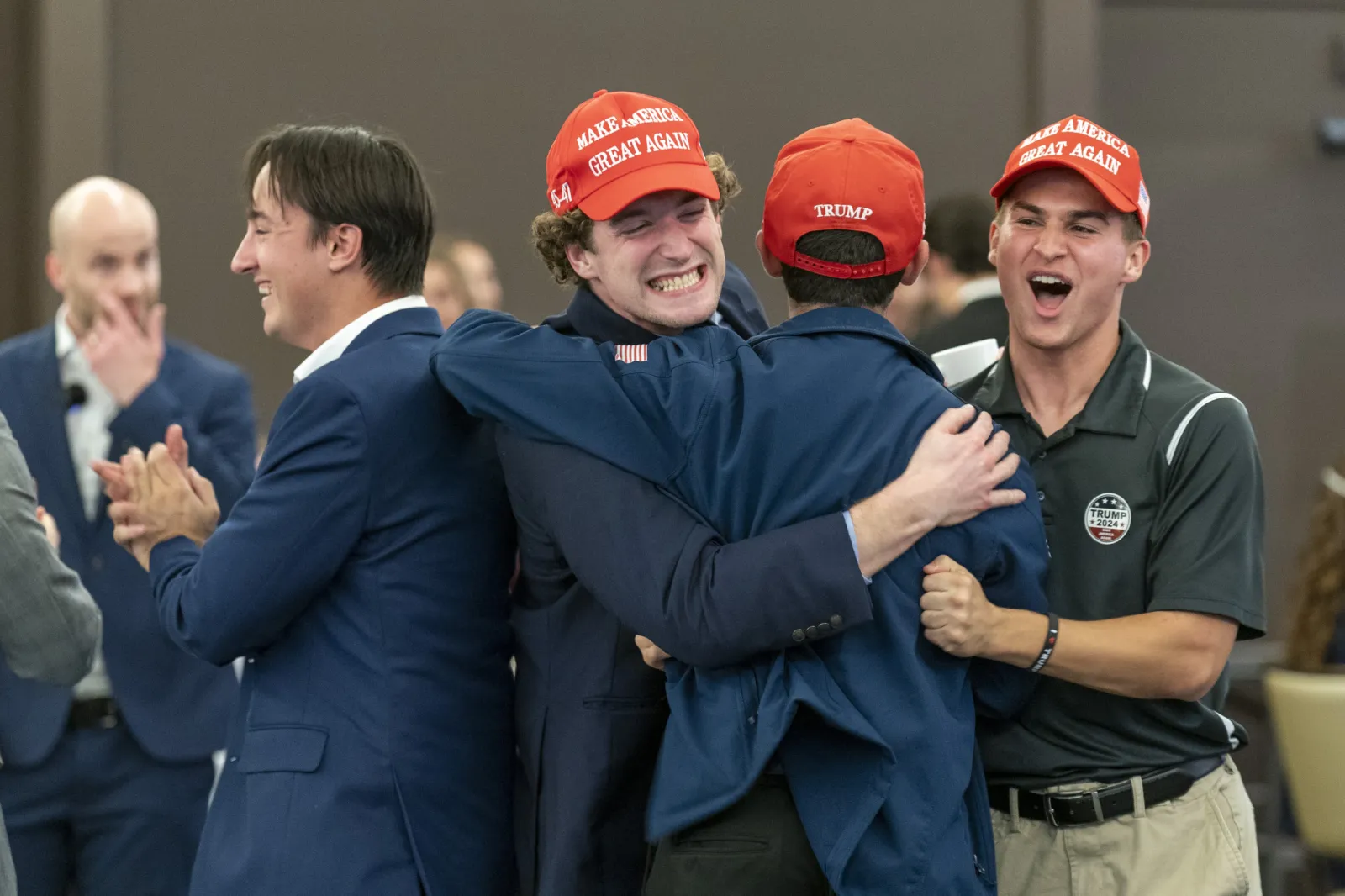
Democrats hoped that Donald Trump's gamble on the "bro" vote would backfire. But on Tuesday, the young men of America proved them wrong.
Trump pulled off one the greatest political comebacks in modern history in the early hours of Wednesday, winning enough electoral votes to defeat Vice President Kamala Harris and return to the White House for a second term. He is also projected to win the popular vote.
Key to Trump's victory? The young men he courted with appearances on podcasts and livestreams hosted by influencers like Joe Rogan, Theo Von, Adin Ross and the Nelk Boys. The same young men that Democrats thought were all talk and no bite.
Read More
The 2026 Senate Midterm Map Looks Rough for Democrats4 min read

Will Donald Trump’s Truth Social Merge With Elon Musk’s X? Rumors Swirl4 min read

Map Reveals New York City’s Shift to Republicans from 2020 to 20243 min read

Exit poll data shows men aged 18-29—a group that's typically disengaged politically —broke for Republicans for the first time in the last four elections, decisively choosing Trump as their next president by a whopping 13-point margin.
For Alan Shindelman, a 27-year-old photographer in New York City, the 2024 election and Trump's candidacy marked "the first time I ever took an interest in politics," he told Newsweek.
...
Shindelman, who had voted for the Democratic candidate in the 2016 and 2020 presidential election "because the people I followed online were doing that," made the switch to Trump over the summer after being swayed by his ironclad support for Israel. Shindelman, who is Jewish, said Thursday that he originally thought he would vote Republican based on a single issue, but that with time, he found himself increasingly agreeing with more and more of what Trump had to say.
Another young man who voted for Trump told Newsweek that it was the vice presidential debate between Senator JD Vance and Minnesota Governor Tim Walz that sealed his vote.
"I was very interested when [Joe Biden] stepped down and Kamala came up. I was open-minded [about her candidacy] because I try not to vote one way or another just because [a candidate] is Democrat or Republican," the 33-year-old from Colorado said.
"The thing that really moved me to Trump was the vice presidency," he said. "That was the tiebreaker... I was really impressed from what I saw with JD Vance. That was kind of the tipping point for me."
Trump's victory among young men is part of a larger shift in which Gen Z as a whole is moving rightward. In the 2022 midterms, Democrats had a single point margin over Republicans with young men, a figure that shrunk from 15 points for Biden in 2020 and 19 points for the Democratic Party in the 2018 midterms.
And even though Harris carried young women by 18 points, her margin was narrower than the Democrats' 21-point victory in the 2022 midterms, Biden's 32-point advantage in the 2020 election and the Democrats' 33-point margin in the 2018 midterms.
Even the Colorado voter, who is from a more Republican-leaning district in the blue state, was surprised by how well Trump did in the popular vote and in Democratic strongholds like California and New York.
"Trump wasn't the most ideal candidate for me but at least we have somewhat of an idea of his plans for the economy. With Kamala, there was just too much uncertainty on her plans here," he said.
Harris supporters had called Trump's bid for young men — who are often referred to as "low-propensity voters" by political scientists — a huge gamble that put his entire campaign at risk. But sometimes, when you bet big, you win big.
The Trump operation did not forget those who carried it across the finish line.
"I want to thank some people," UFC CEO Dana White told the crowd during Trump's victory speech in Florida in the early hours of Wednesday. "Real quick. I want to thank the NELK Boys, Adin Ross, Theo Von, Bussin' With The Boys. And last but not least, the mighty and powerful Joe Rogan."
When Trump declared victory he was also joined by his new secret weapon, his 18-year-old son Barron. It was Barron, now a freshman at NYU, and his best friend Bo Loudon who were tasked with helping the campaign reach a young male audience. It was also Barron who introduced his father to Ross and Von and stressed just how big their platforms were.
Asked if those podcast appearances boosted Trump's campaign, the 33-year-old told Newsweek, "Absolutely, and for me, seeing JD Vance on Theo Von's show was important and helpful. Even though he's VP, it gave me an idea of what his views are on topics and in a way, he's different from Trump as a person."

...
"[Trump] appearing on the podcasts—Joe Rogan, Theo Von—I think definitely helped," Shindelman agreed.
Taking a lesson from Hillary Clinton's failed 2016 campaign, Harris' team largely avoided identity politics. While Clinton had her famous "I'm with her" slogan, Harris rarely mentioned on the trail that she would, if elected, be both the first woman and first Black woman to win the White House. When talking about her own story, she would more often start by mentioning that she "comes from a middle-class family" — so much so that it became something of a meme on the right.
"I know a lot of women felt the way—kind of the thing that [Barack] Obama ran into with the minority vote, where it's almost like [the Democrats] expect just to get [their vote]," the Colorado voter said.
"Kamala's campaign didn't really target men much compared to Trump, so there were a lot of independent/middle of the road votes that she missed out on," he added.
In a way, it was Trump who actually ran an identity politics campaign this time with his laser focus on young men — though he deftly played to the group regardless or their race, background or ethnicity.
"Trump did the same thing to men to some regard," the 33-year-old said.
"I don't think any guy has ever said that but it might be an intuition feeling," Shindelman suggested. "Not at all how I felt and not at all how anyone I know felt. But if you talk about the group as a whole that could have been a driving reason."
But Harris' bigger problem came down to an inability to connect with people like them, these men said. The voter from Colorado said that when walking around his neighborhood where there's been a lot of new construction, he'd think to himself: "There's no way that these guys [construction workers, builders, plumbers and electricians] are voting for Kamala, she's too far removed from them and they have nothing in common with her."
He had the same thought in 2016 with Clinton, but added: "I don't think that is a totally a gender thing. I wouldn't think that about Elizabeth Warren, Tulsi Gabbard to name a few."
There's still another four years and second Trump term standing between now and the next election, but some of Trump's young male supporters say that's plenty of time for the Democrats to win them back.
"In four years, I could definitely switch back [to the Democratic Party]. It really just depends on who is pushing for the things that I believe in," Shindelman said. "It's still very much fluid."
View 0 Comments
Submit Correction
View Editorial & AI Guidelines