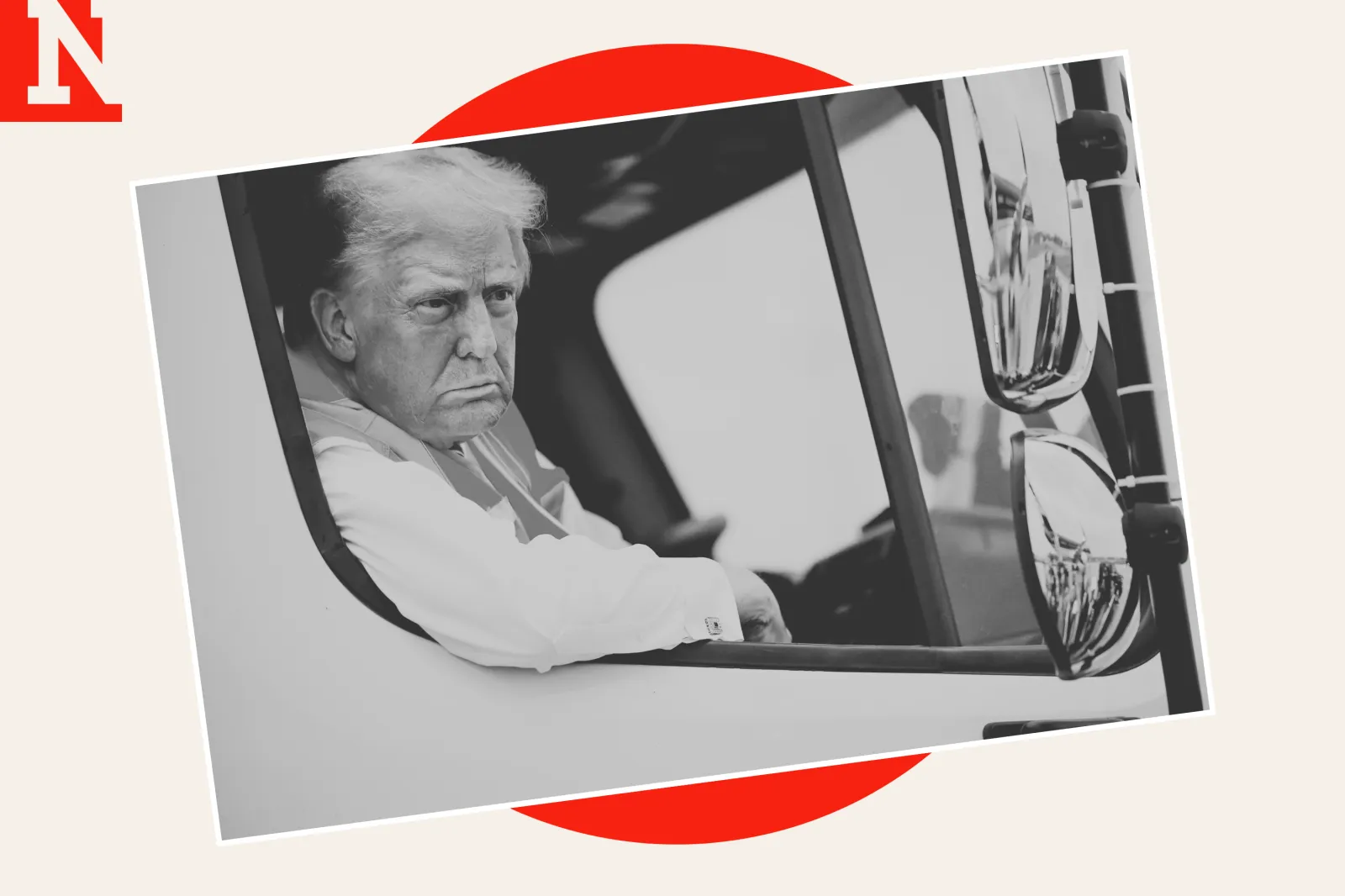
Newsweek illustration/Getty Images

By Newsweek Editors
0
Share
Newsweek is a Trust Project member
See more of our trusted coverage when you search.Prefer Newsweek on Googleto see more of our trusted coverage when you search.
In the winter of 1973, Americans queued for hours at gas stations as the Arab oil embargo turned cheap driving into a rationed privilege and helped push Congress to create federal fuel-economy rules under President Gerald Ford in 1975. Those Corporate Average Fuel Economy, or CAFE, standards were designed to cut oil use by forcing automakers’ fleets to use less gasoline.
Half a century later, another Republican president stood in front of auto executives to talk about gasoline—but this time to make it easier to burn more of it. On Wednesday, Donald Trump announced he would scrap Joe Biden’s fuel-economy rules, slashing the 2031 target for new cars and light trucks from roughly 50 miles per gallon to about 34 to 34.5 mpg. Flanked by CEOs from Ford and Stellantis, he called his predecessor's CAFE rules "ridiculously burdensome” and "horrible.”
In a country where SUVs and pickups now make up about 75 percent of new vehicle sales and the Ford F-series has been America’s bestselling vehicle for decades, Trump is betting that he understands want drivers want. But does he?
Read More on Analysis
In a national survey published in January 2025, 96 percent of American drivers said fuel economy mattered when buying a vehicle, and nearly two-thirds, across the political spectrum, wanted the federal government to keep raising fuel-economy standards. That same Consumer Reports poll found 91 percent of respondents still drive gasoline cars or trucks.
Overall, polling suggests most drivers want better mileage and tougher standards; most truckers want clean air but loathe aggressive diesel and EV mandates. Trump is trying to turn that muddle into a single demand for cheaper, thirstier trucks.
Why is this happening?
Trump’s National Highway Traffic Safety Administration (NHTSA) has proposed cutting the previously finalized fuel-economy path for new cars and light trucks so that the fleetwide average in model year 2031 is about 34.5 mpg, instead of the roughly 50.4 mpg target set under Biden. NHTSA analysis says that softer standards would shave about $930 off the average new-vehicle sticker price by 2031, but at the cost of around 100 billion extra gallons of gasoline burned through 2050, up to $185 billion in additional fuel spending, and roughly 5 percent more U.S. transport CO₂ emissions than under the Biden rule.
This is the second step in a broader Trump effort to dismantle the clean-car regime built under Obama and Biden. The administration has already repealed fines for automakers that miss CAFE targets and terminated federal tax credits of up to $7,500 for EV purchases, as Ford, GM and Stellantis cool or delay electric-vehicle plans.
So what do drivers actually want in this tug-of-war between cheap trucks and climate rules? The polling record is surprisingly consistent:
- In Consumer Reports’ 2024 nationally representative survey of 2,191 adults, 96 percent said fuel economy was at least "somewhat important” in their next purchase, and 66 percent called it "very” or "extremely” important.
- Sixty-four percent said the federal government should continue to increase fuel-economy standards, rather than freeze or weaken them; only 27 percent believed automakers would improve efficiency on their own.
- A 2019 poll by the Consumer Federation of America found 78 percent of Americans supported existing fuel-economy standards, with bipartisan backing—66 percent of Republicans and 92 percent of Democrats. Roughly 71 percent favored raising standards to 40 mpg by 2025 rather than adopting Trump’s earlier lower target.
- A separate American Lung Association poll in 2018 found "nearly 7 in 10” voters wanted EPA to leave Obama-era fuel-efficiency standards for cars, SUVs and light trucks in place rather than weaken them.
On trucks and freight, the picture is more complicated. The American Lung Association survey found 72 percent of voters—again, including Republicans—support stronger EPA limits on carbon emissions from heavy-duty trucks and buses, and 60 percent support stricter limits on emissions from light-duty vehicles. But when you zoom in on actual truck drivers, attitudes harden.
A 2023 survey by Commercial Truck Trader, reported by Truck Drivers USA, found that only 5 percent of truckers were eager to buy an electric truck immediately and 4 percent might do so within five years, while 79 percent said they had no interest in adding electric trucks to their fleets at all. The Owner-Operator Independent Drivers Association (OOIDA), which represents about 150,000 small-business truckers, has called recent heavy-duty emissions and EV rules unworkable environmental mandates.
What is the Right saying?
Trump’s case is simple: he claims to be rescuing buyers from climate technocrats. In the Oval Office, he argued that Biden’s rules "forced automakers to build cars using expensive technologies that drove up costs” and insisted that "people want the gasoline car.”
Non-partisan industry figures are happy to echo that. Ford CEO Jim Farley called the rollback "a win for customers and common sense,” praising Trump for "aligning fuel economy standards with market realities” and promising Ford can still cut emissions while giving buyers "choice and affordability.”
What is the Left saying?
Environmental and consumer groups argue that the "drivers versus regulators” framing is exactly backward—that weaker standards stick motorists with higher long-term costs. The Natural Resources Defense Council’s Kathy Harris says Trump’s plan is "sticking drivers with higher costs at the pump, all to benefit the oil industry,” warning that drivers could pay "hundreds of dollars more at the pump every year” if the rule takes effect. The Sierra Club’s Katherine García says: "Gutting the gas-mileage program will make cars burn more gas and American families burn more cash.”
What happens next?
NHTSA’s proposal will be published in the Federal Register, opened for public comment and likely finalized sometime next year—unless lawsuits derail it. Blue-state attorneys general, environmental groups and perhaps some automakers that bet heavily on EVs could argue in court that the agency is violating its statutory duty to set the "maximum feasible” fuel-economy level and undercounting climate and consumer costs.
The effect of tariffs, although seemingly protective of U.S. car manufacturers, could in theory backfire if foreign competitors produce evermore leaner and cleaner engines which become attractive to U.S. consumers.
The more difficult question is political. Polls show drivers want more miles per gallon and long-term savings; trucker groups say their members can’t survive clean-truck mandates. Trump’s rollback fuses these into a single story about rebelling against "green elites.” If opponents want to beat it, they may have to convince pickup owners and long-haul drivers that tougher standards are not a cultural attack on their trucks—but a way to make sure they can keep driving them without going broke at the pump.
Once a core feature of Newsweek’s print edition, Perspectives distilled the week’s news into a chorus of standout quotes. Today, we’re relaunching Perspectives in a different format, but with the same mission of keeping our members informed by showcasing the views that shape the conversation.
View 0 Comments
Submit Correction
View Editorial & AI Guidelines