10
Loading video...

By Jesus Mesa
Reporter
0
Share
Newsweek is a Trust Project member
See more of our trusted coverage when you search.Prefer Newsweek on Googleto see more of our trusted coverage when you search.
Michigan Democrats head to the polls Tuesday in what has become one of the party's most closely watched primaries of the year, not simply because it will decide who succeeds retiring Senator Gary Peters, but because many Democrats see it as a referendum on the party's future.
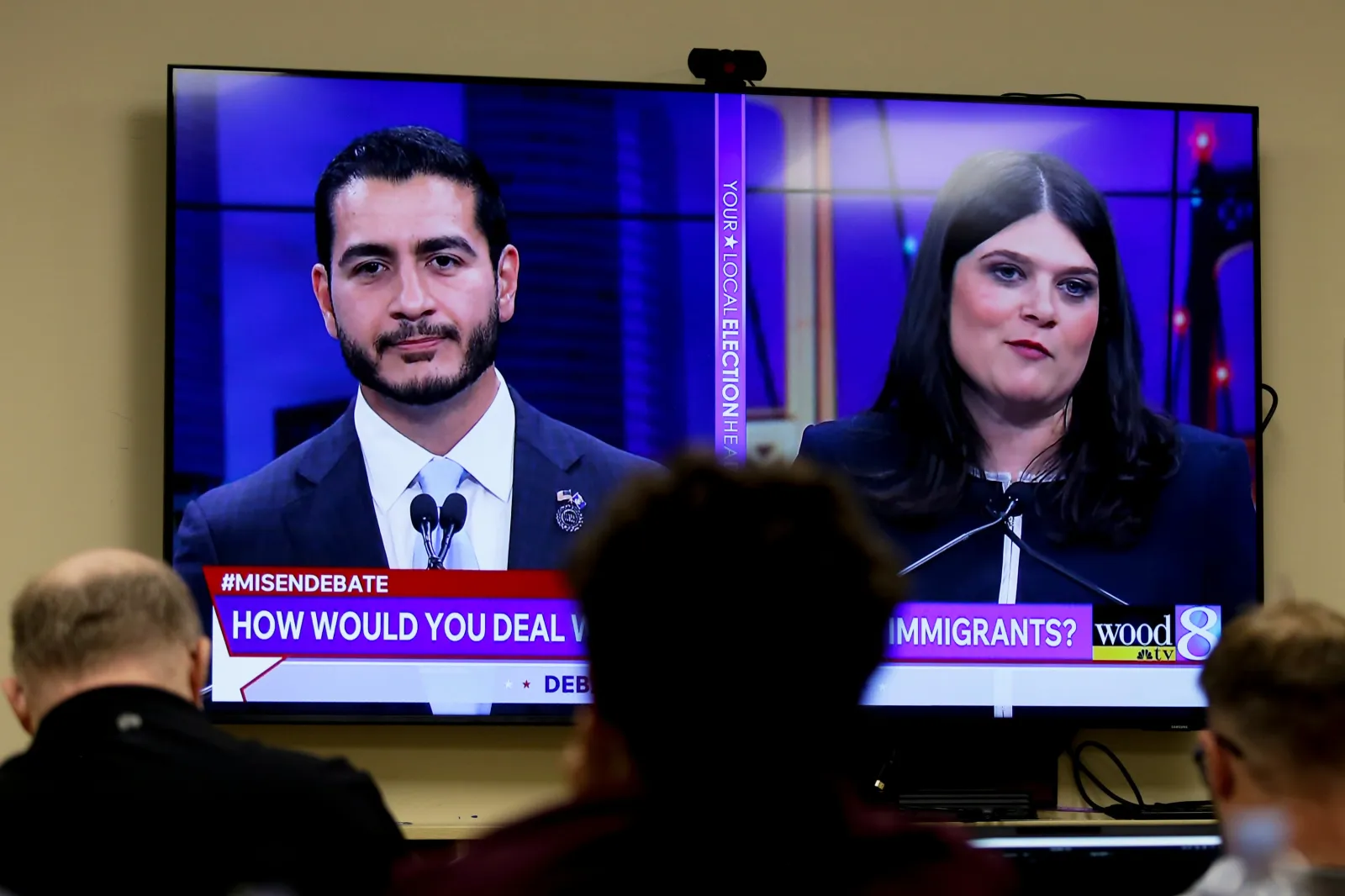
Former public health official Abdul El-Sayed and Representative Haley Stevens are competing for the Democratic nomination in a race that has grown into a national proxy battle over ideology, campaign spending, and influence within the party. Stevens has emerged as the establishment favorite, backed by Governor Gretchen Whitmer and supported by tens of millions of dollars in outside spending from the American Israel Public Affairs Committee's affiliated super PAC.
El-Sayed, meanwhile, has rallied the progressive wing of the party, earning endorsements from Senator Bernie Sanders and Representative Alexandria Ocasio-Cortez while arguing that grassroots organizing can overcome institutional power.
Read More on Politics
The outcome could reverberate far beyond Michigan. If El-Sayed wins both the primary and the general election against Republican Mike Rogers, progressives will point to the victory as evidence that their message can prevail in one of the country's most competitive battleground states. If he secures the nomination but loses in November, moderates are likely to argue the opposite—that progressive candidates remain a liability in swing-state elections.
Stevens faces the same test in reverse, with supporters arguing she represents Democrats' strongest chance of keeping the seat in party hands.
...
Money, Influence and the AIPAC Debate
Much of the national attention surrounding the race has centered on the unprecedented level of outside spending.
United Democracy Project, AIPAC's affiliated super PAC, has poured roughly $30 million into supporting Stevens and opposing El-Sayed, according to the Associated Press, making it the organization's largest investment in a single race to date.
For progressives, the spending has transformed Michigan into a broader fight over whether outside money can determine Democratic primaries.
Joseph Geevarghese, executive director of Our Revolution, the organization that grew out of Sanders' 2016 presidential campaign, said a Stevens defeat would send a message well beyond the state's borders.
"This election is ultimately a test of whether unlimited outside spending can substitute for genuine grassroots organizing," Geevarghese told Newsweek. "Regardless of where the money comes from, voters are demonstrating that there are limits to what money alone can buy."
He argued the contest is ultimately about more than AIPAC itself, saying Democratic voters are responding to candidates focused on affordability, housing and health care.

...
"We've been outspent," Geevarghese said. "We have not been out-organized."
Stevens' campaign rejects the notion that outside spending explains her position in the race. Campaign spokeswoman Joetta Appiah told Newsweek that polling has consistently shown Stevens as the strongest Democrat to face Rogers and argued Republicans privately would prefer to run against El-Sayed instead.
Democratic strategist Doug Gordon said an El-Sayed victory would nevertheless be interpreted as a setback for AIPAC regardless of what happens in November.
"There is no question that an El-Sayed victory would be a huge defeat for AIPAC and another sign of how toxic their brand has become within Democratic politics," Gordon told Newsweek.
He also noted Michigan's unusually late primary calendar leaves the eventual nominee with fewer than 100 days to unify Democrats before the general election against Rogers—a challenge for either campaign.
Jim Kessler, Third Way's executive vice president for policy, said the AIPAC spending fight obscures a demographic reality specific to the state. Michigan has a higher percentage of Arab American residents than any other state in the country, he said, while its Jewish population is less than half the size of its Arab American population.
"Israel will continue to be a dividing line in Democratic politics," Kessler told Newsweek. "That will be the case no matter who wins next Tuesday."
Michigan's Democratic establishment has largely lined up behind Stevens. Whitmer endorsed her last week, calling the congresswoman someone who has "what it takes to win." The endorsement also revived memories of Whitmer's decisive victory over El-Sayed in the party's 2018 gubernatorial primary.
El-Sayed's campaign dismissed the move as further evidence that the "corporate establishment has closed ranks," arguing voters—not party leaders—will ultimately decide the nominee.
The Fight for Black Voters
Whether either campaign can build a winning coalition may ultimately depend on Black voters, who make up roughly one-fifth of Michigan's Democratic primary electorate.
Historically, Black voters have tended to support more moderate candidates in high-profile Democratic primaries, including former Secretary of State Hillary Clinton over Sanders in Michigan in 2016. Recent polling suggests Stevens continues to hold an advantage among Black voters overall, particularly those over 55, while El-Sayed has found stronger support among younger and college-educated voters across racial lines.
Both campaigns have spent the closing weeks focused heavily on that constituency.
Stevens has made repeated visits to Detroit and Flint. El-Sayed has campaigned in Pontiac while visiting Black churches and community events across southeast Michigan.

...
Still, El-Sayed continues to face questions over his prominent role in the 2024 "uncommitted" movement, which encouraged Democrats to withhold presidential primary votes in protest of the Biden administration's handling of the war in Gaza.
More than 100,000 Michigan Democrats ultimately cast uncommitted ballots that year, and CNN interviews with Black voters and party leaders found some remain skeptical of El-Sayed because of his involvement.
Matt Bennett, co-founder of the centrist think tank Third Way, has been among his sharpest critics, calling El-Sayed "a radical" and predicting Stevens would perform better against Rogers in November.
“It’s pretty evident that running far to the left is extremely dangerous in a place like Michigan,” Bennett told The Hill.
National Ambitions Under the Microscope
As the race has tightened, Stevens and her allies have increasingly questioned whether El-Sayed is focused on Michigan—or on building a broader national movement.
Those attacks intensified after leaked audio from a Zoom donor call, first published by Politico's Playbook, captured El-Sayed describing a Senate victory as an opportunity to reshape the Democratic Party ahead of the 2028 election cycle and potentially support a primary challenge to Pennsylvania Senator John Fetterman.
"You put one ogre on a pike, and then everyone else gets the message," El-Sayed said, describing the broader political implications of his campaign.
His campaign later told Politico that he had been speaking metaphorically and argued Fetterman has too often aligned himself with the Trump administration.
Stevens has seized on the comments, portraying El-Sayed as more interested in becoming a national political figure than representing Michigan in the Senate. During the campaign's final debate, she described him as a "celebrity candidate."
Stevens campaign spokesman Arik Wolk pushed back on that framing directly, saying her focus is entirely on the state.
"Haley fights for Michigan and only Michigan," Wolk told Newsweek. "In the Senate, she'll fight for all Michiganders from every zip code to lower costs, protect manufacturing jobs, and take on Donald Trump's corruption and abuses of power. And as Michigan's most effective fighter, she's got a plan to deliver for all of Michigan on day one: stop Trump's tariffs on groceries, win back our supply chain from China, and stop utility companies from jacking up rates on Michigan families."
Related Story

El-Sayed vs. Stevens Chances of Beating GOP’s Mike Rogers in Michigan—Polls
Momentum Appears to Shift
The competing strategies appear to have reshaped the race in its closing days.
While earlier surveys showed Stevens narrowly ahead or the contest effectively tied, recent public polling has consistently given El-Sayed the advantage.
A SoCal Strategies survey conducted July 28-30 found him leading 56 percent to 39 percent. An Emerson College Polling survey for WLNS-TV and WOOD-TV released the same day showed a 57-41 lead, while a Tavern Research poll first reported by Politico put El-Sayed ahead 48-37.
Just weeks earlier, polling conducted by The Detroit News and WDIV-TV had shown Stevens with a narrow edge, prompting pollster Richard Czuba to describe the race as "wide open" because of the large number of undecided voters.
Prediction markets have shifted alongside the polls.
By Thursday morning, Kalshi gave El-Sayed an implied 84 percent chance of winning the Democratic nomination, up sharply from 64 percent just days earlier. Polymarket showed an even larger advantage, pricing his chances at roughly 91 percent.
Whitt Kilburn, a political science professor at Grand Valley State University, said Michigan's electorate has become unusually difficult to predict.
"Regarding the conventional wisdom on Michigan voters, all bets are off," Kilburn told Newsweek, pointing to education, race, gender, ideology and attitudes toward Israel and U.S. foreign policy as factors reshaping turnout.
The Road to November
Whoever wins Tuesday will immediately face another difficult challenge.
Michigan has been one of the nation's closest battleground states in recent elections. Donald Trump carried the state in 2024 with 49.7 percent of the vote to Kamala Harris' 48.3 percent after Joe Biden won it in 2020. Trump also narrowly carried Michigan in 2016, the same year Sanders stunned Clinton in the Democratic presidential primary.
Rogers also demonstrated Republicans' competitiveness last cycle, losing to Elissa Slotkin by less than a percentage point.
Kilburn said this year's political environment could prove somewhat more favorable for Democrats because some swing voters who backed Trump in 2024 may be less likely to participate without the former president on the ballot.
Kessler cautioned against reading too much into a primary win alone. The primary electorate and the general electorate are not the same voters, he said, and El-Sayed would still need to win over the decisive middle in a swing state even amid what looks like a favorable environment for Democrats in November.
Head-to-head polling suggests either Democrat would begin the general election within striking distance. A late-June Quantus Insights survey gave Stevens a 1.4-point advantage over Rogers and El-Sayed a 1.1-point edge, with both matchups well within the margin of error.
Republicans have not won a Michigan Senate seat since 2001, but the contest remains one of the party's strongest pickup opportunities as they look to expand their Senate majority.
Tuesday's primary will answer one immediate question: who Democrats believe is best positioned to defend one of the country's most competitive Senate seats. The broader debate over whether the party's future belongs to its establishment or to the progressive movement challenging it is likely to continue long after Michigan's votes are counted.
Contact Newsweek editors on this story: Jason Lemon and Sam Wilson.
View 0 Comments
Submit Correction
View Editorial & AI Guidelines