
...

By Anna Skinner
Associate News Editor
0
Share
Newsweek is a Trust Project member
See more of our trusted coverage when you search.Prefer Newsweek on Googleto see more of our trusted coverage when you search.
California water officials are not implementing statewide emergency water conservation mandates despite concerning snowpack measurements at Phillips Station, a California Water Boards spokesperson told Newsweek.
The announcement comes as the California Department of Water Resources (DWR) conducted its critical April snow survey at Phillips Station and found no measurable snow, a stark confirmation that record March heat and high‑elevation rain have effectively erased the Sierra Nevada snowpack months ahead of schedule. The statewide snowpack now sits at just 18 percent of average, marking the second‑lowest April reading ever recorded at the longtime monitoring site.
Despite the grim news, no emergency conservation measures have been implemented.
Read More on News
"Statewide emergency water conservation mandates are not being implemented due to the results of yesterday’s Department of Water Resources snow survey," the California Water Boards spokesperson told Newsweek on Thursday. "The State Water Board is not currently discussing emergency drought regulations, which could only be implemented under a state of emergency issued by the governor, nor does it expect to do so this summer."
...
Typically, the April measurement marks the point at which California’s mountain snowpack reaches its maximum volume before melting into streams and reservoirs. This year, that melt came far too early—accelerated by a March heatwave that scientists say more closely resembled summertime conditions.
Snowpack in the Sierra Nevada acts as California’s natural reservoir, slowly releasing water throughout spring and summer—precisely when demand rises statewide. In an average year, Sierra snowmelt supplies about one‑third of California’s total water for households, farms and ecosystems.
Snowpack surveys are a crucial forecasting tool: They help determine how much meltwater will flow into major reservoirs like Shasta, Oroville and Trinity, which collectively serve millions of residents and a vast agricultural network. With the snowpack now at only a fraction of normal, water managers warn that runoff will be severely limited heading into the dry season, heightening concerns of drought and future water restrictions.
However, there's one key difference between this year and 2015, which was the worst year on record for California snowpack: current reservoir water levels.
California Water Levels Compared
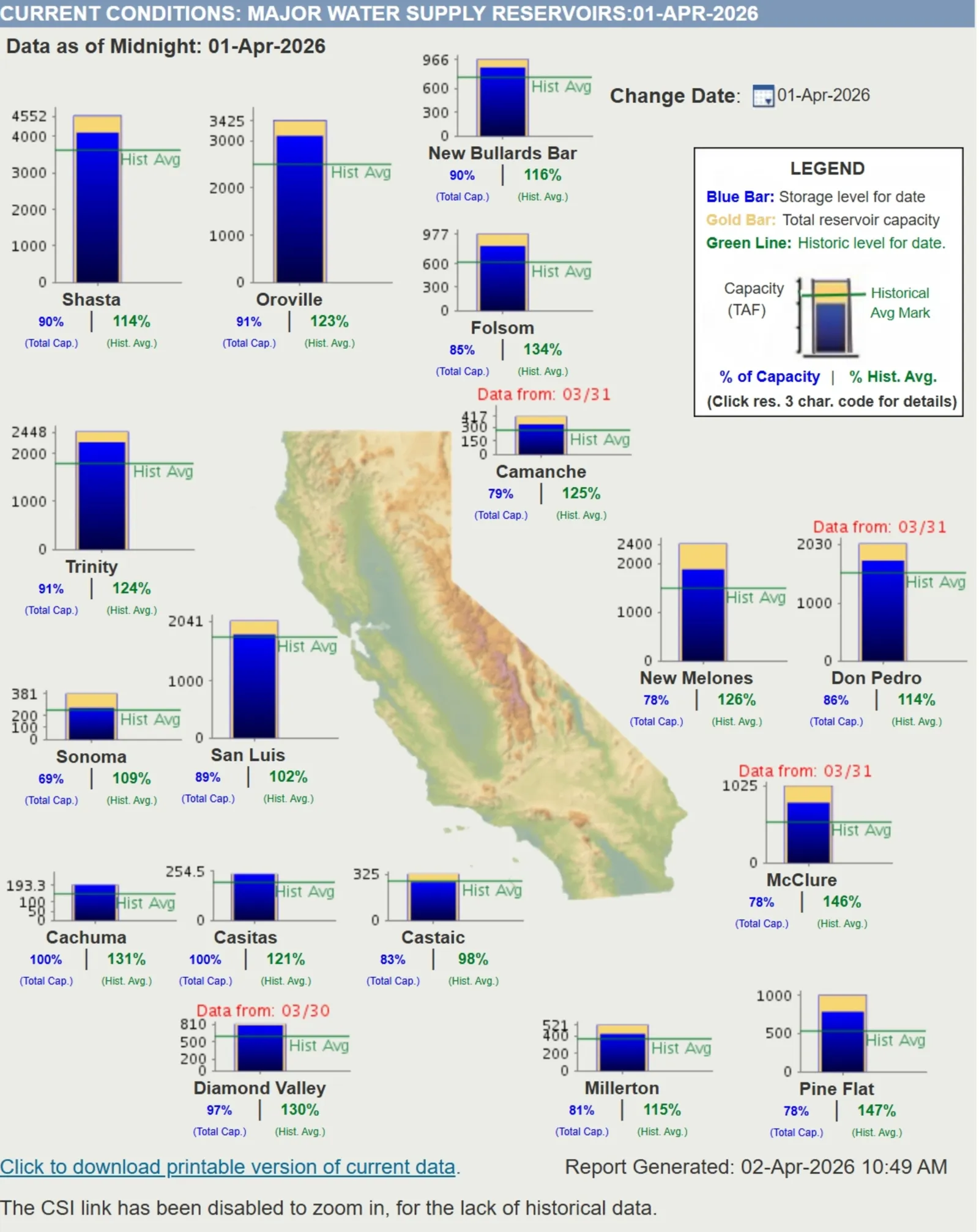
As of the most recent measurements taken by the DWR, nearly all of California's largest reservoirs are 100 percent of their historical average for this time of year.
For example, Lake Shasta, which was California's largest reservoir, was at 90 percent of its total capacity, which is 114 percent of the historical average for this time of year. Lake Oroville, the state's second largest reservoir, is at 91 percent of capacity, which is 123 percent of the historical average. Trinity Lake's water levels were also in a good spot at 91 percent of capacity and 124 percent of the historical average.
...
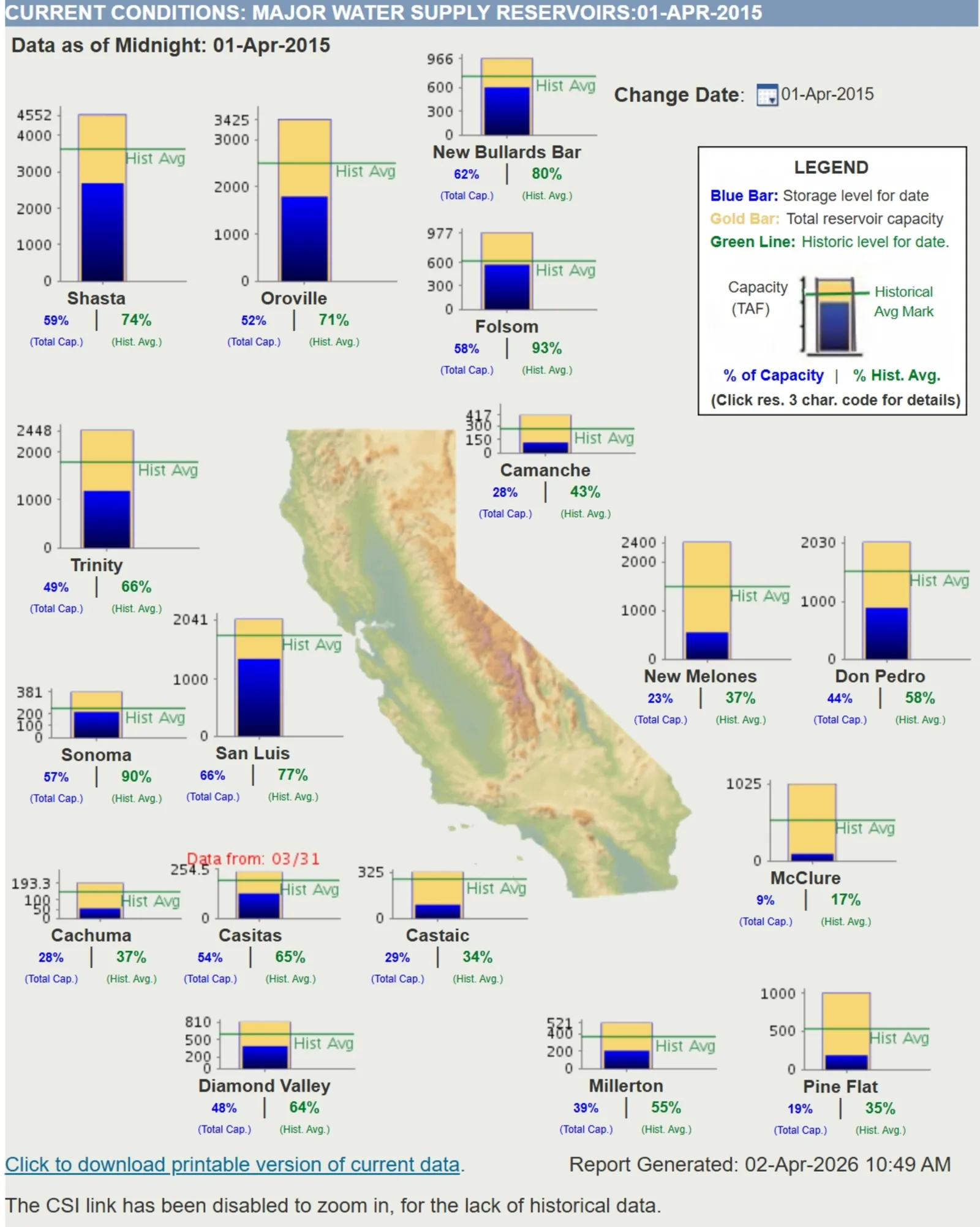
On April 1, 2015, the reservoirs' conditions told a much different story.
At that time, Lake Shasta was 59 percent full, Lake Oroville 52 percent, and Trinity Lake 49 percent. Out of all major reservoirs tracked by the DWR, none were at 100 percent or more of their historical average.
...
In comparison, this year on April 1, all but one either met or exceeded their historical averages. The sole outlier, Castaic Lake in Southern California, was at 98 percent of its historical average.
While many reservoirs remain high from earlier storms, the stored water may be the only significant supply California receives this year, given the concerning snowpack measurements.
Update 4/3/26, 9:22 a.m. ET: This article was updated with a new headline.
View 0 Comments
Submit Correction
View Editorial & AI Guidelines