
...

By Hannah Millington
Health Reporter
0
Share
Newsweek is a Trust Project member
See more of our trusted coverage when you search.Prefer Newsweek on Googleto see more of our trusted coverage when you search.
Diagnosing endometriosis could soon be much easier thanks to a new at home-test that can detect a biomarker for the disease in period blood.
The pregnancy-like test created by researchers at the Pennsylvania State University offers up a diagnosis with high sensitivity in just 10 minutes.
While the device developed by professor Dipanjan Pan and his team is just a proof-of-concept at this stage, the advancement could lead to the time it takes to diagnose endometriosis being reduced "from years to minutes".
Read More on Health
Endometriosis—where cells similar to the lining of the uterus (womb) grows outside of it—is estimated to affect at least 11 percent of women in the US, or more than 6.5 million.
The chronic disease can cause severe symptoms like extreme pain and in some cases contribute to infertility.
Pan said in a statement that menstrual effluent (blood and tissue) shed from the uterus each month is often overlooked as medical waste—and even stigmatized by some—but could help with earlier and more accessible endometriosis detection.
While he acknowledged other attempts to use period blood for diagnosis of the disease, he told Newsweek, "This is the first time we have a proof of principle pregnancy-like test that shows one can collect menstrual blood and run it in the privacy of home and obtain the results in 10 minutes."
It can take between seven and 10 years to diagnose endometriosis typically, which can be delayed further depending on someone's access to healthcare, according to Pan.
...
Pan's team's prototype device is capable of detecting HMGB1—a protein involved in endometriosis development and progression—in period blood with 500% more sensitivity than existing laboratory approaches.
Existing diagnostic approaches involve intravenous blood tests and laboratory analyses alongside imaging studies and extensive patient history collection.
"Currently, the only definitive method is laparoscopic surgery [keyhole surgery, often invasive]. While menstrual blood is not yet a standard diagnostic tool for endometriosis, it's an active area of research with the potential to revolutionize how the condition is diagnosed and monitored in the future," Pan explained.
"With our technology, we are hoping to democratize women's health by providing a much-needed tool to track the onset or progression of this disease at the convenience and privacy of home. We anticipate that combining this technology with clinical symptoms will allow for early detection or diagnosis of endometriosis in adolescents and women."
As well as the condition facing social stigma related to menstruation and chronic pain— made worse by a lack of awareness—cost is also an issue.
"A recent study found that the average cost for a woman with endometriosis was around $30,000 per year. This huge financial burden can be reduced [as well as the shame and isolation from stigma] if an accurate at-home test becomes available," said Pan.
The test is based on a new technique to synthesize nanosheets made of the atomically thin 2D material called borophene, according to Pan and his researchers.
Borophene is a derivative of the chemical element called boron, which is similar to the more commonly researched graphene, a lightweight 2D material made from carbon.
Borophene, however, has an advantage over graphene in that it is highly biocompatible and a biodegradable, although the team Pan acknowledge that fabricating the pure form of the material does come with challenges.
In the study, researchers swapped alcohol solvent—used in traditional methods which can make it unsuitable for biomedical applications—for water. They dispersed powdered boron in the water, breaking down the chemical and reforming it into "pristine" nanosheets. They then fixed antibodies that would recognize HMGB1 to the nanosheets.
"Borophene's role here is to facilitate the 'lock-and-key' process. This emerging two-dimensional material helps to orient the 'lock', i.e., the capture molecule on the surface of these sensors so that the 'key', i.e., the target protein (HMGB1) for endo can bind tightly. Tight binding ensures that the test brings high specificity and sensitivity," Pan explained.
...
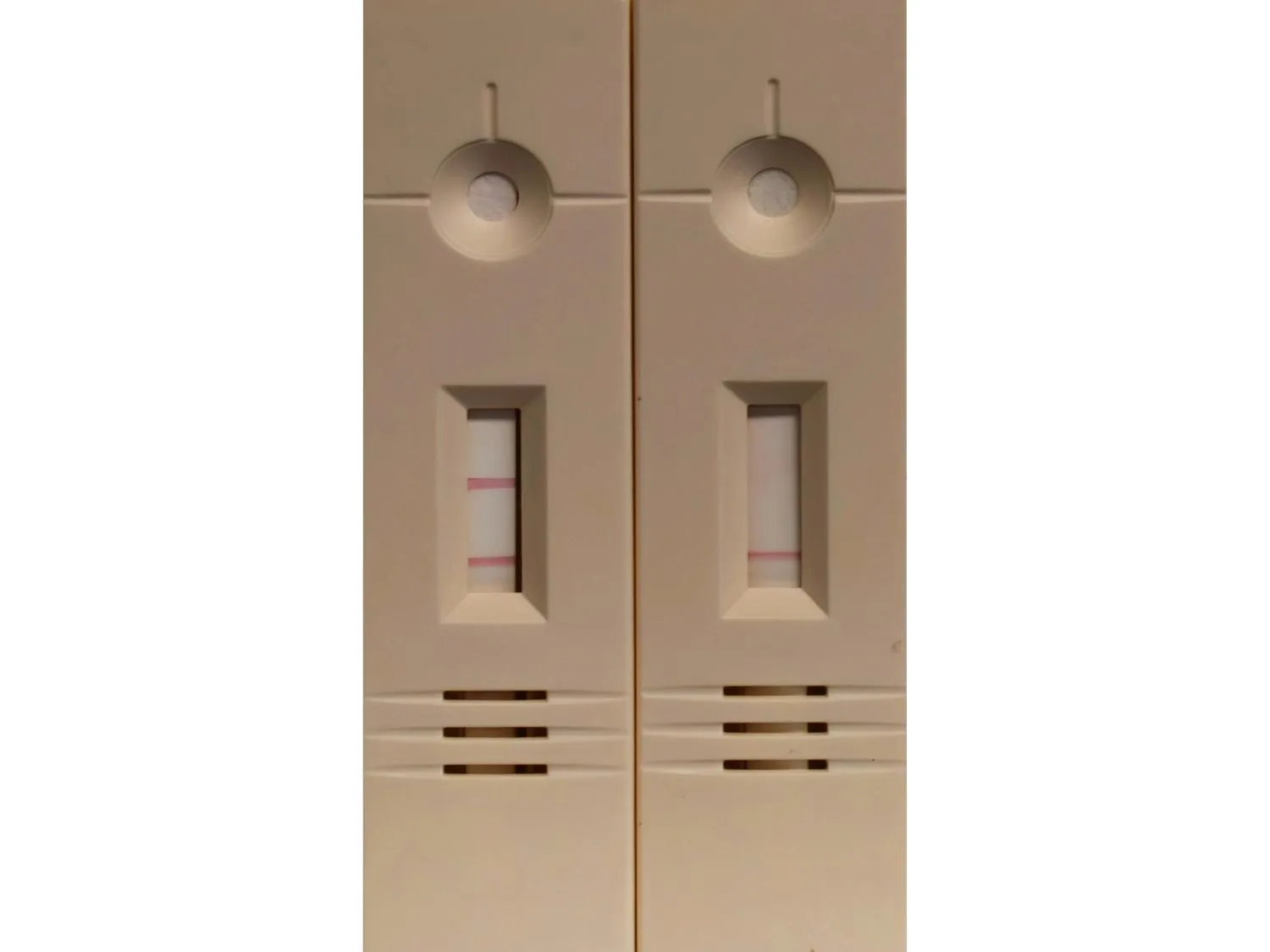
Pan and his team used multiple techniques to check the antibodies correctly caught and bound to HMGB1 specifically. They then arranged the nanosheets into the test device, which displays either one line if negative or two if positive.
Just like urine in a pregnancy test, the blood sample flows over the test strip. If any HMGB1 proteins are present, they bind to the antibodies and darken the test strip.
The researchers also spiked period blood with various concentrations of the protein and discovered the test could detect it at low concentrations with five times more sensitivity compared to existing lab tests.
"Our technology once developed, can reduce the time of diagnosis dramatically from years to minutes. Technologies are being developed that claim to be 'at-home' tests for endometriosis, but in fact they are developing ways to collect samples for laboratories to test," Pan warned.
"It is our goal to [eventually] provide the kits directly to the public, at a reasonable price point, so women can do the test at home and share the results with their doctors, who will offer diagnoses and advice about next steps.
"We are looking at a couple of years of effort at this point. The team is actively looking for funding and partners to further develop the test. With funding, this timeline can be reduced in my opinion. "
The test could even be integrated into period pads, making it possible to discreetly and conveniently monitor HMGB1 levels this way at home too.
The researchers plan next to scale up their approach for clinical studies, improve the device's sensitivity even further, and expand the test to detect additional disease biomarkers like HPV and cervical cancer.
Do you have a tip on a health story that Newsweek should be covering? Do you have a question about endometriosis? Let us know via health@newsweek.com.
Reference
Natarajan, S., Dighe, K., Aditya, T., Saha, P., Skrodzki, D., Gupta, P., Gunaseelan, N., Krishnakumar, S., & Pan, D. (2025). Photoinduced Immobilization on Two-Dimensional Nano Borophene Spatially Orients Capture Antibody for Highly Sensitive Biological Interactions. ACS Central Science. https://doi.org/10.1021/acscentsci.5c00474
View 0 Comments
Submit Correction
View Editorial & AI Guidelines