
By H. Alan Scott
Senior Editor
0
Share
Newsweek is a Trust Project member
See more of our trusted coverage when you search.Prefer Newsweek on Googleto see more of our trusted coverage when you search.
...
“You only get innocence once, you know? And there's something fantastic about it.”
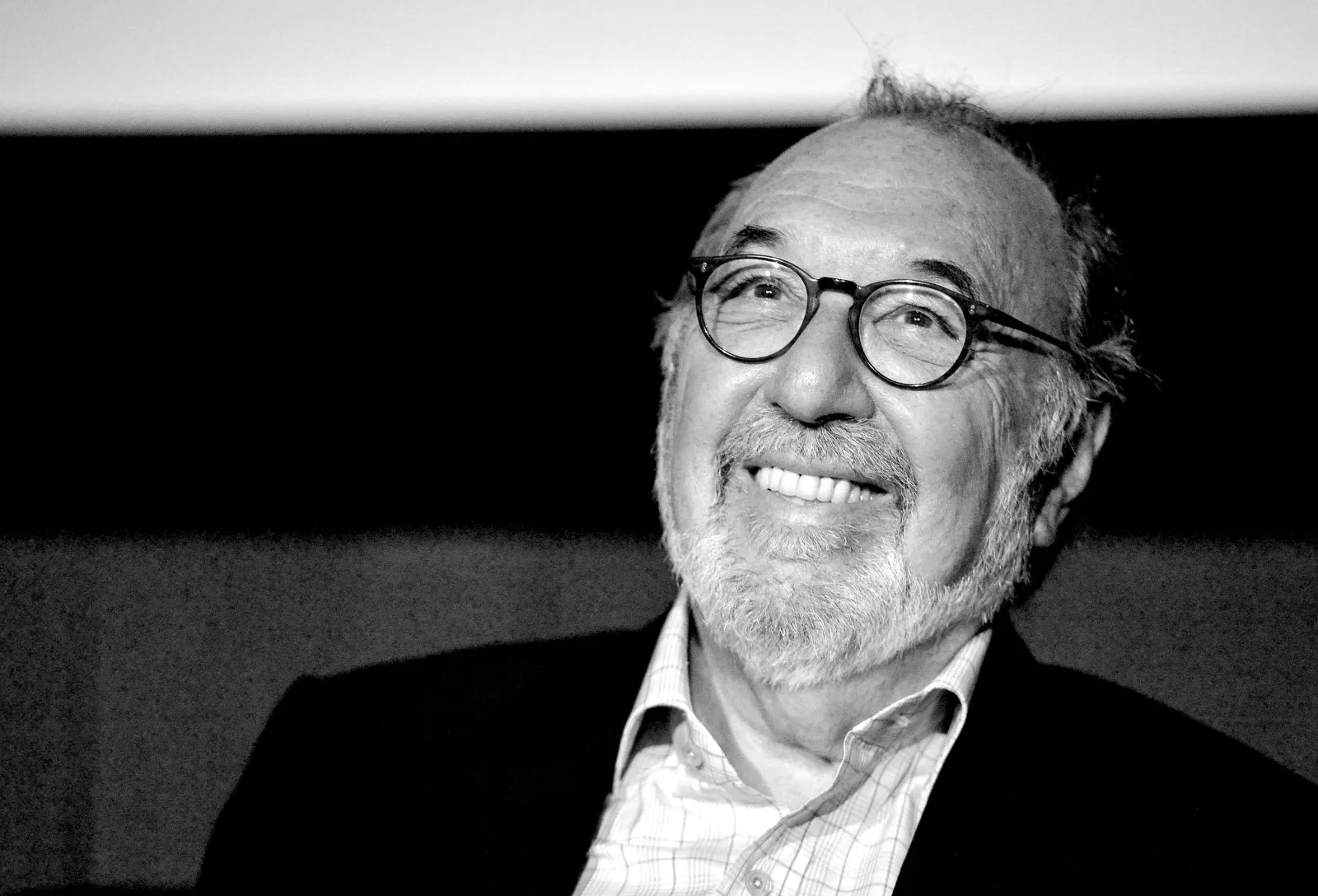
It’s been 15 years since Oscar-winning director James L. Brooks has released a film, and his absence has been felt. The architect of classics like Terms of Endearment, Broadcast News and As Good as It Gets is back. He returns to form with Ella McCay, a story rooted in the messy human emotions of complicated relationships—a genre he has mastered, yet one that’s become increasingly rare in modern cinema.
Read More on Entertainment
Brooks’ decision to make Ella McCay wasn’t sparked by a trend or franchise opportunity, but rather by an emotional irritation. “It was a reaction to so many films ending with, ‘I forgive you. OK, we’re all OK,’” Brooks tells Newsweek. “So I had a little perverse reaction, you know? Because I think some things must be unforgivable for forgivable to mean anything. If you don’t have unforgivable, what are you doing with forgivable? That’s my theory.”
This theory forms the spine of the story, which follows Ella, played by Emma Mackey, a young politician who juggles being a trailblazer at the moment with trying to avoid a set of scandals that risk ruining it all—all largely created by the men in her life: her husband Ryan (Jack Lowden), father Eddie (Woody Harrelson) and former boss Governor Bill (Albert Brooks). She’s supported throughout it all by her Aunt Helen (Jamie Lee Curtis) and longtime secretary Estelle (Julie Kavner).

...
Typical of Brooks’ films, his characters walk a razor’s edge between comfort and trauma, with the writer/director often drawing from his own history. “I was raised around women,” Brooks says. “My father was not a good guy. And so I maybe carry still a grudge. He was a really bad guy. I think that you’re always trying to catch the right heroine at the time, you know?”
Mackey is fully aware of the cinematic legacy resting on her shoulders as the title character in a James L. Brooks movie. Not only does it mean joining a lineage that includes Shirley MacLaine, Holly Hunter and Helen Hunt, but it also means bringing to life a character that will join other great heroines created by a man long celebrated for his ability to write for women. “It’s a huge honor,” Mackey says, noting that “it’s just a wonderful, fateful thing to have a name that’s relatively similar to a character that Jim has written for the past 13, 14 years. It’s a great responsibility, really, not to get intense about it, but it is.”

...
The Women Behind James L. Brooks
The origin for why, and perhaps how, Brooks has come to be known as the man with one of Hollywood’s most decorated track records for writing complicated, three-dimensional female characters is because his past was defined by these very women.
“My sister was eight years older than I. My mother worked all the time. She raised me, my sisters raised me. I had two aunts. My mother and her sisters were close,” Brooks recalls. “I was [raised] around women. So I heard—maybe before I should—their plight, my mother’s plight certainly, and certainly witnessed some of it.”
The proximity to “their plight” is what has allowed him to craft female characters that feel lived-in rather than just observed. Take MacLaine’s Aurora Greenway in 1983’s Terms of Endearment, a widow with a complicated relationship with her daughter; Hunter’s neurotic newsroom director Jane Craig in Broadcast News (1987); or Hunt’s Carol Connelly, a single mother doing what’s needed to get by in 1997’s As Good as It Gets. Like these women, Mackey’s Ella McCay was inspired by Brooks’ curiosity about how trauma impacts the decisions we make.
“To me, what I started with is [how] somebody who was marked by family trauma and had that case to make and spoke up at that very young age and is somehow in a moment of abandonment [now] is made to feel [doing the] abandoning,” Brooks explains.
For so many women who inhabit these roles, working with Brooks is different from other male directors. When asked what it is about Brooks that makes him different, Hunt isn’t able to pinpoint exactly what it is, but it’s there. “What I can say is, it’s the lack of something, a lack of prejudice, a lack of a limited idea of how women’s brains work,” Hunt says. “It has as much to do with the lack of limited thinking as it does to do with his incredible ability, like a truffle pig, to smell for humanity and humor and heartache all in one bite.”
That instinct is what drew Mackey to Ella McCay. Even as a new generation of talent takes to the screen, Mackey says Brooks’ depth of writing stands out. “He just seems to have a deep, profound, intrinsic understanding of female relationships and how certain women operate within a family structure and outside of a family structure and in a chosen family environment perhaps, too,” Mackey says. “Nothing’s left to chance. Nothing’s gratuitous or just kind of popped in there and see what happens. He’s really diligent in his whole manner. And he’s very poetic, too. But it’s never for free. It’s never for show. There’s always something behind it.”

...
A Rare Opportunity
A James L. Brooks movie is an event not just because it’s good, but because it’s rare. Immune to just churning out content in quantity, Brooks is known for the amount of time he takes between projects. “I did produce,” he’s quick to note. “I have a very good day job on The Simpsons [as an executive producer], which means that you’re not just lazing around the house all the time.”
With that said, part of the reason for the intervals between projects is that Brooks is a writer first, which fuels his perfectionist streak. But he’s quick to note he doesn’t want these long stretches to always be the case. “I now have notes for something I want to do,” he says. “I don’t want it to be like that again. I want to be writing soon. When you are writing...you have a blank screen, and you’re trying to put something on it. It’s a wholly respectable endeavor.”
Regardless of when it comes, getting cast in a James L. Brooks movie is a mark of a career-long endurance. Jamie Lee Curtis is blunt about the wait. “You know, I’ve waited my entire life to have the life I have today. I have been patient as f***.”
For a Hollywood veteran like Curtis, who has experienced every aspect of the acting business a performer can—and has picked up an Oscar along the way—she’s honed her craft to the point where she often relies on instinct when discovering a character. “Jim Brooks, you give him that instinct, and he’s like, ‘Yeah, no, I don’t want that. Now what are you gonna give me?’” Curtis says. “It becomes a wrestling match. Beautiful wrestling match, creative, collaborative, complicated. But he isn’t going to just be like, ‘Oh, that’s great.’”
She describes the experience as both “thrilling and terrifying.” “Your instinct will carry you most of the time, but with the Jim Brooks, it’s not good enough. And he really removes it and kind of strips it off you, and then that’s when the work begins.”
Mackey echoes this grueling yet rewarding process. “He just doesn’t stop until we’ve tried everything,” she says. “Yes, you’ve done it that way 15 times, but I want another 12 times until something a little different, a shift happens, whatever. It’s exhausting and exhilarating all at once.”
An Archive of Humanity
Even for a legend, the green light is not guaranteed. “This is a data age. This is a practical age,” Brooks observes. “And damn it, their [studio executives’] jobs depend on having a certain feeling of security that they’ll make money out of something. And God, that’s their job. The executives on this were, I think, a little amazing for this day and age, in that regard.”
But what is guaranteed is the emotional resonance that has made Brooks’ work endure for decades. More than mere movies, they are an archive of humanity. “They feel like time capsules to me, as well,” Mackey says. “They feel nostalgic without being sort of soppy. They’re nostalgic for the right reasons. They sort of capture something that’s really essential in people and humans and whatever it is and the messiness of it.”
Looking back on the film that started it all for Brooks, Terms of Endearment, he’s quick to note the “innocence” lost after the pureness of that film’s vision. “You only get innocence once, you know? And there’s something fantastic about it, as nerve-wracking as it is, as scared as you may be, there is a great boon to what comes along with innocence. I mean, you don’t know better is frequently better than if you did know better, and so you have more of a blank canvas. It’s not cluttered with this happened to you and that happened to you.”
However, despite this lost innocence, Brooks’ goal is the same as it was 40 years ago. He’s still chasing those characters that show the myriad complexities that make up the human condition. “One of the goals that you have is characters that linger,” Brooks says. “That’s one of those stories you’re shooting for. I hope that happens.”
H. Alan Scott is a Newsweek senior editor and host of The Parting Shot podcast. Follow them everywhere @HAlanScott
View 0 Comments
Submit Correction
View Editorial & AI Guidelines