...
By H. Alan Scott
Senior Editor
0
Share
Newsweek is a Trust Project member
See more of our trusted coverage when you search.Prefer Newsweek on Googleto see more of our trusted coverage when you search.

Elizabeth Weinberg/Prada
“I came up in the broadcast sitcom. That's where I earned my bones. I would love to see it maintained.”
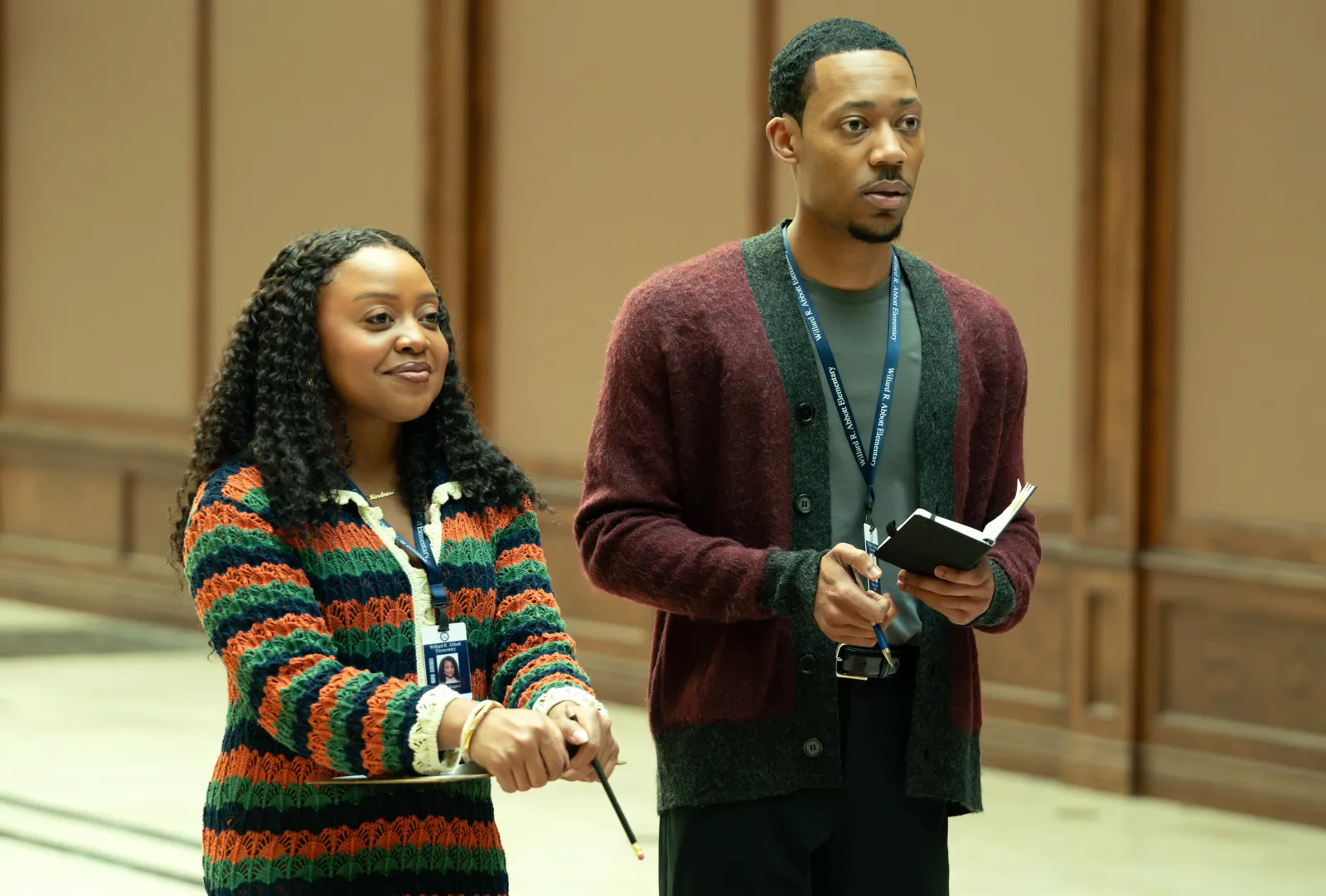
After five seasons playing Gregory on ABC’s Abbott Elementary, Tyler James Williams is adding a new title: director. “I have been wanting to get my hands dirty in another aspect of the process.” With his acting background, “My brain thinks in act breaks and pacing, and I guess finding the funniest way to see and show something.” This evolution is just another notch in an already impressive career, with his breakout lead role as a child actor on Everybody Hates Chris and in the film Dear White People. “There’s definitely a consistent thread...a guy who’s trying to find his way ultimately, who may be a bit more awkward and outside of the norm than most people, but who’s sincerely trying.” With multiple Emmy nominations for Abbott, Williams said of his red-carpet opportunities: “We may have a little bit more hill to climb. So with that being the case, we’re gonna have fun with it.”
Read More on Entertainment
SUBSCRIBE TO THE PARTING SHOT WITH H. ALAN SCOTT ON APPLE PODCASTS OR SPOTIFY AND WATCH ON YOUTUBE
Editor's Note: This conversation has been edited and condensed for publication.
To have a network television show get to a fifth season, the syndication mark, if you will, and get to that point, it means a lot. What does it mean to have Abbott be this successful five seasons in?
I think the marker for standing the test of time, good long-lasting TV is always going to be network TV. You just do episodes at a higher clip. We do 22 rather than this “10 to 13” thing. And for that reason, when you hit that milestone of five years and you hit that 88 to 100 episodes, it means so much more. Because, it's quite literally harder to do. We don't have a year or two years to write the seasons. We have to write in between. We went down in March, and it has to be ready to go by the time we go back up in August. It's a hard road, and I think it it's all that more rewarding when that's the case. The fact that people are still coming back for more—I think at this point in the show it evolves into a stability thing, which I really love. Where people are returning to you because they know that you're surefire. They know what they're coming here to get, and that's something that they need. And that's where the trust gets built. So, season five feels like a very mature relationship, not only with the show but with the audience as well.
We're in an age of television where network sitcoms are rare because the networks just slash 'em real quick. In that regard, Abbott is an outlier. What is it like to have that support from a network like Disney?
I think there's a lot of conversation, particularly now, as everyone's talking about which company is going to buy what, about mediums possibly dying. For a while there, it really did seem like specifically broadcast comedy was dying. That even the multicam sitcom was dying, and that it was getting outpaced by these sleeker, economically easier-to-make shows on these streamers. But thankfully we're still here. I came up in the broadcast sitcom. That's where I earned my bones. I would love to see it maintained. And I think shows like Abbott and the support that ABC has given it, remind people that it's possible. It's not necessarily easy, but it is definitely possible. And the reward and the return can be so high if you do it right. For that reason, I think, the health and strength and culture that is America, a lot of times, hinges on the back of broadcast TV. When you think about it, since its inception, it's things that we could all mutually laugh about, things that we could all mutually cry about. It is the equalizer. It doesn't matter what you pay for, you turn on your television, if you have a signal, you can get these channels. And I feel like we have to fight to keep it alive for that reason. The bar isn't just high, unnecessarily. It's an equalizer. It's finding something that the majority of the country can get behind. And that's a difficult task.
...
I would argue that to create a family sitcom or a sitcom that is on a network is actually harder to create, because you can't drop the f-bomb like you can elsewhere.
I one hundred percent agree with that. I've done shows across all of the platforms. You can get a joke out of a the f-word so much easier than you can with anything else. But also, the fact that we have 21 minutes and 30 seconds to tell a story. That's the thing in the last few seasons of Abbott, particularly where it comes down to my episode to direct, where I think we are playing in a box that nobody else is playing in. You turn on Netflix, and you'll see the episode lengths all over the place, depending on how much time they needed. We have a finite amount of time to tell the story to get you to laugh and then it gets you to the end of that story. And that's very difficult to do. And I think oftentimes that gets overlooked. It's definitely really hard to maintain. I still don't understand how our writers' room does it. But it's definitely a more difficult execution for everybody involved.
I want to get to the episode you're directing and just directing in general. I've always thought that people who've grown up in the television world actually make great television sitcom directors. Unlike film, television is a writer's medium, and directors really are the conduit of the writers to make the thing happen. So, what was it that made you want to explore directing and how is it different for you going from acting to directing something like this?
I feel like it's exactly what you talked about. It's when you've grown up in this world, the closest thing I can relate it to is like basketball. When you notice somebody who is a second-generation basketball player, who grew up around the game. They understand the game and the inner workings of it differently than everybody else because they learned it faster. That's what initially piqued my interest. I've now fallen in love with every aspect of television making. I want to know where camera is, not just for my performance as an actor, but how does that inform the rest of the scene and the way everybody else moves and the dance and the choreography that goes along with that? So I think for a while, I have been wanting to get my hands dirty in another aspect of the process. But then once I started doing it, I found that what you were saying was correct because my brain thinks in act breaks and pacing and I guess finding the funniest way to see something and show something. It came quite naturally because so much of a director's job is not only facilitating the vision of the writers, but anchoring the set, driving the day forward, getting everything that you need and everything that you need shorter, just in case you have to chop it all up and cut it down. So it just became an instinctual thing at some point.
Tell me about the episode you directed and why you wanted to direct it. Did you get to choose the episode?
Another thing, you never get to choose! I did not get the choice. In fact, I think the writers know that at some point in the story of the season I'm gonna come in and direct an episode. So, there's usually like one or two, but they're like, ‘OK, [we] will write this a little lighter for Gregory in case you happen to get it.' There happened to be an order flip that happened this year, so I got one that was super Gregory-heavy. And I do not recommend to people being in something that you have to direct at the same time. But it was a challenge and I liked it. And I think that's what I talked to Justin Halpern [co-showrunner], Quinta [Brunson] and Patrick [Schumacker, co-showrunner] about...‘Listen, we wanna tell the story you want to tell. As an actor, it's my job to execute that story, and as a director, it's my job to show it to you the best way that I possibly can. I have two jobs this week. That's fine. I'm gonna do both. As long as you give me a good story to tell, we'll get there.' So, they threw the kitchen sink at me, but it was fun. And I think that for me, every time something like that happens, especially as a younger, newer director, I just prove myself right more and justify those instincts, which is really nice to get those opportunities because most directors have to wait much longer in their career to test their strength on that.

...
This cast is so tight with each other, what is it like directing someone that you know so well? And is the relationship different than it would be for you as a scene partner?
It almost feels like cheating because the audience sees what ends up making the final cut. I see every take that didn't. So there's a wide range of things that I know my castmates are capable of that people never get a chance to see, whether it be because the joke just ran too long for time or like all the air at the back end of scenes where we just let each other improv and play, I'm privy to that. Most other directors won't be. So, in a lot of ways, what I'm doing for that week that I'm directing is letting my castmates off a leash. Like, me very quickly going, ‘Hey, I know where you can go, get there! I know what you're waiting for! I know what best suits you! Let's go for it!' And as a castmate, I find myself in episodes that I'm directing more in awe of the performances of my castmates than I am as an actor.
How so?
As an actor, you need to stay present. You're supposed to be here. But it's an interesting aspect that happens to me in the scene sometimes where I'm in it and then also making sure that performances are there from a directing point of view. And I'll just find myself just enjoying and watching TV up front. Like, really in the most close view. I had it with Chris Perfetti. You watch him work and you watch him refine over the course of takes. And it's just a beautiful thing. Thankfully, I got a chance to shoot one of our testimonials with him, where I actually could just do that and be the guy on the other side of the camera and make eye contact with him so he had somebody to talk to, but just watch him work. You really learn to appreciate your castmates on another level when you have to approach them as a director. You really see like, ‘Wow you made a scene that I was concerned about that much easier just by being you and doing what you have always done well!’ It's really beautiful.
You almost make their performances better because you're an actor who knows where they can go. A director coming in who is unfamiliar—sure they can manage the set, and oftentimes sitcom directors are essentially managers, but to be someone who knows what someone like Chris can do or Sheryl Lee Ralph can do, or even Quinta can do, that must be a great invitation for the actor to really go in areas that they don't normally get to go.
I hope so. That's what always my goal is going into an episode. I had that with Zack Fox in this episode of mine. It's like he came in not knowing I was directing, I think. I think he figured that out late once I started calling rehearsal. But there was definitely a moment when I saw him realize, ‘Oh, it's you.’ Then I'm going crazy. And I'm like, ‘No, let's do it. I'll find a way to chop this up. Just give me everything that you got. There's no wrong answer here.’ And I watched him take his own leash off and throw it down the hall. And that's another really beautiful thing. I think most directors are trying to build a sense of trust with their actors so they can pull those performances out. I am at an advantage where that's already there. And I'm really getting just the most moldable performance possible.
We’ve had a relationship with you as an actor since you were a kid. And what I think is so interesting about the cast of Abbott is so many members, Lisa Ann Walter, Sheryl, even Quinta from her Buzzfeed days, we have had a relationship with many of the actors on Abbott from a different thing that then gives us perspective on the character you're playing. Like, I always think of you as Lionel from Dear White People or Chris on Everybody Hates Chris, of course. How does Gregory compare to maybe those two other very big characters you played in your career?
I feel like there's definitely a consistent thread that runs through all of them: that is a guy who's trying to find his way ultimately, who may be a bit more awkward and outside of the norm than most people, but who's sincerely trying. I think they exhibit different behaviors in how they do that and have different levels of maturity. But it is something that I'm still surprised at. Like, how many layers there are to playing a character that I continue to find. I hope in the grand scheme of things, Gregory holds up as well as those two hold up—in the way that people see themselves in them and fall in love with him as a character. But there's definitely a conversation I think that they're all having with one another. There's definitely something—the truth that speaks to each of them—that I think ties them together.
A lot of reactions people had when they first saw you in this role were like, "Wow, Tyler’s a man now!" You were able to very seamlessly grow up in this business and grow up into an adult actor and be able to be an adult actor without having that weird introduction of ‘Now I'm an adult!’ You know what I mean? What was that like for you in your career when Abbott finally came along?
I think one of the biggest mistakes that somebody who starts very young and comes to success very young can make is a straight up and down rejection of the person that everyone got introduced to. I've been there and I understand why there is a instinct to do so. It happens with most people as they grow up. There's this rejection of your younger self as you craft who you are. But then there's this other really beautiful option where…Have you ever had a puppy? So, when you get a puppy and that puppy has really big paws, that's gonna be a really big dog. You don't need to reject the look of the puppy that you're looking at, but it's giving you context of where they can go. And I think that what I found is, it's not necessarily about introducing yourself to your audience as this new person that's nothing like the child that you knew before. No, you get the chance to watch the evolution and there's something beautiful in that as well. The puppy is just as strong and lovable as the grown adult dog it's gonna turn into. And I think that was something that Abbott was able to close the book on for me. I think from my teens until Abbott, I feel like my transition into an adult actor was being built. And it feels like with Abbott, that was the bow on that. And now I can go from there. But I'm happy I did it that way. Rather than try to force people to see it. Let them grow and notice it on their own. They'll see it, just can stay consistent with it.
While there is no end in sight for Abbott Elementary, you are evolving as a person in this industry by directing and doing other things. What is something that you're eager to do more of, either on Abbott or afterward?
I think directing is a step in, ultimately, the producing direction. That's ultimately where I'm headed. I understand now much more intimately, over several decades, what it takes to make a television series—what it takes to make a successful television series and the people that need to come together to do so, how that needs to work, not only for the fans and the audience, but economically. That's another big issue that we're having industrywide, is how do we scale everything? How do we make tight stories that can be told in a very finite amount of time that still sells well with ad revenue? There's a lot of things that go into that. And I feel like now, having a few hits under my belt, I'm getting ready or preparing to try my hand at building something from the ground up. There always will be ideas, it's just about putting those ideas together and packaging them well. So, I think that's ultimately where I'm heading. I'm trying my hand at several different pieces that will ultimately come together and make something hopefully really memorable one day. I'm a student of this game, like it or not. I'm 33 and I've dedicated 29 years of my life to it. I'm gonna continue to go in further, and I think that's the next step.

...
The show and so much of the cast, yourself included, have been so lucky to pick up Emmy nominations over the years. But one thing that I find so particularly interesting about you and Chris in particular is that you guys eat up a red carpet. You take male fashion to a level that I don't think has been seen by cast members at the Emmys often. Do you and Chris have a competition to try to one-up each other on what you're gonna wear to a particular award show? Because it feels like that's what's going on.
I know it does. And it feels like it's very coordinated. I swear to you, it is not. I have a series of photos in my phone now that eventually I'm gonna frame and put up in my house of me and Chris at different award shows, essentially looking like a power music-producing duo who just won producer of the year. Like our own Daft Punk. I think what happened from the very beginning of this show is that we understood, ‘Listen, we're the broadcast comedy in this landscape. We understand what that means. We understand that we may have a little bit more hill to climb.’ So, with that being the case, we're gonna have fun with it this whole time. We're gonna show up and we're gonna be here and we're gonna celebrate not just television, but the fact that we're still here. And I think we linked up on that very early on, and we show up and end up matching and it’s like we're in a fashion battle. But it's a fun aspect of this. I think so many times you can get so in your head or shows can get in their head about the awards and resting and all of that. And at the end of the day, there's so much TV, it's hard to quantify it down to the best five or six. This is a celebration of everything that is this art form. I would like to show up to that celebration in yet another art form.
View 0 Comments
Submit Correction
View Editorial & AI Guidelines