10
Loading video...

By Kirk McKeand
Contributing Sports Writer
0
Share
Newsweek is a Trust Project member
See more of our trusted coverage when you search.Prefer Newsweek on Googleto see more of our trusted coverage when you search.
The first Kingdom Come: Deliverance is a game about being told off for sleeping in other people's beds. Casting you as an orphan peasant called Henry, you're essentially a vagrant who isn't welcome anywhere and doesn't know which end of the sword you're supposed to stick people with.
By the end, you're working for the historical figures of early 1400s Bohemia – real lords and ladies of the period – but the stakes remain relatively low. It's a bit of a flawed gem. Kingdom Come: Deliverance is full of brilliant ideas and wholly unique – no other open-world RPG commits to grounded history in the same way – but those ideas were often executed poorly, much like Henry's swordsmanship.
I love the idea of the game more than the game itself. I spent entire in-game weeks training with a guard captain to get anywhere close to competent in sword fights because it's one of those good RPGs where you level up skills by doing the thing, and that's just a cool idea. I had to train. And train, and train, and train – my skill as a player rising in tandem with Henry's abilities. It puts you in Henry's shoes (if you can afford to buy him shoes) and reminds me of Shenmue in how repetitive, mundane actions pull you into the character and world in a way flashy set pieces never can. But it's still a bit monotonous – especially as the combat felt clunky and a little random, with enemies constantly getting you in unblockable grab animations.
Read More on Video Games

...
When it did try to go bigger, it often couldn't live up to its concepts. One such moment was a nighttime raid during a siege, where inconsistent stealth and a poor auto-save system collided, creating one of the most frustrating ten-minute sections in any video game. Then there was another where you were undercover in a monastery in a monk whodunit, another cool idea that fell apart because of the underbaked stealth mechanics.
Kingdom Come: Deliverance 2 fixes almost everything wrong with the first game to the point where it feels like the studio went straight from The Witcher to The Witcher 3. Combat is slightly more simplified – you have fewer directions to angle your weapon from – but there's a lot more weight to each attack, and battles are filled with the clang of steel as you trade blocks, parries, and blows back and forth with an enemy. It's also easier to deal with multiple enemies now because Henry knows which bit of the sword to stick them with. Stealth is also a more reliable tool, allowing you to creep about in the darkness (as long as you're wearing dark clothes and carrying a light load) and choke people out and pocket their valuables.
It's still excellent at the small, personal moments, but now it manages to shine even when the stakes are raised. The production values are way higher for this sequel, which received its initial batch of funding via Kickstarter, and technical performance is improved despite the boost in visual polish.

...
Performance capture adds a new dynamic to each cutscene, so each cast member gets to showcase their full talent as an actor, to the point where some returning characters from the first game surprised me with their range. This is reinforced by brilliant character writing that finely balances the line between fun and serious, pushing and pulling you around emotionally, bringing you back to the core messages when it needs to, and lifting you when you need levity at just the right time.
It's self-aware, too. Characters mention Henry's monastery infiltration a couple of times, and he brushes them off because he says it's better to forget it. There's also a notoriously difficult boss fight in the first game that most players cheese by shooting the guy in the face with an arrow, instead of dueling him as the game intends. Henry cops to that in this game if you fail a speech check when someone asks if he killed him with his bare hands – "No, I shot him in the eye with a crossbow bolt," he says, losing reputation in the process.

...
Kingdom Come Deliverance 2 is an ambitious game, stuffed with interacting systems. The world is simulated, so each named person you meet has a schedule. If you creep into a bandit camp at night, you can stab them while they sleep. If you get to a shop too early, you'll find them eating their breakfast. If someone says they're traveling somewhere, they physically travel there. You can feel the strain on your CPU as you enter the game's big city and during fast travel, and there's a hitch as it attempts to calculate what everyone's doing. Dogs and horses find their way to water troughs and take a drink. People have disagreements in the street and start fistfighting, and these fights can pull other characters away to spectate. It's always tracking how much food you've eaten, what you're wearing, the durability of your clothes, how clean you are, what you've done, and the world reacts to every system.
I love stuff like this. It creates moments where these systems collide in a way that creates a unique story just for you, outside of the authored moments. Sometimes, these systems interact in hilarious ways, and sometimes, it's frustrating, but it's never boring. I have a perk where I can scream a battle cry to strike fear into my enemies and deal more damage in fights, so I use it in almost every battle. In one duel, I lost because I couldn't stop laughing. I forgot to eat beforehand, so I pulled out my sword, closed in, performed a battle cry, and Henry screamed, "I feel quite hungry!" – a line from the first game that's been memed to death by the community.
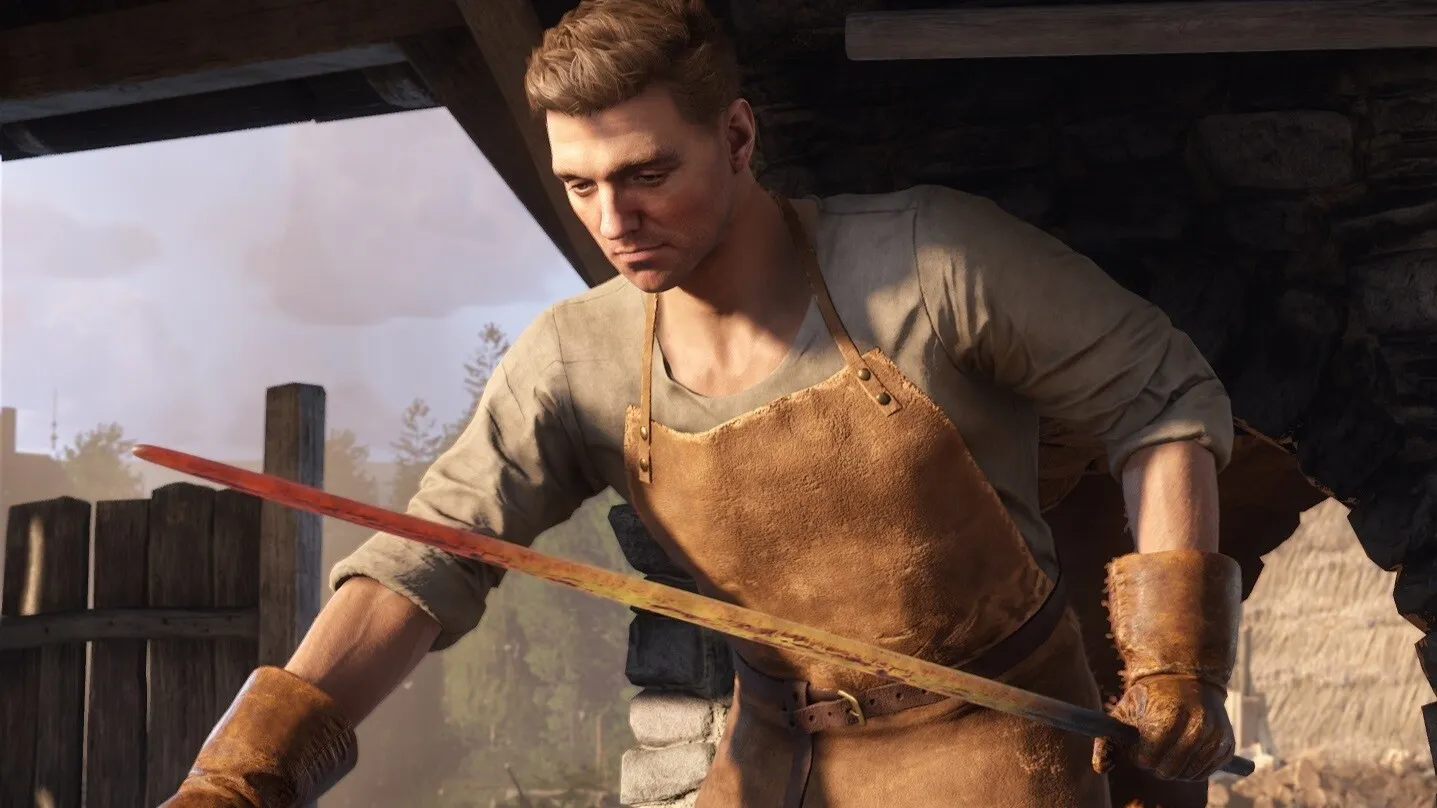
Because of these complex, interlocking systems, there are still bugs, of course. No way near the amount there were in the first game, but sometimes people won't be where the quest marker says they are, sometimes an NPC's voice changes mid-conversation, and people will get in your way all the time in doorways and on staircases (and some of those staircases don't work properly either, forcing you to jump over an imaginary massive step). I've had the camera cut to a wall mid-conversation, and the blacksmithing minigame broke for me when I reached the second map. The review code came in a month before launch so the developers have time to patch some of these issues up, but you will run into something – a game like this simply cannot be bug-free. How much you get out of it depends on how much you can forgive the little things and appreciate the sheer ambition.
...
Other RPGs can rely on fantasy to create any manner of scenario and they often still fall short of creating situations you've never seen before. Kingdom Come: Deliverance 2 is packed full of novel moments, all grounded within the confines of what could feasibly have happened in this period. You'll decide the fate of a local poacher and either see him hanged – where he'll remain, buzzed by flies for the rest of the game as a reminder of your choice – imprisoned, or freed. You'll solve disputes between a fishwife and a tanner. You'll help a traveling knight reclaim his seat. You'll infiltrate a council meeting as a waiter. It rarely feels like the game repeats itself, and very few missions simply ask you to go somewhere to fight some men – and even when they do, that's rarely your only option for resolution.
I was worried playing as a more experienced Henry wouldn't have the same appeal as the rags-to-nags story of the first game, but it's dealt with so elegantly here. Henry is injured and robbed, stranded in a new place, and you have to build up your reputation again. When you eventually do get it all back and the stakes go up, the missions only get better. One sees you creeping through an enemy castle during a nighttime storm, slipping a dagger into sentries' necks, and it perfectly builds up to a showdown with someone who players of the first game know has it coming. It's so great at building tension – something that's usually missing from a game so filled with distractions – letting you mentally prepare for the big stuff with pre-battle feasts, chats with your friends, and war meetings.
Between all of that, just exploring the landscape is enchanting. Sweeping, beautiful countryside rolls hill by hill in every direction, split into grids by natural hedgerows or manmade walls with the overgrown brickwork of an old country cottage. The dynamic orchestral soundtrack swells and deflates as you roam, going almost silent as night falls, bringing in organs when you near a church. Birds chirp from the trees, there's the trickle of a distant stream, and the church bells from the next town echo across the hills. Stepping through the thicket is like being transported to another world — light shafts penetrate the canopy as the vegetation encloses you into beautiful woodland. They feel different between each forest, too. The Apollonia Forest is treacherous at night, where any misstep could see you fall into some crack in the earth.

...
The city of Kuttenberg almost feels like a game in itself. Merchants and town criers shout out at you from every corner, while characters debate and fight as pickpockets roam the streets. By the end of the game, you'll know these muddy pathways, with their half-eaten veg scatterings, horse dung, and swill runoff from the nearest latrine. It's also where Warhorse hammers home its ruminations on class divides.
There's a rift in Kuttenberg between the local lords and the burghers, the upper-middle-class who the lords see as lesser. You see this conflict through the lens of Henry, the bastard of a lord who was raised as a commoner by a blacksmith father, but you also see it from other perspectives, with certain quests exploring what it meant to be a woman during this time, the struggles of the Jewish population, and even the disputes between the lords and the local Romani population passing through. The poor are constantly punished in this game for things that the rich simply shrug off, and it's a stark reminder of how some things never change. "I'm a nobleman so I'm not a thief," one bandit lord tells me. "I'm a robber baron."
It also explores the impact of war on all sides, though its attempt at straddling the center occasionally undermines its message. Several missions humanize the other side of a conflict, and there are some good points about how war makes monsters of us all and there's no such thing as the morally righteous, but there's a little too much "We're exactly the same, you and I" monologuing for my taste. Otherwise, the writers have done an excellent job of exploring some heavy themes with humanity and tact.

...
I spent almost 100 hours playing this sequel, completing almost every side quest and doing every main mission, and I could have easily spent 100 more. You can compare Kingdom Come Deliverance 2 to Skyrim but it's a superficial comparison. The fact is, there's nothing else quite like this, and I hope it does the same for the Czech game development scene as The Witcher 3 did for Poland.
View 0 Comments
Submit Correction
View Editorial & AI Guidelines