
Newsweek/Courtesy of Sundance Institute
By Marni Rose McFall
Reporter
0
Share
Newsweek is a Trust Project member
See more of our trusted coverage when you search.Prefer Newsweek on Googleto see more of our trusted coverage when you search.
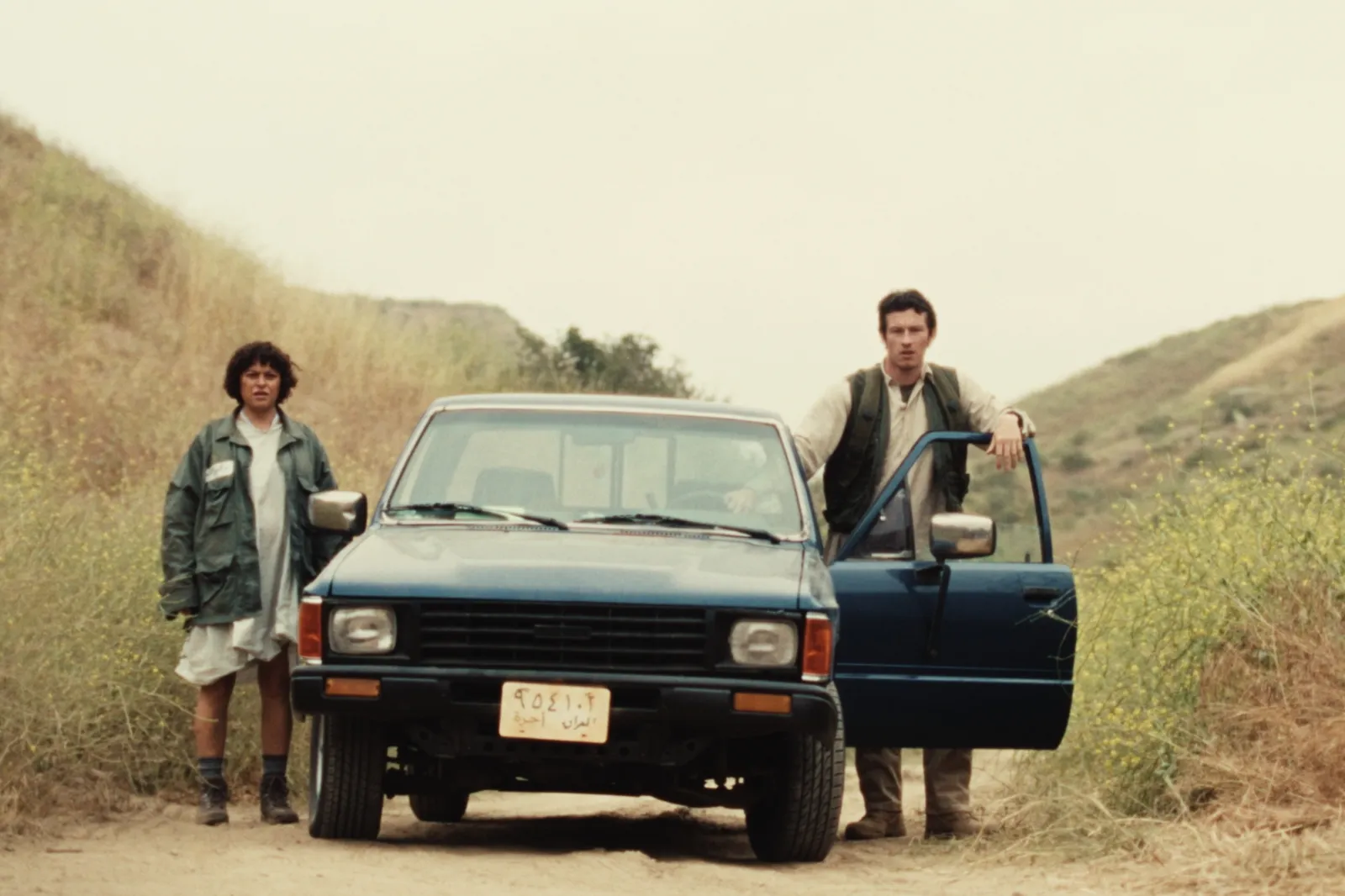
It’s the story of a real, fake place. That is, Hailey Gates' new movie, Atropia, a film based on military training camps in the American desert that simulated war zones in Iraq.
Written and directed by Gates in her feature-length debut and starring Alia Shawkat alongside Callum Turner, Zahra Alzubaidi, Tim Heidecker and Chloë Sevigny, Atropia follows an aspiring actress (Shawkat) working for a military role-playing facility.
In one swoop, Atropia satirizes the military, the media and Hollywood, and while the film has comedy at its core, there’s a pain and a poetry behind the absurdity. Atropia had its world premiere at the 2025 Sundance Film Festival in January of this year, where it won the Grand Jury Prize in the festival's U.S. dramatic competition.
Read More on Entertainment
Ahead of the film’s release, Newsweek sat down with Gates and Shawkat to speak about why they wanted to reexamine the Iraq War, the cultural fascination with Bush-era politics and why Hollywood is the perfect tool for mockery.
...
Reexamining the Iraq War
"Alia and I were both really frustrated still about the Iraq War and felt like it deserved some reexamining," Gates told Newsweek. She and Shawkat are both California natives, with her being from LA and Shawkat from Palm Springs.
Gates is an actor, director and journalist with a background in documentary making, and the Atropia project was originally approached as a documentary before evolving into an unreal satire. The film moves between English and Arabic, something Gates said was important as it is "a reality of the simulation."
The Iraq War lasted from 2003 to 2011, beginning with the invasion of Iraq by a U.S.-led coalition, which ultimately resulted in the overthrow of former Iraqi President Saddam Hussein's government. The invasion of Iraq was a part of former President George W. Bush's broader war on terror, which came in response to the 9/11 attacks.
"The war on terror really inflicted a lot of terror," Gates said. "I think there's a little bit of cultural amnesia about that time because we don't have a lot of art from that time that speaks to it."
"I wanted to figure out how to make a film about the forever wars," Gates said. "This movie is, of course, about Iraq," she said before referring to longstanding accusations against the Bush administration that they either skewed or manufactured evidence of Saddam Hussein's arsenal of weapons of mass destruction (WMD) in order to justify the 2003 invasion of the country.
Gates said that this "really set the stage for the world that we live in today. I think that sort of erosion of trust in our government and institutions is so prescient right now."
Atropia directly revisits and reexamines the Iraq War and Bush-era politics and comes amid a cultural revisiting of that time.
"I think for young people, there's a fascination with that time that seems to be almost a longing or an envy for that kind of naïveté," Gates said.
She said: "I think it feels like kids today feel that weight of knowing too much and they sort of look at that moment. I think, yeah, it was a kind of longing."
Shawkat, meanwhile, pointed to "a kind of nostalgia."
"We were children then…now we’re of a certain age where we’re smart enough to look back," she said. "History, it’s not repeating itself, it’s rhyming. It’s good to look back and understand what’s happening now."
The film grapples with the idea of the American military complex, nationalism and patriotism and is arriving at a moment of political turmoil the world over.
"I wrote the film in 2022, we shot it in 2023, and it came out in 2025," Gates said. "It was very much about revisiting the war on terror, but I think it would be naive for us to think America wouldn’t embroil itself in something that would make this film very relevant today."
The real, and the unreal
It’s not just the military that Atropia takes on, but Hollywood too.
"Hollywood is the perfect tool to mock things," Shawkat told Newsweek, adding that it "takes itself so seriously, and yet it’s so silly."
Shawkat plays the role of Fayruz in the film, a struggling Iraqi-American actor working on the simulation of a U.S. military base. This character and her ambition "is really a perfect metaphor," Shawkat said.
She said it's a "representation of the kind of fantasy that America lives in. Of truth. Our search for truth."
Like her character, Shawkat is also Iraqi–American. She has also spent her life in Hollywood, starring as Maeby Funke in the cult classic comedy Arrested Development before later taking on roles in Search Party and The Final Girls.
Of the similarities between herself and her character, Shawkat told Newsweek: "I don't know who else could have played this role."
"It’s so much my interior being this character. Her ambition, her urge to want to prove herself. A lot of actors never feel like they've gotten their shot," Shawkat said.
...
Atropia is filled with tension between the real and the unreal. Central to this is the depiction of pain in the film. On one hand, there is the performed pain of the actors in the military simulation. On the other hand, there is the knowledge of the very real conflict that was happening.
"I think that’s the beautiful poetry of this film," Shawkat said.
She said that people don’t believe the military simulation is real: "It’s almost like a too on the nose metaphor for life or for war."
That it is real, Shawkat said, is "even more of a mirror."
Pointing then to the younger generation, Shawkat said: "They’re taking in so much."
"You're scrolling, and you're seeing a child losing limbs and being starved to death," she said. "And then the next beat, you're seeing a pair of shoes that you wanted that you're going to buy. And then you see a celebrity wearing those shoes, and then you go back to seeing the child. It's this constant hit."
For Shawkat, Atropia gives "one step of separation to actually understand what's happening in a way to be able to talk about it."
"If we were really showing the real thing, it might be too hard to stomach," Shawkat said.
A Comedy That Curdles
The film itself was shot in only 19 days.
"I would love to have had more days," Shawkat said, speaking about the process, while Gates said that coming from a documentary background, "I didn’t know to be afraid of that number."
"I’m often in situations where I don’t know what story I’m following," Gates said.
"Low-budget movies are hard, but also exciting," Shawkat said. "For me, it’s kind of my favorite way of filmmaking."
She added that a little more money "would have been nice," but creatively, a lack of funds can be beneficial.
"You can get really lazy on bigger projects," she said. "We were all doing it for the love of the game. To make this thing."
"As an actor, comedy is my way into things," Shawkat told Newsweek. "I think if there's not a lot of humor in something I have a really hard time accessing it, it's kind of how I feel I express myself the best. Because humor does come from pain just in a classical sense."
Shawkat said the film is not telling you historically what happened or telling people right from wrong, in a way, she says, a lot of war films and television shows do.
"They take sides," she said. "And usually they're created by people who have no understanding of how war affects real families."
Shawkat’s father, Tony Shawkat, has a role in the film.
"I think he was also really touched by it," she said. "As someone who was born and raised there and also saw his country be bombed several times over."
But Shawkat emphasized that the film is "not cynical."
"At the end, we are talking about, you know, life, the life that Fayruz is carrying, and what happens to her," she said.
"I have a lot of tenderness for everyone at the mercy of this exercise," Gates said. "I didn’t want to be too damning towards anybody.
"Humor is really important. "This world is so ghoulish that it really feels like the only way to approach it.
"I wanted to really dive into the absurdity of the world and then, you know, as the film develops, I think that comedy kind of curdles and, you know, my hope is that you leave thinking about what you were laughing at."
Atropia will be released by Vertical on December 12.
Update 12/11/25, 10:15 a.m. ET: This article was updated at Gates' request to change an instance where Alia Shawkat was referred to as Allie.
View 0 Comments
Submit Correction
View Editorial & AI Guidelines