...

By Melissa Fleur Afshar
Reporter
0
Share
Newsweek is a Trust Project member
See more of our trusted coverage when you search.Prefer Newsweek on Googleto see more of our trusted coverage when you search.
The U.S. government’s new dietary guidelines, released this week, are under scrutiny after it emerged that some of the experts behind the recommendations have financial ties to the beef and dairy industries.
The Departments of Health and Human Services and Agriculture published the "Dietary Guidelines for Americans, 2025-2030" on January 7. Health Secretary, Robert F. Kennedy, Jr., signed off the update with Brooke L. Rollins, secretary of the U.S. Department of Agriculture. The new guidelines call for a return to "whole, nutrient-dense foods" and warn that chronic disease linked to poor diet is driving nearly 90 percent of U.S. health care spending.
Newsweekspoke with a U.S. Department of Health and Human Services spokesperson. They did not comment on how some of the experts consulted align with different food companies but did say that the "nutrition scientists and subject matter experts" involved were selected through a federal contracting process based on demonstrated expertise.
Read More on Health
The spokesperson clarified that the experts' views were thoroughly reviewed through an external peer review process coordinated by The National Institutes of Health (NIH) Office of Nutrition Research. Reviewers were selected on experience and absence of "conflicts of interest," while review authors are said to have addressed all peer-review comments, revising their analyses accordingly.
"All experts publicly disclosed any nutrition related private interests, including those that could present an appearance or potential for private interests," the spokesperson said. "Prior to initiating the evidence review, a methodology expert established standardized protocols governing study inclusion and exclusion criteria, assessment of study quality and risk of bias, approaches to evidence synthesis, and criteria for grading the strength of evidence.
"These protocols were designed to ensure that conclusions were driven by the evidence itself rather than by predetermined interpretive frameworks. Expert reviewers conducted rapid systematic reviews, umbrella reviews, and comprehensive literature syntheses. Evidence was evaluated based solely on scientific rigor; study design, consistency of findings, and biological plausibility, and all reviews underwent internal quality checks to ensure accuracy, coherence and methodological consistency."
White House spokesperson Kush Desa said: "Making America Healthy Again is a top priority for President Trump, who has entrusted Secretary Robert F. Kennedy, Jr., a lifelong health champion and advocate, to deliver on this core campaign pledge.
"The only special interest guiding MAHA policymaking is the health and well-being of the American people, and near-universal praise from physicians, researchers, influencers, and medical groups is indicative of how the Trump administration’s new Dietary Guidelines for Americans are scientifically unimpeachable."
Scrutiny poured in after readers spotted a page in the accompanying document, "The Scientific Foundation for the Dietary Guidelines for Americans, 2025-2030," that discloses the nutrition-related private interests of the key experts involved. While the health benefits of whole foods, particularly non-processed, organic dairy products, fish and meats are well known, concerns that the members of the new guidelines may be more guided by personal connection than fact.
Review authors from a variety of academic institutions and hospitals were shown to have affiliations with several dairy and meat groups, including Global Dairy Platform, Danone's subsidiary Nutricia, National Cattlemen's Beef Association, Texas Beef Council, American Dairy Science Association, Seafood Nutrition Partnership National Dairy Council and National Pork Board.
The guidelines emphasize more protein and less sugar and ultra-processed foods, while leaving long-standing advice on saturated fat unchanged.
"To Make America Healthy Again, we must return to the basics. American households must prioritize diets built on whole, nutrient-dense foods—protein, dairy, vegetables, fruits, healthy fats, and whole grains," the document states. "Paired with a dramatic reduction in highly processed foods laden with refined carbohydrates, added sugars, excess sodium, unhealthy fats, and chemical additives, this approach can change the health trajectory for so many Americans."
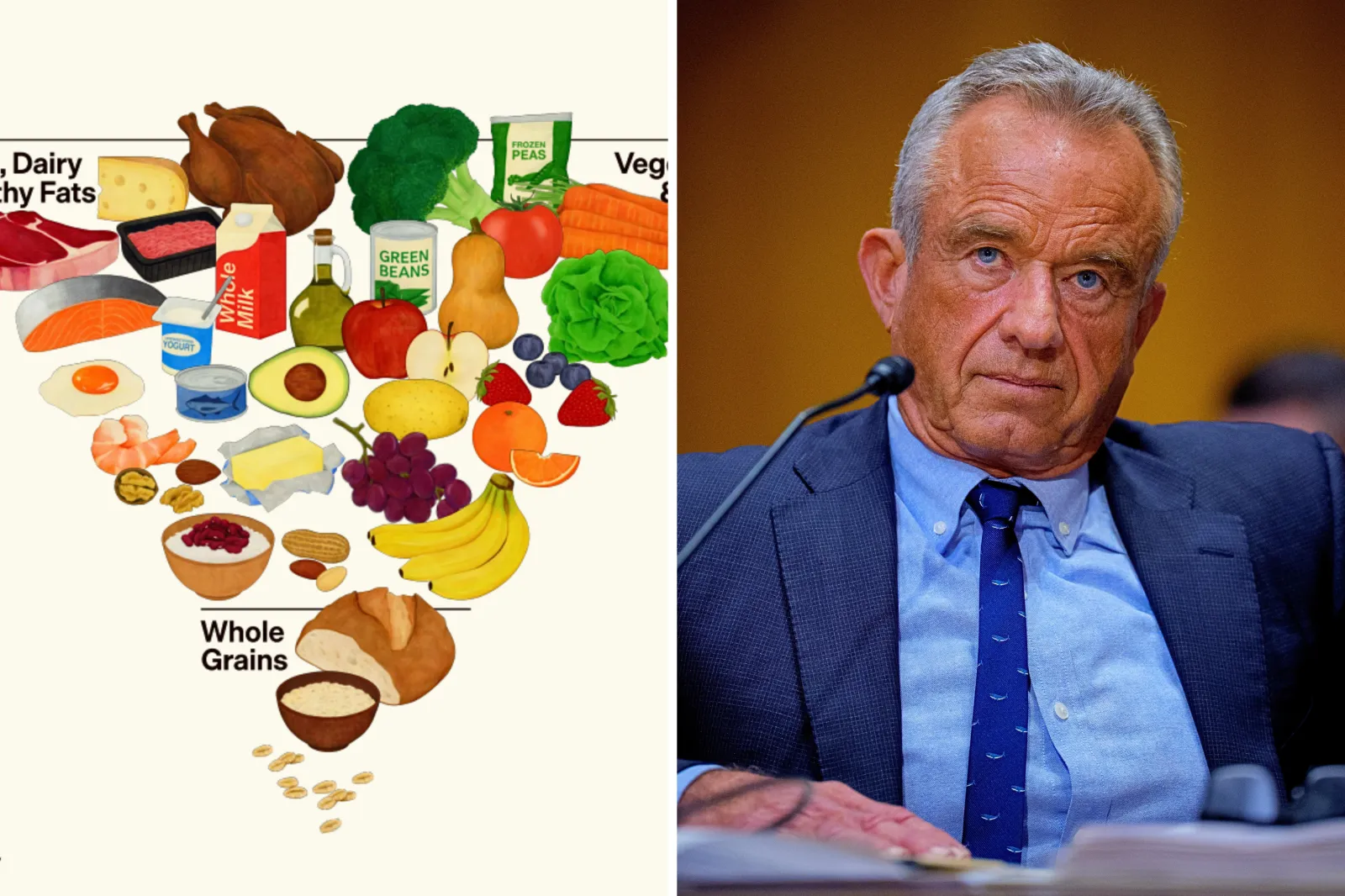
The new food pyramid places proteins—including red meats, chicken, fish, eggs, and dairy products such as whole milk, yogurt, and cheese—at the top, alongside vegetables, fruits, and healthy fats like olive oil and avocados. Seeds and whole grains form the base.
Kennedy framed the changes as a response to what he called a "health emergency," citing data that more than 70 percent of American adults are overweight or obese.
...
"The United States is amid a health emergency," the guidelines note. "Many of these illnesses are not genetic destiny; they are the predictable result of the Standard American Diet—a diet which, over time, has become reliant on highly processed foods and coupled with a sedentary lifestyle."
While the slamming of ultra-processed foods and lack of exercise has been supported, the makeup of the advisory panel has raised some concern with worry that the guidelines may not be unbiased and accurate, but the department spokesperson rebutted these claims.
"The National Institutes of Health (NIH) Office of Nutrition Research coordinated an external peer review process, assigning two independent reviewers to each scientific review," the spokesperson said. "Reviewers were selected based on relevant experience and absence of conflicts of interest."
The Dietary Guidelines for Americans are updated every five years and serve as the basis for federal nutrition programs, school meal standards, and public health messaging. With chronic disease rates climbing and diet-related illnesses costing billions annually, the stakes for these recommendations remain high.
The news cycle is loud. Algorithms push us to extremes. In the middle—where facts, ideas and progress live—there's a void. At Newsweek, we fill it with fearless, fair and fiercely independent journalism.
Common ground isn't just possible—it's essential. Our readers reflect America's diversity, united by a desire for thoughtful, unbiased news. Independent ratings confirm our approach: NewsGuard gives us 100/100 for reliability, and AllSides places us firmly in the political center.
In a polarized era, the center is dismissed as bland. Ours is different: The Courageous Center—it's not "both sides," it's sharp, challenging and alive with ideas. We follow facts, not factions. If that sounds like the kind of journalism you want to see thrive, we need you.
When you become a Newsweek Member, you support a mission to keep the center strong and vibrant. Members enjoy:
Help keep the center courageous. Join today.


View 0 Comments
Submit Correction
View Editorial & AI Guidelines