10
Loading video...

By Nick Mordowanec
Staff Writer
0
Share
Newsweek is a Trust Project member
See more of our trusted coverage when you search.Prefer Newsweek on Googleto see more of our trusted coverage when you search.
The most complete fossil of a gigantic sea monster that lived some 150 million years ago was discovered last year during a random beach stroll but was just recently revealed to the public.
A skull belonging to a pliosaur, an ocean-dwelling carnivorous marine reptile from centuries ago, was discovered by a fossil enthusiast in April 2022 who was walking on the beach on the Jurassic Coast—a World Heritage Site on the English Channel coast of southern England that stretches about 96 miles from Exmouth in East Devon, to Studland Bay in Dorset.
The skull of the pliosaur that was found is about six-and-a-half-feet long and is described by paleontologists as one of the most complete specimens of its type ever discovered. The discovery was initially reported by the BBC on Sunday and will be featured in an upcoming documentary starring famed British historian and biologist David Attenborough called, Attenborough and Jurassic Sea Monster in the U.S. It will air on PBS on Wednesday, February 14.
Read More
This Climate Solution Rocks: Crushed Stone Helps Farmers Capture Carbon5 min read

Scientist Invents Potato That Could Warn Us About Nuclear Leaks6 min read

Extinct Sea Creature Fossils Help Solve Ancient Geography Puzzle5 min read

Steve Etches, a local paleontologist who began collecting fossils from the Kimmeridge Clay more than 40 years ago and operates the Etches Collection Museum of Jurassic Marine Life in the village of Kimmeridge in Dorset, described the finding to the BBC as "an underwater T-Rex [Tyrannosaurus Rex]."
...
"It's one of the best fossils I've ever worked on," Etches said. "What makes it unique is it's complete.
"The lower jaw and the upper skull are meshed together, as they would be in life. Worldwide, there's hardly any specimens ever found to that level of detail. And if they are, a lot of the bits are missing, whereas this—although it's slightly distorted, it's got every bone present."
Pliosaurs lived between 220 and 70 million years ago, and they were not dinosaurs even though they shared similar characteristics.
Etches' friend, Phil Jacobs, was the individual who first saw the tip of the fossil snout jutting out of a cliff shingle near Kimmeridge Bay on the Jurassic Coast. He garnered Etches' help due to the size of the fossil, and the pair made a makeshift stretcher to safely transport the finding.
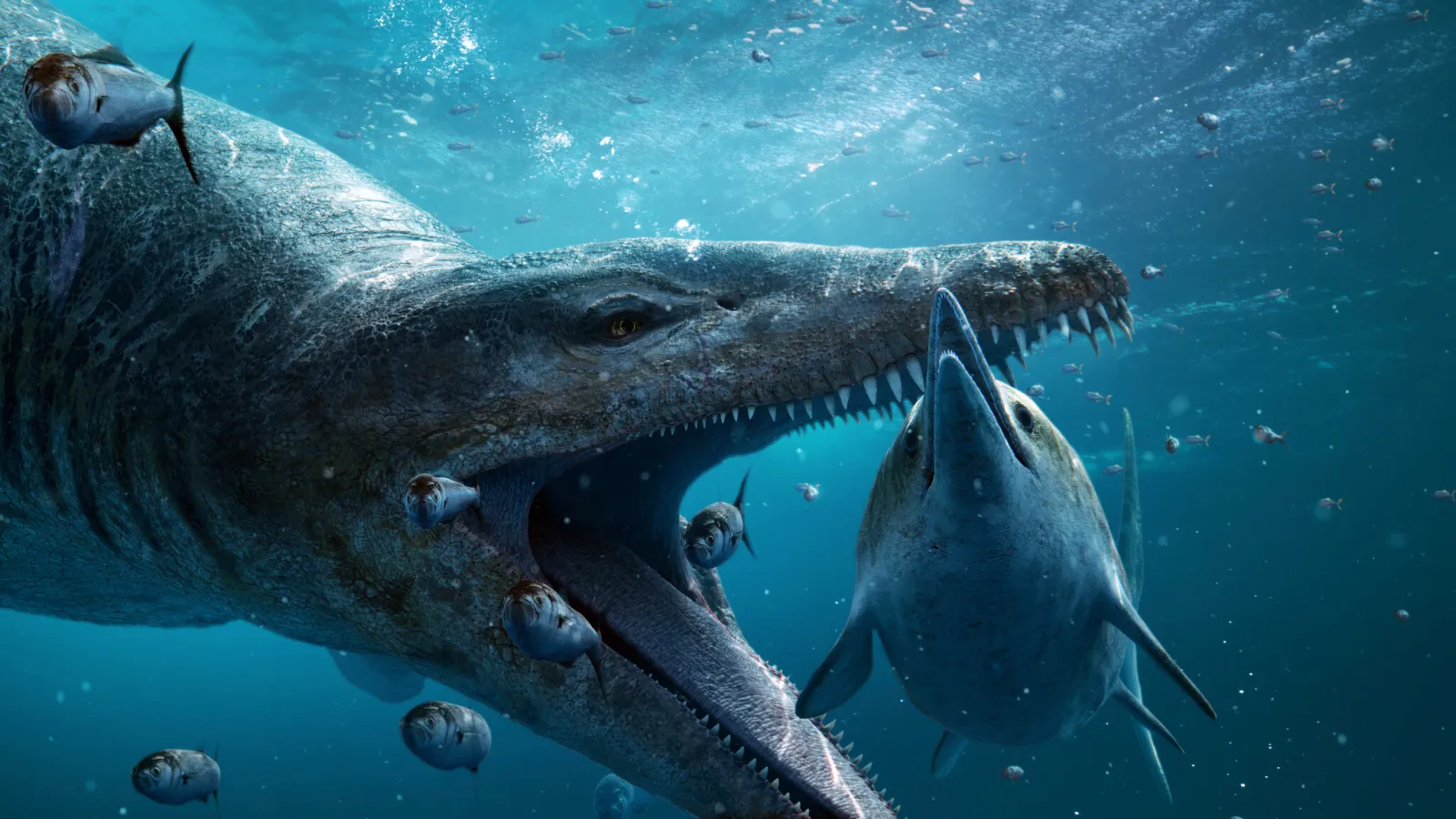
The skull is massive and longer than most humans are tall. It is accentuated by 130 teeth, so razor sharp that they could kill with a single bite. The back of each tooth contains fine ridges said to have helped the pliosaur tear into flesh, able to release its "dagger-like fangs" for a swift second attack if necessary.

...
Etches told Newsweek in a Zoom interview on Monday that the skull was found by Jacobs in April 2022 and the cleanup concluded in August of the same year. From that time until now, Etches and others have prepped and cleaned the fossil as part of its documentation in the upcoming BBC documentary.
Jacobs couldn't carry the skull as part of a two-and-a-half-hour walk back home, so he recruited Etches and a couple of others to help. The skull was hidden along the coastline and marked with a piece of wood.
They came with the strapped stretcher and carried the fossil about one-and-a-half miles over a rocky shore, which Etches described as "quite a formidable job."
"It took a long time," he said. "And then in the next couple of days, we went down with a drone to scan the cliff, looking through to see where [the rest of the pliosaur was] located and what we thought it was, where it came from."
The experience has been "groundbreaking," Etches said, noting that many academics have inquired about working on the project and dissecting its features. What is known now is different than what was known before, he said.
One major feature is its large sagittal crest, a ridge of bone at the rear of the skull that may indicate dimorphism, or differentiate between the male and female sexes. The crest also features a light-sensitive "third eye" that stretches from the skull's back to about one-third forward towards the snout.
Stephen Brusatte, a professor of paleontology and evolution at the University of Edinburgh, told Newsweek that this "is a fantastic new discovery and surely one of the most evocative British fossil reptiles discovered in years."
He said the skull's length and sharp teeth indicate a "mean predator" in seas of yonder.
"The skull is so gorgeously preserved that I am in awe," Brusatte said. "This is one of those discoveries that all fossil hunters dream about. And to think that it was collected from the middle of a cliff face, by paleontologists hanging from ropes, hanging over the choppy waves of the sea as they dug. It's a remarkable story and an amazing fossil. And it's yet another major find by Steve Etches, one of Britain's greatest fossil collectors."
Etches is a plumber by trade and self-taught in the field of paleontology.

...
Paul Sereno, a professor of paleontology at the University of Chicago, told Newsweek that the pliosaur is a reptile cousin to the dinosaurs, namely a closer cousin to the small skulled wing-armed plesiosaurs it may have dined on.
And like the dinosaurs, it was doomed to extinction.
"It's a fabulous find, a fortuitous fossil, a freak of nature.... Fortuitous to be discovered because had it not been for the persistence and intuition of a local fossil enthusiast to connect the fallen snout tip to a hidden skull many meters above entombed in the cliff, the monster skull would have weathered out in pieces over the next centuries and washed out to sea," Sereno said.
This creature was so big and strong that it could dine on anything slow enough to enter its massive jaws studded with piercing teeth, he added, probably including rare water-bathing dinosaurs.
"It's got a lot of features that we haven't seen on many other pliosaurs," Etches said. "Its completeness is the really significant thing, knowing that the rest of it is still up in the cliff to be extracted."
Many large pliosaur skulls are incomplete or feature significant distortion, according to Ohio University paleontology research associate D.J. Morgan, so finding a skull of this size that still preserves some of the three-dimensionality of the animal's skull during life is incredible.
"From an anatomical/physiological perspective, the Dorset pliosaur skull could hold a treasure trove of information," Morgan told Newsweek. "This includes information about the thermal physiology of these animals, how they obtained food and adaptations that allowed these large organisms to flourish in a pelagic environment.
"The biological information that this specimen could provide will help advance our understanding of pliosaur anatomy/physiology and ecology. This fossil highlights the importance for us to keep searching for fossils."
A drone survey of the cliff showed that the rest of the pliosaur is believed to be in the same cliff, but it requires rigorous excavation involving ropes and manpower and a lot of resources.
Etches called it a "costly" endeavor of major exploration, involving permission from government bodies. But the attention this discovery has already attracted, coupled with the upcoming BBC documentary, may push the scientific limits in this instance.
"We're gonna have a worldwide appeal to interested parties for science," he said. "It is to the benefit of science to extract that, give us a tremendous amount of new information that we previously didn't know."
Etches added: "When David Attenborough is involved, everyone's interested. That name is synonymous with worldwide interest because of his fame, so getting him on board is a big feather in our cap. And as you can see, at the moment it's gone worldwide, it's gone viral. So, his name has caused that. Otherwise, it would probably get less attention."
Dorset and East Devon Coast have cliff exposures that span the Mesozoic Era, approximately 185 million years of the earth's history, according to UNESCO, which administers World Heritage Sites. The area's fossil sites and geomorphologic features have reportedly contributed to over 300 years of scientific studies.
Update 12/12/23, 8:18 a.m. ET: This story was updated with comments from Steve Etches and other experts.
View 0 Comments
Submit Correction
View Editorial & AI Guidelines