...

By Giulia Carbonaro
Senior Reporter
0
Share
Newsweek is a Trust Project member
See more of our trusted coverage when you search.Prefer Newsweek on Googleto see more of our trusted coverage when you search.
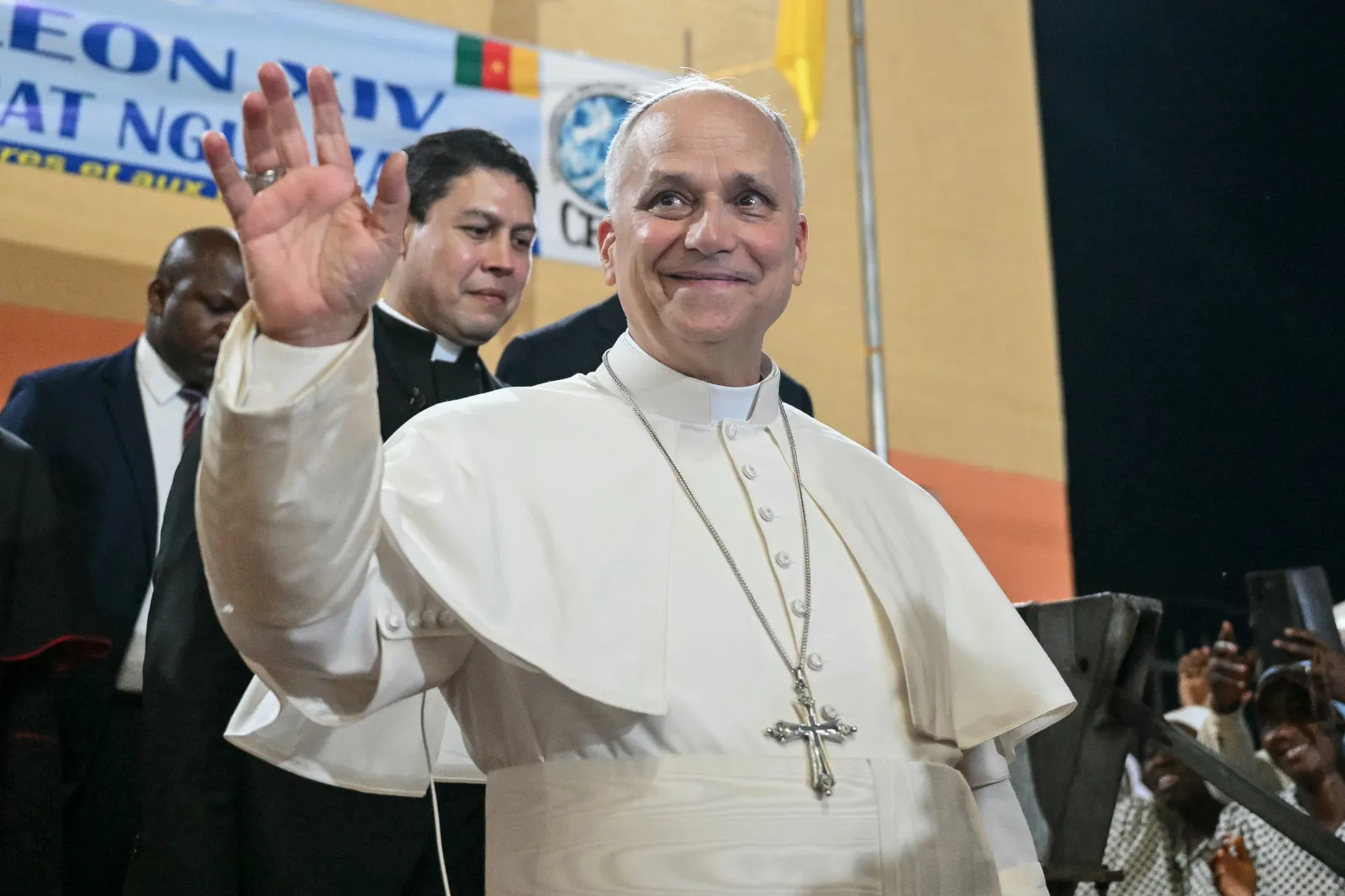
President Donald Trump defended his recent criticism of Pope Leo XIV on Thursday, saying he has a “right to disagree” with the pontiff over whether Iran should be allowed to have a nuclear weapon.
“The pope made a statement. He says Iran can have a nuclear weapon,” Trump falsely claimed while speaking to reporters on the South Lawn of the White House, before departing to board Marine One. “I say Iran cannot have a nuclear weapon.”
Pope Leo, however, never made a statement in support of Iran developing or owning a nuclear weapon.
Read More on News
Trump’s (Very) Public Rift With the Pope
A deepening rift between the White House and the Vatican made headlines over the past week, starting from reports of a tense meeting at the Pentagon in January and culminating in a social media tirade where Trump called Pope Leo “weak” on crime and “terrible” for foreign policy, urging him to “get his act together as pope.”
The attacks against the pontiff have followed repeated criticism of the Iran war by Leo, who earlier this month decried the “delusion of omnipotence” which has led to “absurd and inhuman violence” spreading “ferociously through the sacred places of the Christian East.”
In a rare response to Trump’s attack against him, the first American-born pope told reporters on Monday that he had “no fear” of the Trump administration and would have continued speaking against the war in the Middle East and all conflicts.
What Did Trump Claim?
Addressing the ongoing feud between the U.S. president and the pope, CNN anchor Kaitlan Collins asked Trump on Thursday why he was fighting with Leo.
“I have nothing against the pope,” Trump said, adding: “I have to do what’s right.” He then referred to the “42,000 people that were killed over the last two or three months, protesters with no weapons, no nothing—so I can disagree with the pope.”
Estimates of how many protesters were killed by the Iranian regime since January, when the country was stormed by nationwide demonstrations, vary. While still to be considered in the thousands, they are usually lower than the '42,000' mentioned by Trump in an earlier Truth Social post, while urging Leo to speak about the context of the war.
...
Shortly after launching the strikes on Iran, Trump had threatened to attack Iran in support of those in the country protesting against the regime. After the killing Iran’s Supreme Leader Ali Khamenei in the U.S.-Israeli strikes on February 28, the U.S. president urged Iranians to take the chance to “take back your country,” vowing the U.S. will “be there to help.”
Since then, the Trump administration has stated different goals for the war, including destroying Iran’s ballistic missiles, annihilating their navy, and preventing the country from ever obtaining a nuclear weapon.
On Thursday, Trump claimed that the pope had publicly supported Iran having a nuclear weapon.
Has Pope Leo Supported Iran Having A Nuclear Weapon?
Footage of the interview with reporters shows that Trump was immediately contradicted by Collins after stating the pope had supported Iran having a nuclear weapon.
The pontiff has not made any statement saying Iran should have a nuclear weapon. He has called for an end to the war in Iran—which is not conditional to the U.S. destroying Iran’s capability to build a nuclear weapon. That does not mean, however, that he supports the country having a nuclear weapon.
Pope Leo has repeatedly spoken against nuclear weapons. In June 2025, when Israel appeared on the verge of attacking Iran, he said: “The situation in Iran and Israel has deteriorated gravely, and in such a delicate moment, I would like to renew strongly an appeal to responsibility and reason. The commitment to creating a safer world, free from the nuclear threat, should be pursued through respectful encounter and sincere dialogue, to build a lasting peace, based on justice, fraternity and the common good.”
On the occasion of the 80th anniversary of the U.S. nuclear bombings of Hiroshima and Nagasaki in Japan last July, the pope said: “Though many years have passed, the two cities remain living reminders of the profound horrors wrought by nuclear weapons.”
He added: “Indeed, true peace demands the courageous laying down of weapons – especially those with the power to cause an indescribable catastrophe. Nuclear arms offend our shared humanity and also betray the dignity of creation, whose harmony we are called to safeguard.”
In February, the pope called on Russian and U.S. leaders not to let the New START treaty signed in 2010, aimed at containing the proliferation of nuclear weapons, lapse.
“I urgently call for this instrument not to be abandoned without seeking to ensure its concrete and effective follow-up,” he said.
“The current situation requires that everything possible be done to avert a new arms race that would further threaten peace among nations. It is more urgent than ever to substitute the logic of fear and distrust with a shared ethos capable of guiding choices towards the common good and to make peace a treasure to be cherished by all.”
And in March, the pontiff posted on X an invitation to pray “that nations move toward effective disarmament, particularly nuclear disarmament, and that world leaders choose the path of dialogue and diplomacy instead of violence.”
View 0 Comments
Submit Correction
View Editorial & AI Guidelines