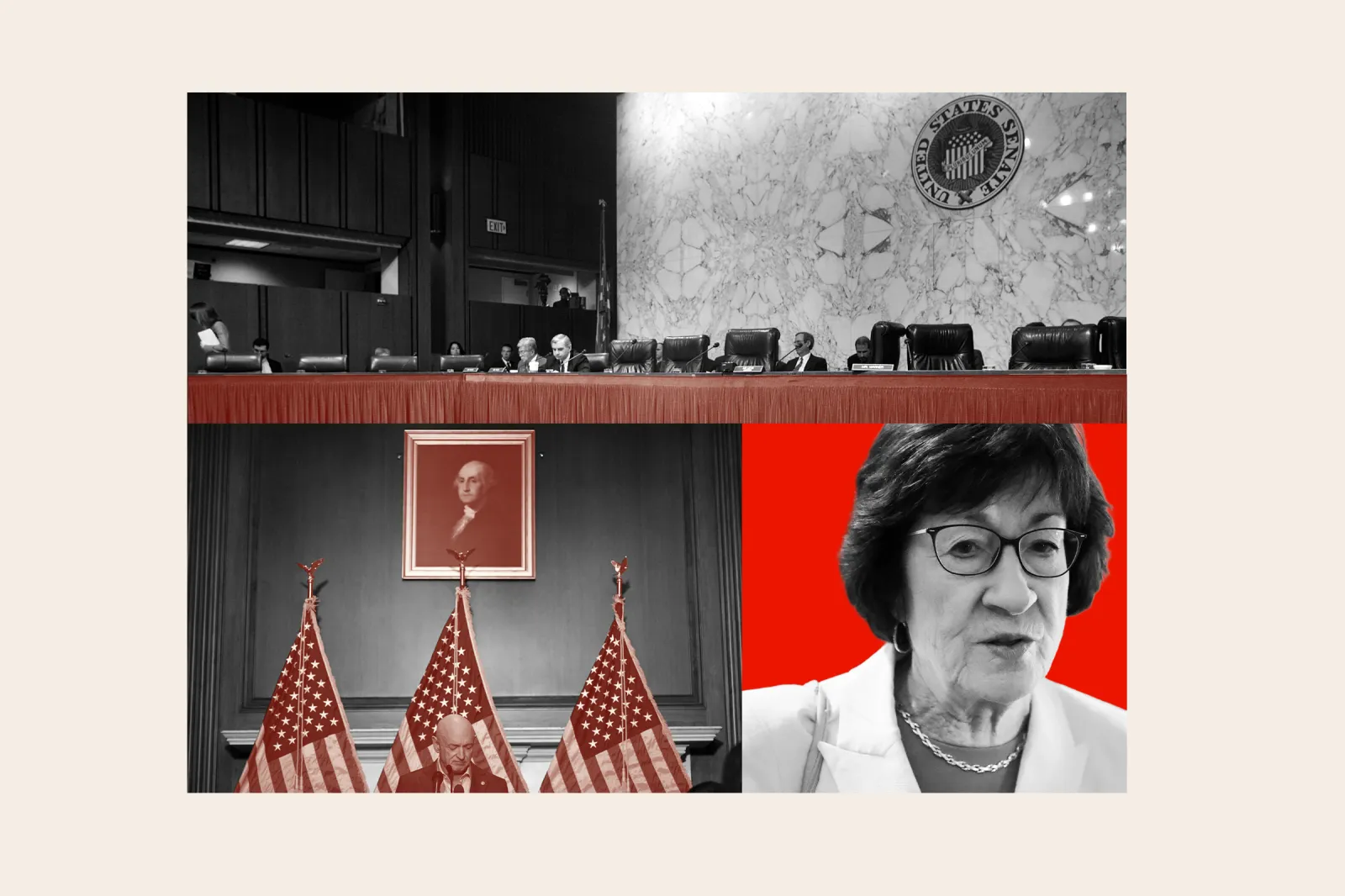
Photo-illustration by Newsweek/Getty

By Andrew Stanton
Reporter
0
Share
Newsweek is a Trust Project member
See more of our trusted coverage when you search.Prefer Newsweek on Googleto see more of our trusted coverage when you search.
Democrats are hoping to overcome a challenging map and win control of the Senate in November as polls suggest several races in states won by President Donald Trump could become competitive.
In a statement to Newsweek, NRSC Regional Press Secretary Nick Puglia expressed confidence in Republicans’ chances, saying that Democrats are “the most unpopular they’ve ever been.”
Why It Matters
Roughly one-third of Senate seats are up for re-election in November. Democrats are optimistic about their chances of winning control of the House—but their math in the Senate is tougher. Republicans hold 53 seats, and Democrats hold 47 seats, so they must pick up four seats to win a majority. They will have to win more conservative states to win a majority.
Read More on News
What to Know
The seats held by GOP Senator Susan Collins in Maine, a state Trump has lost in each of his three runs, and retiring Senator Thom Tillis in North Carolina, which Trump won by only about 3 points last November, are viewed as Democrats’ best pickup opportunities.
But no other Republicans representing single-digit Trump or states won by former Vice President Kamala Harris are up for reelection. This means Democrats must win more solidly conservative territory to win a majority.
Democrats are also defending two seats in states won by Trump—the seats in Georgia held by Senator Jon Ossoff and Michigan by retiring Senator Gary Peters.
Photo-illustration by Newsweek/Getty
Stephen Farnsworth, political science professor at the University of Mary Washington, told Newsweek the Senate “seems more likely to remain in Republican hands than not.”
“Democrats have good pickup opportunities in NC and ME—and perhaps an outside chance in Ohio. Even so, a very good election night for Democrats in the upper chamber would only bring the Senate to 50-50, with a Republican VP serving as the tie-breaker,” he said.
Trump’s messaging on the economy will be a key question for Republicans.
“Voters will not be distracted from poor economic performance. Republicans need voters to feel better about their financial situation - and soon—if they hope to retain control of the House,” he said.
The Cook Political Report lists five Republican-held seats as potentially being competitive. Maine and North Carolina are viewed as toss-ups, Ohio is viewed as Leans Republican, and Iowa and Texas are both viewed as Likely Republican.
Here is a look at the GOP-held seats considered the most competitive ahead of the midterms.
Maine
In Maine, Collins has won in tough environments before—most recently in 2020, when she won despite former President Joe Biden carrying the state by 9 points. But 2026 may prove to be her toughest race yet. Despite the nation drifting 6 points rightward in 2024, Maine barely budged, backing Harris by 7 points.
It’s not clear who she will face in the general election, as Democrats in Maine are set to decide a competitive primary between Governor Janet Mills and Graham Platner.
Mills has won by large margins in her elections, so many Democrats view her as the strongest candidate to defeat Collins. But more progressive Democrats believe Platner may have a more inspiring message and represent a new generation of leadership. He has faced backlash for old social media posts, but it’s not clear how that has reshaped the campaign.
The most recent poll of the race shows a close election. The Pan Atlantic Research poll of 820 likely voters from November 29-December 7, 2025, showed Collins and Mills in a tie (43 percent each), while Platner led Collins by a single point (43 percent to 42 percent).
A poll from the Maine People’s Research Center gave Collins an advantage over Mills (46 percent to 42 percent), but Platner a lead over Collins in the hypothetical matchup (45 percent to 41 percent). It surveyed 783 likely voters from October 26-29, 2025, and had a margin of error of plus or minus 3.5 percentage points.
North Carolina
North Carolina represents Democrats’ other prime target. It gave Trump a 3-point victory last November and remains one of the most evenly divided battlegrounds across the country.
Democrats haven’t won a Senate race in the Tar Heel State since 2008, but the party believes its candidate, former Governor Roy Cooper, may be poised to change that next year. Republicans have coalesced around Michael Whatley, the former Republican National Committee chair who has received support from Trump.
Early polling gives Cooper an advantage.
A Harper Polling survey showed Cooper up 8 points over Whatley (47 percent to 39 percent). It surveyed 600 likely voters from November 9-10, 2025, and had a margin of error of plus or minus 4 percentage points. Meanwhile, a Change Research survey from September showed Cooper with a 7-point lead (48 percent to 41 percent). It surveyed 855 likely voters from September 2-8, 2025, and had a margin of error of plus or minus 3.6 percentage points.
Ohio
Ohio, once a premier battleground state, has steadily become more Republican over the past decade, backing Trump in each of his presidential races. But Democrats view the race to finish out Vice President JD Vance’s full term as potentially being competitive.
Senator Jon Husted, appointed to the seat after Trump and Vance’s victory last November, is viewed as the likely Republican nominee. Former Senator Sherrod Brown, who lost reelection last November, is seen as the frontrunner on the Democratic side. Ohio backed Trump by about 11 points last November.
The most recent polls point to a close race.
An Emerson College poll of 850 registered voters from December 6-8, 2025, showed Husted up three points (49 percent to 46 percent), but a Bowling Green State University survey of 800 registered voters from October 2-14, 2025, had Brown up by a single point (49 percent to 48 percent).
Texas
Democrats have been eyeing Texas as an emerging swing state for years—but that dream hasn’t come to fruition. They are hoping the 2026 midterms could be another opportunity to make inroads with the largest red state in the nation.
How competitive the race could become may depend on the primary.
On the Republican side, Senator John Cornyn is facing a challenge from Attorney General Ken Paxton and Representative Wesley Hunt. Cornyn is viewed as a stronger incumbent, and polls suggest he would be in a stronger position than his rivals.
The Democratic primary pits Representative Jasmine Crockett against state legislator James Talarico. So far, polling gives Crockett, who has risen to national prominence, an advantage.
A University of Houston/Texas Southern University poll from earlier in the fall showed Cornyn with a 6-point lead over Crockett (50 percent to 44 percent) and a three-point lead over Talarico (48 percent to 45 percent). Paxton led Crockett by 2 points (49 percent to 47 percent) and Talarico by 3 points (49 percent to 46 percent).
Meanwhile, Hunt led Crockett by five points (50 percent to 45 percent) and Talarico by 6 points (50 percent to 44 percent). The poll surveyed 1,650 registered voters from September 19 to October 1, 2025.
Iowa
Democrats are also hoping to make the Iowa Senate competitive, vacated by GOP Senator Joni Ernst. Like Ohio, it has shifted away from Democrats during the Trump era, backing him by 13 points last November.
Republican candidates include Representative Ashley Hinson and former state Senator Jim Carlin; Hinson has been endorsed by Trump. Democratic candidates include state Senator Zach Wahls, state Representative Josh Turek and KNIA market director Nathan Sage.
There have been no polls on the race since Ernst said she wasn’t running.
What People Are Saying
NRSC Regional Press Secretary Nick Puglia told Newsweek: “Democrats are the most unpopular they’ve ever been with the American people. Radical leftists like Jon Ossoff, Janet Mills and Roy Cooper think the answer is more progressive policies like men in women’s sports and higher taxes. Good luck with that.”
Democratic Senatorial Campaign Committee spokesperson Maeve Coyle wrote in an October statement: “This week, as open enrollment begins, millions of Americans across the country are receiving notices that their health care premiums have skyrocketed – in many cases doubling or more – because Senate Republicans continue refusing to address the health care crisis that they created. These health care price hikes will hurt working families and will be an electoral albatross for every Republican Senator and candidate who created this crisis, and voters will hold them accountable in 2026.”
What Happens Next
Candidates will spend the coming months making their cases to voters in hopes of winning a majority of support in key races. Issues like Trump’s approval rating and the economy are likely to loom over the midterms.
View 0 Comments
Submit Correction
View Editorial & AI Guidelines