
...

By David Averre
0
Share
Newsweek is a Trust Project member
See more of our trusted coverage when you search.Prefer Newsweek on Googleto see more of our trusted coverage when you search.
Cast your mind back to the early days of the Ukraine war, and you may remember a certain drone that took the world by storm.
The Bayraktar TB2, a long-range unmanned aerial system manufactured in Turkey, was among Ukraine’s most powerful weapons in the first months of resistance against the Russian invasion. It quickly became a symbol of modern warfare, soaring over enemy lines and raining down strikes on Russian convoys.
But by mid-2023, this once-formidable UAV was rarely seen or heard of. The innovation war was in full swing, and Russia’s improved air defenses and electronic warfare, coupled with the proliferation of smaller, cheaper FPV drones, had largely pushed the TB2 out of front-line strike operations.
Read More on Analysis

...
Until now. Its manufacturer, Baykar, has reconfigured the Bayraktar from a long-range surveillance and strike aircraft into a drone mother ship capable of carrying 16 one-way UAVs and serving as their communications relay. In doing so, the Turkish drone maker has gotten right to the heart of one of the biggest challenges confronting military planners today.
The technology of modern warfare is evolving so quickly that traditional models of military procurement simply can’t keep up. Governments can’t risk going to war with outdated equipment, but neither can they afford to pour billions into developing and purchasing weapons systems that might be useless in a matter of years or even months.
The Obsolescence Trap
The Pentagon is currently working its way through an eye-watering shopping list. More than $2.4 trillion is earmarked for developing and acquiring its costliest weapons programs, which now take more than 12 years on average from the start of a program to delivering equipment the military can actually use, according to a recent Government Accountability Office analysis.
For exquisite, highly complex systems like advanced aircraft, warships and missile systems, lengthy development cycles are nothing new. But in a modern combat theater where offensive and defensive systems evolve at a frenetic pace, 12 years might as well be an eternity.
Former Ukrainian Prime Minister Oleksiy Honcharuk, now chairman and co-founder of defense technology company UFORCE, knows this better than most.
"The main value in Ukraine is not some specific drone," he recently told Newsweek. "Every three, six months, it’s already outdated. It doesn’t make sense to try to copy something. What’s unique is the way you think about the battlefield, how you think about the innovation cycle, and how you are playing this game in order to [develop weapons] faster than the enemy."
Spurred on by the events in Ukraine, Western nations are trying to slash the red tape obstructing military procurement. But buying weapons faster only solves half the problem. Governments still have to decide which emerging technologies are worth investing in, with no guarantee they’ll remain effective once deployed.
Fortunately, America’s military-industrial complex already has plenty of experience teaching old dogs new tricks.
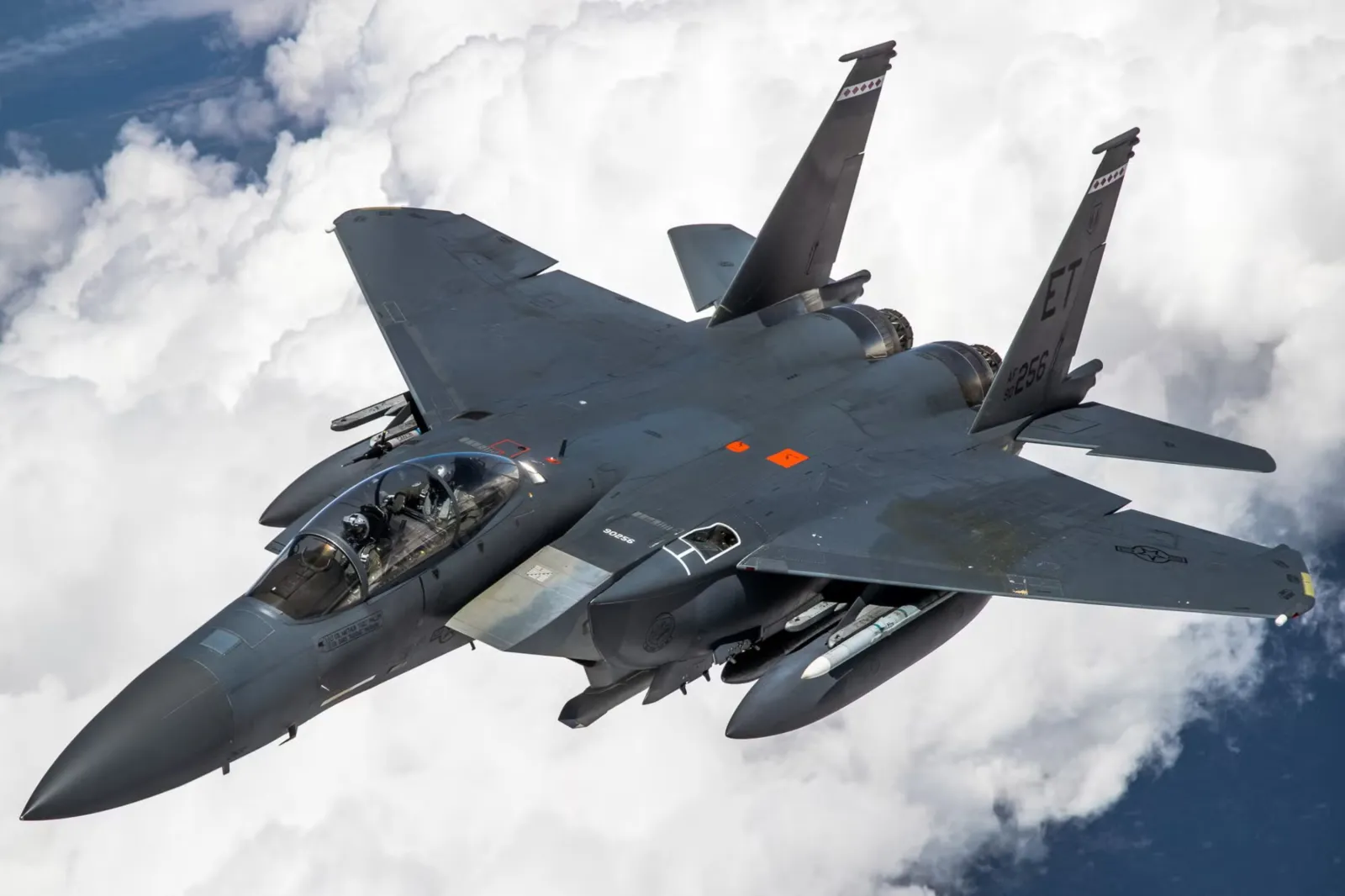
The F-15 fighter jet was designed in the 1960s and first took to the skies in 1972, yet successive upgrades to its radar, avionics and weapons have kept the airframe relevant for more than half a century. The B-52 bomber, introduced in 1955, is undergoing another modernization program intended to keep it flying beyond 2050.
One-way attack and FPV-style drones are vastly cheaper and conduct vastly different missions than traditional multimillion-dollar combat aircraft. But for larger, reusable platforms, the principle remains much the same.
"We must distinguish platform longevity from adaptability," Maurits Korthals Altes, CEO of Dutch military software company Intelic, told Newsweek. "The objective is not to preserve every piece of hardware, but to integrate new capabilities quickly. Militaries should be able to replace individual drones or payloads without replacing their wider software and command infrastructure."
...
Integration Station
Ukraine’s MAGURA naval drones, manufactured by Honcharuk’s UFORCE, demonstrate how an established platform can acquire entirely new capabilities as the battlefield evolves.
Initially developed as explosive-laden attack boats to take the fight to Russia’s Black Sea Fleet, the MAGURA family has since expanded to include several variants capable of performing vastly different missions. In May 2025, a MAGURA V7 armed with air-to-air missiles shot down a Russian Su-30 fighter jet over the Black Sea, according to Ukrainian military intelligence. Then, in August 2026, the agency reported using MAGURA mother ships carrying FPV drones to strike two Russian radar-related targets in occupied Crimea.
The principle is straightforward: the underlying platform provides mobility, endurance and carrying capacity; the equipment it carries determines its actual combat function.

...

...
"Our decade of experience on the counter-UAS (unmanned aerial systems) side has confirmed how quickly drone technology and the threat can change, and that same challenge applies to the systems being deployed," Ty Safreno, CEO and co-founder of American counter-drone technology company Trust Automation, told Newsweek.
"The advantage of a modular platform is that you can change the things that matter to the mission—sensors, payloads, communications or software—without having to replace the underlying system. You might configure it one way for one mission and differently for another. The important part is having a common architecture underneath it so you’re not starting over every time the mission or threat changes."
Take Baykar’s upgraded TB2. Commanders could still deploy the aircraft on conventional reconnaissance or strike missions. But if enemy air defenses make those operations too dangerous, the same TB2 could instead release smaller, cheaper attack drones from a safer distance, then serve as an airborne communications relay allowing operators far behind the front line to guide the FPV drones toward their targets.
One aircraft, several potential missions, and no need to redesign or purchase an entirely new platform every time the battlefield demands something different.
There’s a catch, though. As modern warfare demands an ever-growing assortment of weapons, sensors, and software, ensuring equipment from different manufacturers can work together and be replaced without spending a fortune on integration presents a challenge of its own.
The Fine Print
There comes a point when upgrading an old weapon begins to produce diminishing returns.
"A better sensor still has to work within the aircraft’s limits on weight, power and cooling. The condition of the airframe matters, too," Foster Ferguson, a former U.S. Marine Corps maintenance commander and now vice president at 3D-printing company Stratasys, told Newsweek. "A cheap component can become an expensive upgrade once you include integration, testing, approval and time out of service."
Then there’s the question of ownership. Militaries frequently purchase weapons whose software, technical specifications and spare parts remain under the control of their original manufacturers. Fitting newer, better technology from a competing supplier can prove a lengthy and costly exercise.
"Settle repair rights before equipment breaks. Buy the ability to repair and adapt at the same time you buy the aircraft," Ferguson advised. "Who has the digital files? Who can use them? Can another approved manufacturer make the parts?"
The U.S. Air Force is trying to break that dependency. Its Collaborative Combat Aircraft program aims to field around 1,000 autonomous "wingman" drones, using a government-owned software architecture designed to allow additional software provided by competing suppliers to operate across different aircraft.
This approach is hardly revolutionary. The Pentagon has promoted modular systems for decades, and in 2016, Congress decided that major weapons programs approved from 2019 onward must adopt a Modular Open Systems Approach (MOSA) wherever practical. In essence, this means designing weapons with standardized, replaceable components so equipment from different manufacturers can be integrated without rebuilding the entire system.
Implementation, however, has been patchy. A January 2025 Government Accountability Office investigation found that 14 of 20 acquisition programs reviewed had adopted modular systems to some extent, yet none had formally assessed their costs and benefits. Without proper planning, militaries risk spending heavily on supposedly interchangeable equipment that doesn’t work together as intended.
The potential savings are substantial: GAO calculates that even a hypothetical 1 percent reduction in five years of tactical-aircraft upkeep costs could save hundreds of millions of dollars.
"Traditional procurement remains platform-centric: militaries select a manufacturer, procure a system and subsequently attempt to integrate it, often as an afterthought," Maurits Korthals Altes, CEO of defense-tech firm Intelic, told Newsweek. "We need capability-centric, software-first procurement, with interoperability built in from the get go. This requires open architectures, standardized interfaces and contracts that allow competing manufacturers to integrate on equal terms."
None of this guarantees that upgrading an old drone will always be cheaper than purchasing a replacement. But as the TB2’s transformation demonstrates, becoming outdated in one role doesn’t necessarily mean a weapon has outlived its usefulness.
The future of warfare will undoubtedly require new weapons. It could also depend on finding better ways to use the ones we already have.
View 0 Comments
Submit Correction
View Editorial & AI Guidelines