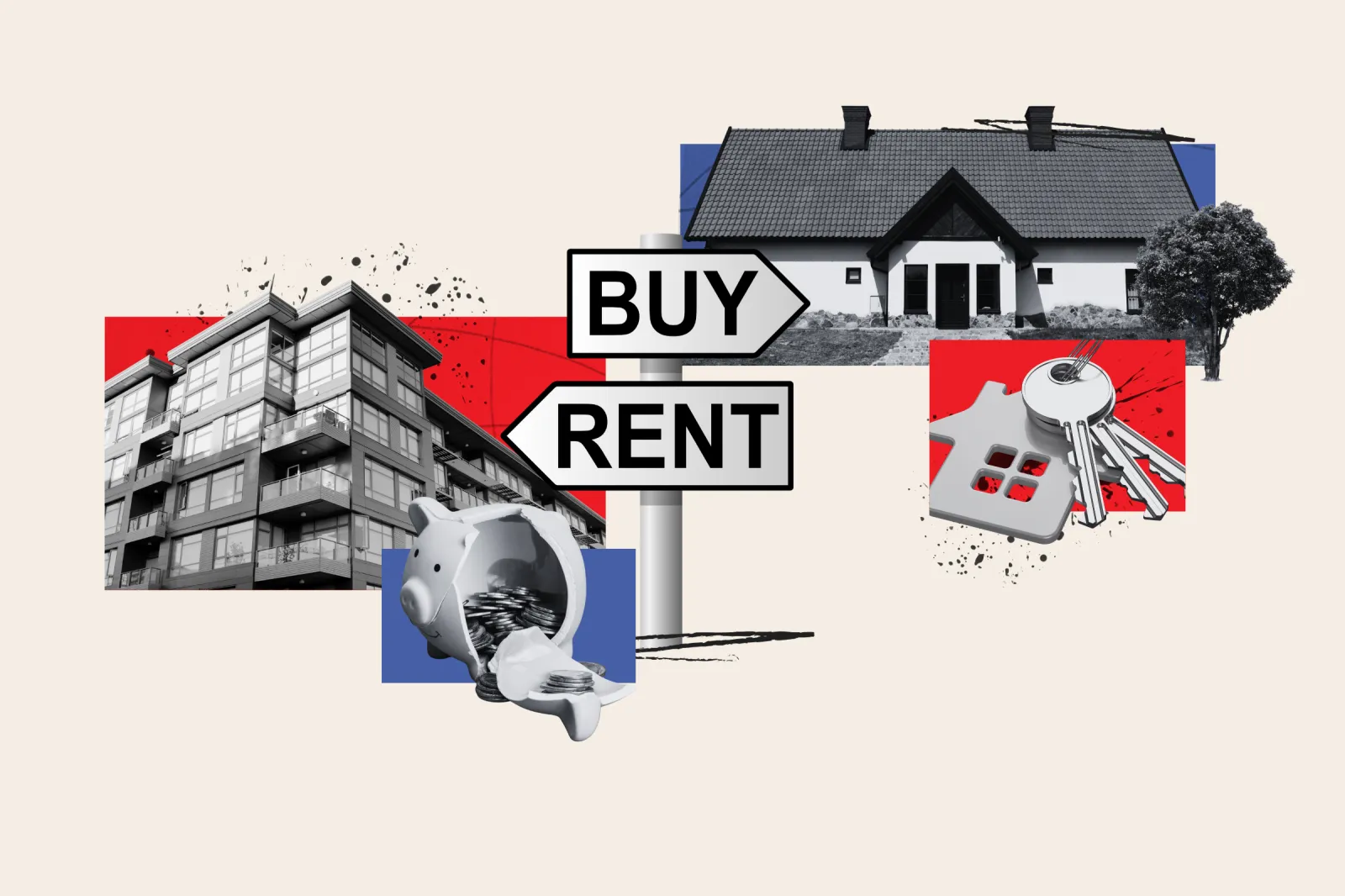
Photo-illustration by Newsweek/Canva/Getty/Gen Z Is Choosing Renting Over Buying

By Giulia Carbonaro
Senior Reporter
0
Share
Newsweek is a Trust Project member
See more of our trusted coverage when you search.Prefer Newsweek on Googleto see more of our trusted coverage when you search.
There are currently a record 46 million renting households in the United States, according to U.S. Census Bureau data, as Americans increasingly look at renting as a long-term solution to the housing affordability crisis rather than a stepping stone to homeownership.
This is especially true for young people, with Gen Z increasingly saying they prefer renting to owning a home. A recent survey by multi-family focused property management company Entrata found that nearly three in four Gen Z renters view renting as a smarter option than buying.
Considering that Gen Z, born between 1997 and 2012, now represents more than 20 percent of the U.S. population, their attitude toward renting and homeownership could signal a massive shift for the entire country.
Read More on U.S.
"What the survey told us about Gen Z, is that renting is a great way of life for them," Entrata's industry expert, Virginia Love, told Newsweek. "While homeownership is something they want at some point in life, they are sort of rewriting their timeline," she said. "They don't feel like they need to follow the whole 'college, marriage, baby, house, bigger house' timeline; they can create whatever life they want."
How Are Gen Zers Approaching Homeownership?
Gen Zers are reaching homeownership age at a particularly difficult time for the U.S. housing market, when sky-high home prices, stubbornly elevated mortgage rates, and other rising costs are making buying and maintaining a property particularly unaffordable.
Home prices are now 40 percent higher than they were before the pandemic, with the median sale price of a typical U.S. home at $443,141 last month, according to Redfin. The 30-year fixed-rate mortgage—the most popular home loan in the country—is still hovering near the 7 percent mark, according to Freddie Mac data.
"It is significantly more difficult for today's buyers to purchase a home compared to past decades," Bankrate financial analyst Stephen Kates told Newsweek. "One measure of this difficulty is the rising average age of first-time homebuyers. Since 1980, the average age of a first-time buyer has increased from 29 to 38 years old."
...
The challenge is not just high prices and mortgage rates. There is also intense competition for the limited inventory of homes available nationwide, especially in the Northeast and Midwest, where the supply is less abundant than in the South.
"Today's first-time buyers are competing not only with peers but also with older generations," Kates said. According to recent data by the National Association of Realtors (NAR), more homes were purchased last year by the Silent Generation (aged 79 to 99) than by Gen Z.
"Collectively, first-time homebuyers accounted for only 24 percent of all purchases in 2024," Kates said.
On top of that, entry-level jobs are disappearing, partly due to the introduction of AI, and partly due to the headwinds faced by the tech and other sectors over the past few years. According to estimates by the U.S. Bureau of Labor Statistics, 1 million office and administrative support jobs are expected to disappear by 2029 due to technological advancements, which are likely to affect younger generations more significantly.
Young people are already facing a much different type of employment than their parents.
"We are seeing less people in that 20 to 24 age group categorized as fully employed," Jimmie Lenz, a financial economics professor at Duke University, told Newsweek.
"I think part of that is probably that categorizations haven't kept up with the time," Lenz said.
"There's a lot more people that are employed by gig work and things like that, and those are jobs that tend to make it a little more difficult to afford mortgages, and in particular, the kind of the traditional 30-year fixed-rate mortgage," he added.
Faced with a rather hostile housing market and an uncertain economic prospect, Gen Z is increasingly choosing to rent. While 41 percent of respondents saw renting as a stepping stone to homeownership, 59 percent saw it as a long-term choice. A majority of 83 percent believe that renting allows them to save for life experiences rather than investing in homeownership, a goal they are happy to delay for the foreseeable future.
Reshaping the American Dream
For previous generations, homeownership was a key part of the American Dream, signifying that one had "made it" and become successful as an adult.
Millennials, who were hit by two recessions during their formative years—one following the subprime mortgage crisis and another following the COVID-19 pandemic—have struggled to achieve this milestone by the age once considered typical for becoming homeowners.
Over 55 percent of millennials now own a home, according to U.S. Census Bureau data compiled by Apartment List, but it took them longer than other generations to reach this milestone. Only 33 percent of millennials were homeowners at the age of 30, compared to 42 percent of Gen Xers and 48 percent of baby boomers at the same age.
While 26 percent of Gen Zers own homes, many have de-prioritized the goal of homeownership, reshaping the American Dream.
"They are such a financially savvy generation," Love said.
"We have to remember that they experienced the downturn in 2008-2009 and what happened with the housing market during the pandemic from their parents', grandparents', friends' and family's eyes," she said.
"Not to mention, this is an online generation. They read everything, see everything, everything is at their fingertips," Love said. "They have seen that financial struggle, they have their own financial issues with student loans and debt and the question of where their career is going. There are a lot of layoffs. There is a lot of uncertainty."
Instead of seeing renting as throwing money down the drain, Gen Zers are seeing it as a way to be flexible, retaining the power to move should they chase a career opportunity elsewhere.
"Renting can offer advantages over buying, including greater flexibility, lower maintenance responsibilities, and improved amenities," Kates said. "While homeownership can provide stability and serve as a long-term wealth-building tool, it is not the only path to financial success."

...
At the same time, there are also downsides to renting instead of buying.
"Renting for longer can delay wealth-building. Owning a home is still the primary way Americans grow their net worth, so every year spent renting is a year without equity growth," Daryl Fairweather, chief economist at Redfin, told Newsweek.
The vast majority of Gen Zers, like every generation before them, "say that they want to own a home one day," Lenz said. "That's a very traditional value in the United States, the idea of homeownership."
They just don't want it just yet.
"When I look at Gen Z and think about what they are looking for, they want to live in one of these larger U.S. cities, and there's a tradeoff that has to be made there," Lenz said. "Not only homes, but taxes and things like that tend to be more expensive. Gen Zers are sometimes reluctant to take one hour and half or so to commute, they think they would rather not do those kinds of things. They don't want the trade-off," he said.
"They can't afford a home where they want to live, and they don't want to have long commutes to go to work, so they end up going to the multi-family, the apartment rental instead," Lenz said.
What Does This Shift Mean for the U.S.?
Some Gen Zers are renting as a way to save enough money to buy a home in the future.
"They understand how renting builds their credit, gives them a taste of responsibility, tells them what they like and what they don't like," Love said. "And I think that we are seeing the entire housing sector respond to this—policymakers, landlords, operators, developers."
However, delaying homeownership could have significant consequences for American society.
The same economic uncertainty that is preventing many young people from buying a home could increase the average age at which Americans form their own families, a trend that is already underway, asfinancial stability is often associated with marriage and family formation. According to the latest data by the Centers for Disease Control and Prevention (CDC), the average age of new mothers in the country has risen from 26.6 in 2016 to 27.5 in 2023.
Second, "fewer young people buying homes could widen the wealth gap between homeowners and renters" in the long term, Fairweather said.
In the short term, Gen Z's habits are likely to have the most significant impact on the housing and rental market. The growth of the rental population in the country is leading to a push for more new apartment construction. According to a recent study by RentCafe, U.S. developers are expected to deliver an estimated 506,353 new apartment units across the country this year, with nearly half of them being built in the South.
Developers, Love said, are increasingly building the type of home that Gen Z wants, including "activated amenities"—spaces that involve activities, services, or events that foster a sense of community spirit.
"Podcast rooms, craft spaces, a place to fix a bike—these are the sort of things that we're seeing folks leaning toward," Love said. "More green spaces, more digital services."
Read the Full Interview
How much more difficult is it for young people to become homeowners now, compared to their parents and grandparents?
Bankrate Financial Analyst Stephen Kates, CFP: It is significantly more difficult for today's buyers to purchase a home compared to past decades. One measure of this difficulty is the rising average age of first-time homebuyers. Since 1980, the average age of a first-time buyer has increased from 29 to 38 years old. The challenge is not just high prices and mortgage rates; competition is also intense. Today's first-time buyers are competing not only with peers but also with older generations. According to NAR data, more homes were purchased by the Silent Generation (ages 79 to 99) than by Gen Z (ages 18 to 25). Collectively, first-time homebuyers accounted for only 24 percent of all purchases in 2024.
Redfin chief economist Daryl Fairweather: It's much harder. Previous generations bought homes when prices were much lower relative to income, and mortgage rates—while not always low—were offset by less competition and smaller down payment hurdles. Today, young people are contending with record-high home prices, limited supply, and steep mortgage rates. That means even if their parents or grandparents faced high rates in the 1980s, the affordability crunch wasn't nearly as severe as it is now.
An increasing number of young people are choosing to rent for longer instead of trying to buy. What consequences could this have on their ability to build up equity and stabilize their finances?
SK: Renting can offer advantages over buying, including greater flexibility, lower maintenance responsibilities, and improved amenities. While homeownership can provide stability and serve as a long-term wealth-building tool, it is not the only path to financial success.
At the same time that homeownership is becoming harder to achieve, younger people are investing at higher rates than previous generations. There have never been so many investment opportunities with such low barriers to entry. When pursued prudently, these opportunities can yield better returns than homeownership and come with fewer hurdles. While home values have increased more than 50 percent since January 2020, the S&P 500 has delivered a total return of 108 percent over the same period.
DF: Renting for longer can delay wealth-building. Owning a home is still the primary way Americans grow their net worth, so every year spent renting is a year without equity growth. That said, renting can be the right choice if it allows people to save, invest elsewhere, or stay flexible in their careers. But in the long run, fewer young people buying homes could widen the wealth gap between homeowners and renters.
What consequences could this have on the rental market?
SK: As with any market, supply and demand dynamics impact prices. High competition for limited rental units drives prices up. In cities like Austin, TX, rental prices have fallen in recent years due to a surge in housing construction. In contrast, cities such as New York and Boston have seen little relief for renters, constrained by a persistent shortage of units.
DF: If more young adults rent for longer, it increases demand for rentals, which can push rents higher—especially in major cities where supply is often already constrained. This could make it harder for renters to save for a down payment, creating a cycle where renting feels like the only option. On the flip side, it may also encourage more multifamily construction, which is one of the few areas where housing supply is growing.
And what consequence could this shift away from homeownership have for the U.S. society and economy at large?
SK: Homeownership represents a tangible stake in the economy and society. It was famously promoted during the Cold War as a tool to counter communism, and it was largely successful. Today, however, the lack of access to homeownership is pushing some younger people in the most housing-scarce regions to question the viability of the current economic system altogether.
Owning a home also offers a more stable environment for raising a family. As homeownership becomes increasingly out of reach, it may further discourage family formation in certain areas. Many major metro areas are already seeing sharp declines in the population under five years old. This trend could worsen as housing becomes more unaffordable.
DF: Homeownership has traditionally been tied to community stability, civic engagement and long-term wealth building. If younger generations aren't able to buy, we could see more inequality between those who inherit homes and those who don't, and between higher- and lower-income households. That could weaken the middle class and reduce economic mobility, which are both vital for a healthy economy.
Is there a way for young people to save enough to buy a home in the near future, or is the system rigged against them?
SK: The last five years may go down as one of the most difficult times to climb onto the property ladder. Home prices rose so quickly and so steeply that only those with high incomes and substantial savings were able to buy amid the supply shortages brought on by the pandemic. Rising mortgage rates have further burdened buyers, with monthly payments ballooning beyond reach for many.
Looking ahead, home price growth is likely to slow, and mortgage rates may fall. While homeownership will remain challenging, it is expected to become more attainable. Motivated buyers are already making sacrifices, either by saving aggressively or relocating to more affordable areas. Falling prices in markets that overbuilt during the pandemic, such as Florida, Texas, and other southern states, will continue to attract new residents.
The broader trend of spending on experiences is unlikely to reverse. It emerged as a response to being priced out of traditional financial milestones such as homeownership and family formation. For those who can afford it, owning a home remains a high priority. However, for many, the dream feels out of reach, and they are choosing to focus their financial resources elsewhere.
DF: The rules of the housing market tend to benefit people who already own homes (e.g., zoning rules, tax rules). That's why the share of first-time homebuyers in the market is the lowest on record, and it's why the median age of first-time homebuyers is now 38. For many young buyers, it takes extreme sacrifices (cutting back on experiences, side hustling, moving in with family) to save for a down payment.
A recent Redfin survey shows that young people are taking those steps, which challenges the stereotype that they'd rather spend on travel or lattes. The risk is that even with these sacrifices, the goalpost keeps moving because home prices and rents are rising faster than incomes. That can lead to burnout and disillusionment with the housing system.
View 0 Comments
Submit Correction
View Editorial & AI Guidelines