
...

By Juliette Bretan
Researcher and journalist
0
Share
Newsweek is a Trust Project member
See more of our trusted coverage when you search.Prefer Newsweek on Googleto see more of our trusted coverage when you search.
The AfD’s win in the Saxony-Anhalt election in eastern Germany, with 43.8 percent of the vote, is as much a major moment for the other nations of NATO as it is for the country where the elections took place. And Poland in particular.
The strongest election result for a far-right party in Germany since World War II comes with the rise of fears of Russian sabotage and hybrid warfare across Europe—including recent attacks on Leipzig/Halle Airport in eastern Germany, and fires in factories in Estonia and Poland.
Germany’s turn to the right may well spell danger for a bloc desperate to defend itself against Vladimir Putin, and protect Ukraine. The AfD will not only weaken Germany, but is also pro-Russia, with its leader Alice Weidel, suggesting that Germany end its boycott of Russian oil and gas. Germany currently hosts NATO’s critical centers such as the Headquarters Allied Air Command in Ramstein, responsible for conducting air operations, as well as the Grafenwoehr Training Area, the largest U.S. military training facility in Europe. Nonetheless, with an AfD victory, it may be harder for NATO to work as a bloc to defend the continent against Russia.
Read More on Opinion
Amid existing debates about NATO’s spending—Germany, according to NATO estimates, will spend only 2.69 percent of its GDP on defense in 2026—the country’s new, disruptive politics will weaken a once essential player in NATO further. Germany is now finally increasing its defense budget as a result of Russian threats, with plans to double this in four years.
But it is a country to its east—Poland—which is rapidly turning into the sparkly new weapon in NATO’s arsenal. It is becoming the operational, and military powerhouse of NATO’s eastern flank—and, potentially, more important than Germany itself to NATO.
Experts are claiming that while Germany remains NATO’s logistical hub, Poland is becoming strategically significant for its forward capabilities. With Russia on its doorstep, and a history of invasion and conflict from its larger neighbor, Poland has in fact been one of the champions of NATO’s aim to spend 5 percent of GDP on defense—even calling on countries to surpass NATO’s target, and achieve 5 percent as early as 2030.
Though Germany has up until recently focused on military restraint, Poland has been investing in defense for years against a Russia the West too easily ignored pre-2022. Poland is now one of the leading centers for military strength in NATO, with an estimated 4.68 percent of its GDP, $53.8 billion, spent on defense in 2026—almost double that of Germany. It is also aiming to build the largest land army in Europe, with its armed forces consisting of over 220,000 personnel this year.
Poland is also heavily investing in military technology, including South Korean K2 Black Panther tanks, with plans to operate 1,100 tanks in total, more than Germany, France, the U.K. and Italy combined, by 2030.
Poland has also been investing in civilian defense, with the "W Gotowości" (Always Ready) program promoting civilian military training, first aid, and cybersecurity, strengthening its overall security. Another scheme launched recently was "What the Fejk": a teaching program for students aged 10-19 to help them spot deepfakes by creating their own. Vitally, Poland is also taking measures to improve domestic defense production, with half its orders now going to domestic producers, and 30.4 billion złotys ($8.15 billion) spent last year on domestic and central European-based defense. Some technologies are even attracting NATO allies, including its Piorun air-defense systems, which have recently been purchased by Norway, Lithuania and Latvia. Previously, Belgium, Estonia and Sweden have bought Pioruns—alongside the United States, which ordered several hundred in 2022.
Related Story
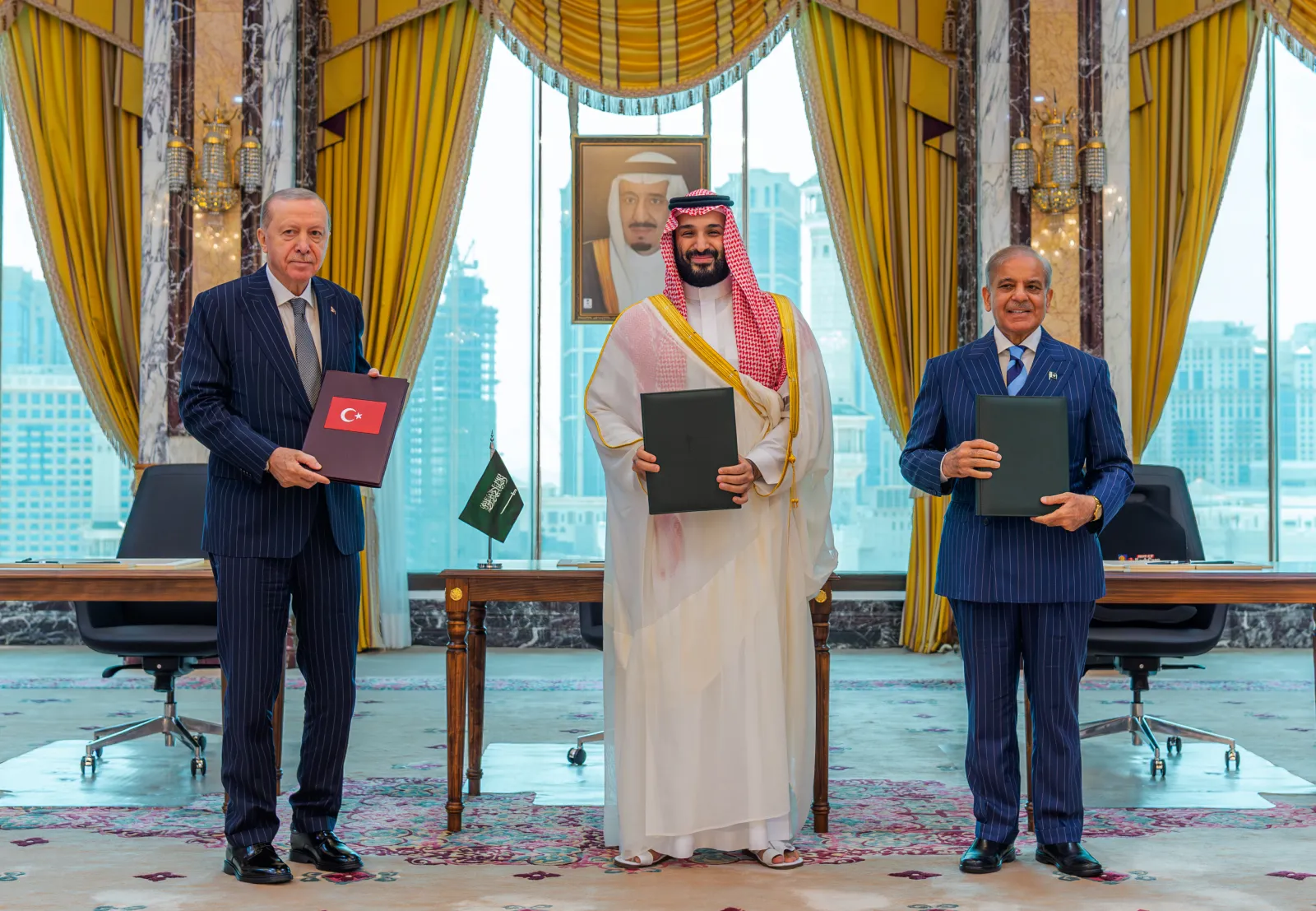
The New ‘Muslim NATO’ Faces First Major Test
Poland has also been essential to Ukraine as a vital front-line hub for Ukrainian military and humanitarian aid. Its Rzeszów-Jasionka airport in the east of the country is home to the NATO Security Assistance and Training for Ukraine logistical hub, which manages 18,000 tons of material per month.
Meanwhile, Poland is also deepening its relationship with the U.S. through the thousands of U.S. troops hosted on Polish soil—including the announcement of an additional 5,000 troops to Poland in May, and plans by the Polish government to allow a new permanent U.S. military base in Poland.
Recently, Poland was the first NATO ally to undertake training developed for the Green Berets, the elite U.S. Army special forces. Based on and simulating Ukrainian battlefields, the training involved drone warfare and travel over enemy lines.
Poland is now turning into a bridge between America and Europe’s eastern flank, as an essential security partner, a military hub, and a regional network.
While Germany is now rebuilding militarily, and remains Europe’s economic giant, this is after decades of underinvestment—Poland is building its military around the assumption that the old world has failed. And Germany’s huge industrial base does not automatically translate into military capability: the collapse of the Franco-German future combat air system is a case in point. As it stands, the country that is closest to the threat is increasingly the one shaping NATO’s strategy.
Juliette Bretan teaches at the Faculty of English at Cambridge University and previously worked as a research assistant for the Centre for Geopolitics at Cambridge.
The views expressed in this article are the writer's own.
View 0 Comments
Submit Correction
View Editorial & AI Guidelines