
10
Loading video...


By Emma Marsden and Hollie Silverman
0
Share
Newsweek is a Trust Project member
See more of our trusted coverage when you search.Prefer Newsweek on Googleto see more of our trusted coverage when you search.
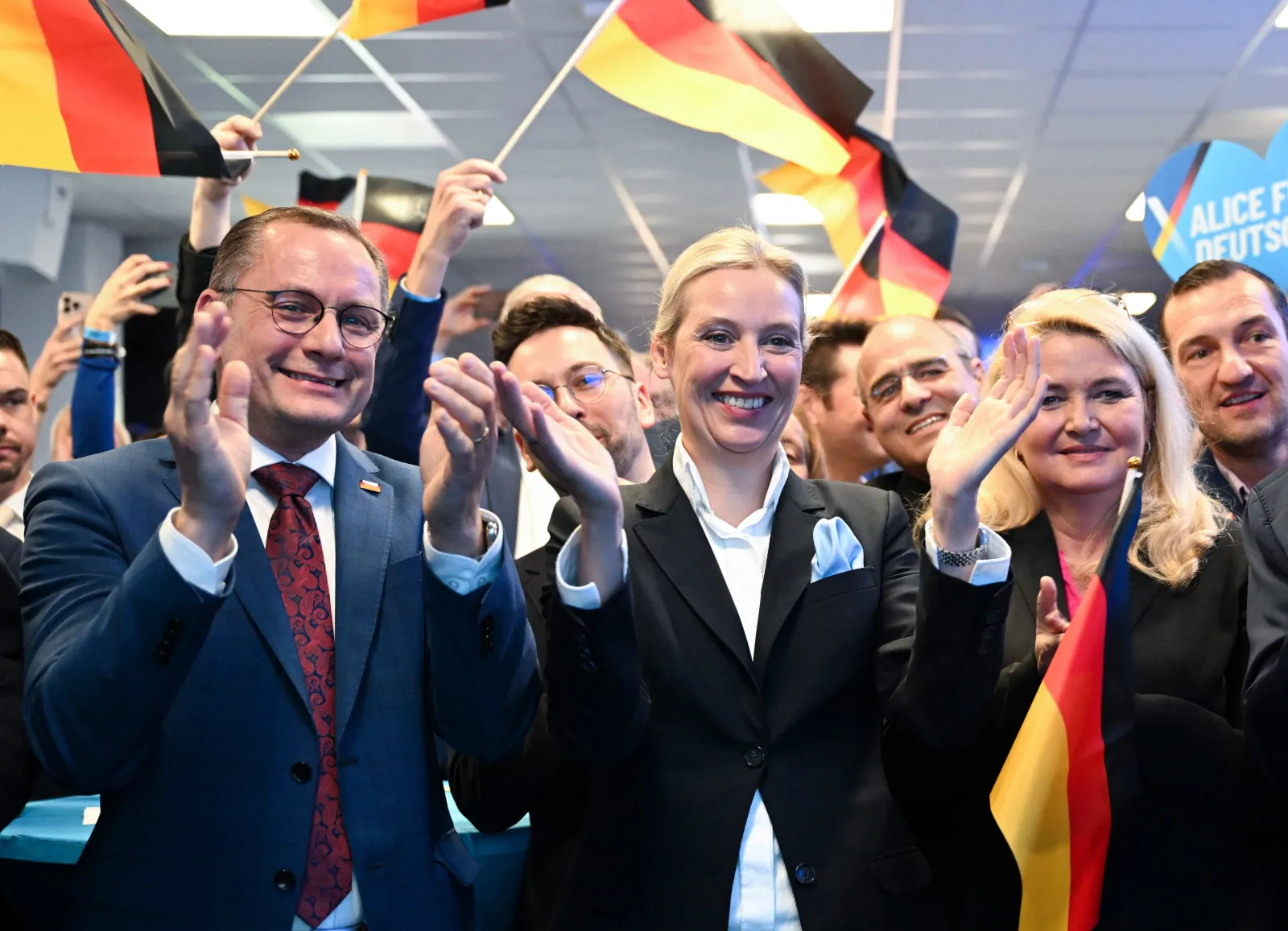
Germany's far-right Alternative for Germany (AfD) scored a historic victory in Sunday's Saxony-Anhalt election, with exit polls showing the party winning 44.6 percent of the vote and finishing well ahead of its rivals.
The result marks the strongest performance by a far-right party in a German state since World War II. The New York Times reported on Sunday afternoon that 90 percent of the votes have been counted, adding that the AfD "looks likely to fall short of an absolute majority."
While the party emerged as the clear winner in Sunday's pivotal state election, it fell short of what was needed to govern alone. The AfD could nonetheless play a role in forming a government in Saxony-Anhalt, depending on coalition talks among other parties that have ruled out supporting an AfD administration.
Read More on World
The result also marked a major setback for Chancellor Friedrich Merz's conservative bloc, Christian Democratic Union of Germany (CDU), and a major breakthrough for the AfD, which has built its strongest support in eastern Germany and campaigned on tougher immigration controls, opposition to the political establishment and a more nationalist agenda.
The AfD, led in Saxony-Anhalt by Ulrich Siegmund, had been polling consistently above 40 percent ahead of Sunday's election, as reported by Reuters, well ahead of the CDU, which governs the state.

...
Voter turnout in Saxony-Anhalt reached a record high, with approximately 78 percent of eligible voters casting their ballots on Election Day, DPA reported, which noted that final voter turnout in the previous election in 2021 stood at 60.3 percent.
“Some would say it was a dark day for Saxony-Anhalt,” Sven Schulze, the Christian Democrat and incumbent leader of the Saxony-Anhalt government, said on a German television broadcast, per the Times. “I say this is democracy,” he continued. “The people have sent a clear message.”
Related Story

5 Hard Truths After AfD Wins German State Election
The result could be a "turning point," Lars Klingbeil, Germany’s vice chancellor and a center-left Social Democrat, said in a television interview, the newspaper reported.
“There are an incredibly large number of people right now in Saxony-Anhalt, but also I believe across Germany, who are afraid and worried about this election result for the AfD,” Klingbeil said. “It is a reason to reflect on politics here in Berlin.”
Immigration Top Concern
Immigration has emerged as one of the defining issues in the election, reflecting a broader debate playing out across Germany ahead of the next federal vote.
AfD has campaigned heavily on promises to tighten border controls, reduce asylum applications and increase deportations, arguing that migration levels have placed pressure on housing, schools and public services.
According to German public broadcasters and national polling, immigration consistently ranks among voters' top concerns, alongside the economy and cost of living, helping drive increased political engagement and turnout in the state election.
Related Story

Ukraine Needs Witkoff’s Sickly Sweet Nothings to Putin
What an AfD State Would Mean
An AfD government would have given the party direct control over state-level policy in areas including education, policing and parts of immigration policy.
As previously reported by Newsweek, the AfD's support is largely rooted in the former communist East, where the party has capitalized on anti-immigration sentiment and skepticism toward Germany's military support for Ukraine amid its war with Russia.
The AfD's Saxony-Anhalt branch was classified as a "far-right extremist organization" in 2023 by the state's Office for the Protection of the Constitution.
The party's manifesto has been described as "radical" and calls for a major shift in policy, including tougher measures on migration and asylum, while also promising changes to education and security policy, along with greater support for traditional families. It also looks at an expansion of nuclear energy, limits on wind power, a smaller public broadcasting system, more nationalist cultural policies and lower taxes and regulation for businesses.
Siegmund has said the AfD would seek to implement its program if it secured a majority, giving the party an opportunity to demonstrate how its policies would work in government rather than opposition.
Related Story
AFD: German Far-Right on Brink of First State Government Since WWII
Why Is the AfD Victory Significant?
The breakthrough comes as the AfD seeks to expand its influence beyond eastern Germany and establish itself as a potential force for national government.
The party's gains have put increasing pressure on Merz and the CDU, particularly over migration and the economy.
The result is likely to be closely watched ahead of Germany's next federal election in 2029, when the AfD will seek to build on its gains and challenge for a larger role in national politics.
Markus Böckenförde, associate professor of Comparative Constitutional Studies at Central European University, told Newsweek that the results may not mean AfD takes power.
"The current result, with the AfD securing over 44 percent of the vote, is even higher than the forecasts," he noted, posing the question "Will the AfD secure an absolute majority of seats and thus have a majority capable of amending legislation?"
"So, though AfD's victory by numbers is even bigger than expected, it remains to be seen whether it is big enough for a political earthquake," he continued. "The first thing to note is that, at 80 percent, this election saw one of the highest turnouts in recent decades for state elections in Germany. Many citizens therefore felt the need to express their political views."
What Happens Next
The CDU ruled out working with the AfD, leaving other parties to consider whether they can form an alternative government if the latter does not have enough seats to govern alone.
AfD's win does not mean that it will take power, PD Dr. Benjamin Höhne, interim professor for Comparative European Governance Systems at the Chemnitz University of Technology in Germany, told Newsweek in an email Sunday before the results were in, noting that the AfD will likely be unable to govern due to the political firewall against the party.
"This is the most likely scenario. No immediate reactions are expected, as state elections are scheduled to take place in Mecklenburg-Western Pomerania and Berlin in two weeks," he explained. "The political parties will likely wait to see how those elections play out."
Contact Newsweek editors for this story: Matthew Cannon, Cristina Diciu, and Anthony Murray.
View 0 Comments
Submit Correction
View Editorial & AI Guidelines