10
Loading video...

By Jordan King
Reporter
0
Share
Newsweek is a Trust Project member
See more of our trusted coverage when you search.Prefer Newsweek on Googleto see more of our trusted coverage when you search.
A gold statue depicting President Donald Trump naked and sitting on the shoulders of a smaller man has been unveiled in the European Parliament building in Strasbourg, France.
The piece, created by Danish artist Jens Galschiot, is titled The Orange Plague and is covered in 23-carat gold leaf. Below the statue, which stands 2.6 meters (8.5 feet) tall, a message says: "I am sitting on the back of a man. He is sinking under my burden. I will do anything to help him. Except stepping down from his back. —The King of Injustice."
During Trump's second term, the transatlantic relationship that defined part of the post-World War II global order has been tense. Europeans have viewed the Trump administration with distrust and the U.S. president has offered little to potentially reassure them.
Read More on News
Galschiot said on his website: "Trump represent one of the greatest threats to the rule based world order, democratic values and our common effort to solving the climate crisis. We must address this issue and stand together against such destructive influence."
The statue is set to remain in the European Parliament until Thursday, before heading to the COP31 U.N. Climate Conference in Turkey in November.
The statue was displayed at the COP30 U.N. Climate Summit in Brazil last November. In 2026, it appeared at the Munich Security Conference in Germany; Denmark's Rebild Festival, celebrating the 250th anniversary of the United States; and Copenhagen's "Hands off Greenland" demonstrations.
Newsweek has contacted the White House for comment on Wednesday outside of regular office hours.
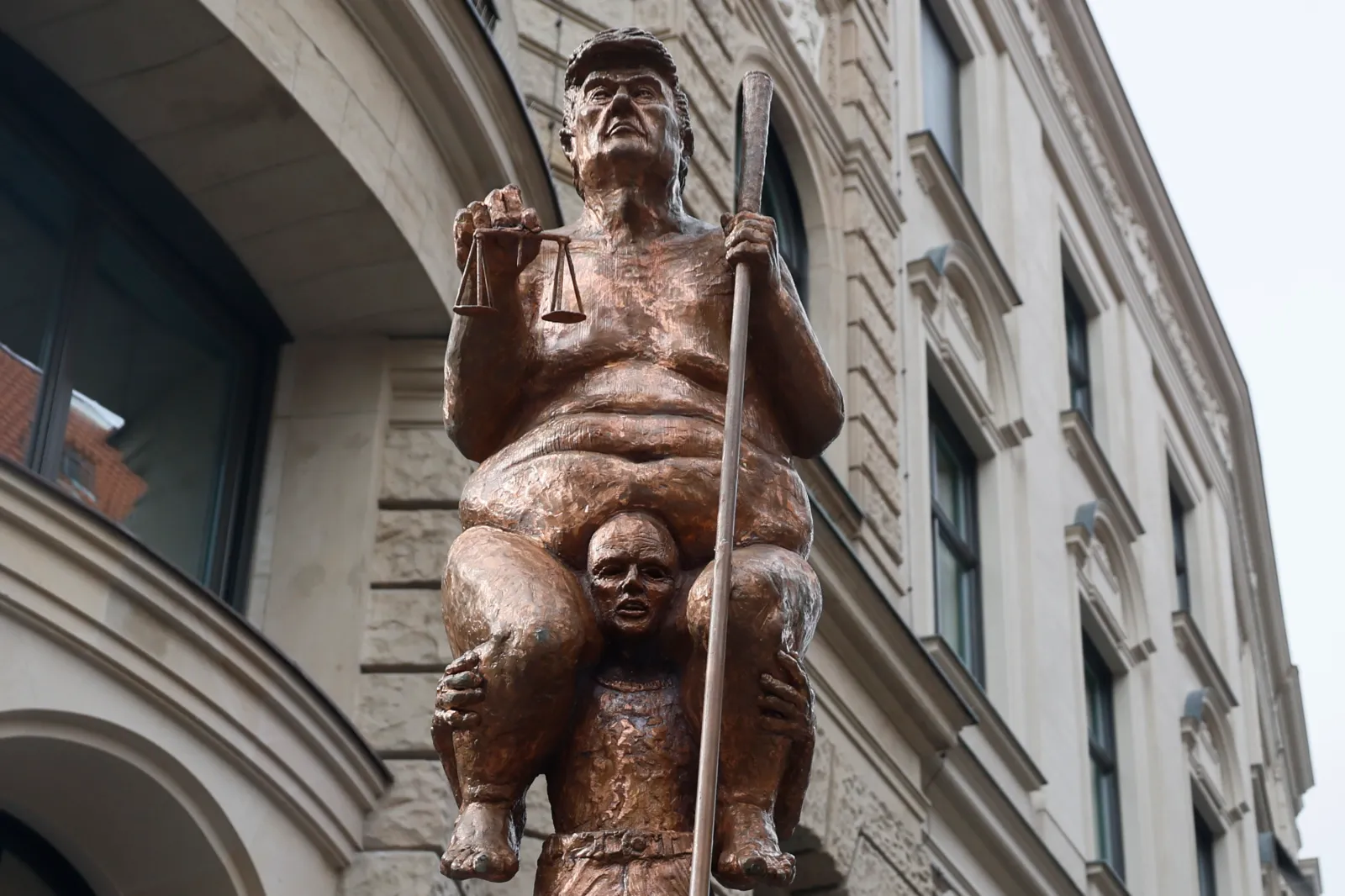
...
Why Is the Statue at the European Parliament?
Danish Member of Parliament (MEP) Per Clausen, who is a member of the Left group, is hosting the exhibition.
“I know some people think we shouldn’t provoke Trump and therefore shouldn’t exhibit a sculpture like this,” he said in a statement “To them, I have to say two things: First, we cannot accept living in fear and self-censorship.”
“Second, if someone is so thin-skinned that they cannot handle this sculpture being exhibited in the European Parliament, then they have no business on the world stage,” he added.
The statue has been in the building since Monday morning, but it was covered by an orange cloth until it was unveiled on Tuesday afternoon.
Clausen argued that it is “absolutely perfect to exhibit it here in the European Parliament, where both fellow MEPs and several EU Commissioners will see it” because “Trump represents one of the greatest challenges to the rules-based global order.”
Trump's Relationship With Europe
Trump, who has long been critical of European immigration policies, defense spending and NATO commitments, has had a particularly strained relationship with the continent during his second term.
One of the major tensions has been Trump's push to acquire Greenland, a self-governing territory within the Kingdom of Denmark, much to the dismay of many European countries.
In January, Trump had said the U.S. would "do something on Greenland whether they like it or not," adding that Washington would pursue the island "either the nice way or the more difficult way." Later, he would not rule out economic or military pressure to achieve his objective.
Greenland's government consistently rejected the idea that its future could be decided by Washington. Nielsen said Greenland would not become part of the United States and stressed the island's right to determine its own future.
Denmark, a NATO ally, said Greenland was not for sale and that its sovereignty could not simply be transferred to another country. Greenland's government also rejected the idea that its future could be decided by Washington
Still, last month, Trump announced a security agreement with Denmark and Greenland that expands the U.S. military presence on the Arctic island, building on a defense treaty that has governed American military access there for 75 years.
Trump described the agreement in his U.N. speech as giving the United States "permanent control over security and all other needs" in Greenland.
"No U.S. adversary will ever be permitted to establish a military presence in Greenland any more, or make sensitive investments there without our express written approval," he continued. The president also announced that the U.S. would build two "very major military bases" on the Arctic island, which remains under Danish control.
Denmark said the arrangement recognizes the sovereignty and territorial integrity of the Kingdom of Denmark and the Greenlandic people's right to self-determination.
Trump's second term has also seen him threaten and implement tariffs on goods from the European Union further straining the relationship with the bloc. The two sides would ultimately strike a trade deal in the summer of 2025. Though members of the European Parliament have since frozen the process of ratification twice—in protest of renewed threats of higher tariffs by Trump and later over Greenland— it did enter into force in July.
Just a day ago, on Tuesday, the U.S. president criticized a European country, when he weighed in on mass student protests taking place across France over complaints pertaining to a lack of resources and deteriorating conditions in schools.
"What's happening in France is nothing less than out of control mass migration," Trump wrote on Truth Social. "This isn't about schools, this is about Islam wanting to take over a once great Country!"
The protests began in mid-September at a high school outside Paris. What started as a local dispute quickly spread nationwide, with students blockading schools and organizing demonstrations in cities including Paris, Marseille and Strasbourg. As of Wednesday midday, roughly 460 schools were partially or totally shut.
How Europeans See Trump
A recent Pew Research Center survey found that majorities in 10 European countries polled said they lacked confidence in the U.S. president to do the right thing regarding world affairs.
And a median of 85 percent across these countries disapprove of his handling of the aforementioned Greenland and tariffs issues. The findings were part of a broader survey of 36 countries involving more than 42,000 respondents conducted between February 8 and May 13, 2026.
In July, YouGov's European tracker also found Trump to be deeply unpopular in many Western European countries. In France, 15 percent of adults had a favorable opinion of the U.S. president while 79 percent viewed him unfavorably. In the U.K., 12 percent had a favorable opinion of him against 85 percent unfavorable.
In Italy and Germany, the share of those who had a favorable view did not crack double digits. And in Denmark, on the back of tensions over Greenland, 3 percent had a favorable view of the American president. The sample sizes varied but ranged from 1,018 adults in Denmark to roughly 2,400 in Germany.
View 0 Comments
Submit Correction
View Editorial & AI Guidelines