...


By Ellie Cook and Toby Meyjes
0
Share
Newsweek is a Trust Project member
See more of our trusted coverage when you search.Prefer Newsweek on Googleto see more of our trusted coverage when you search.
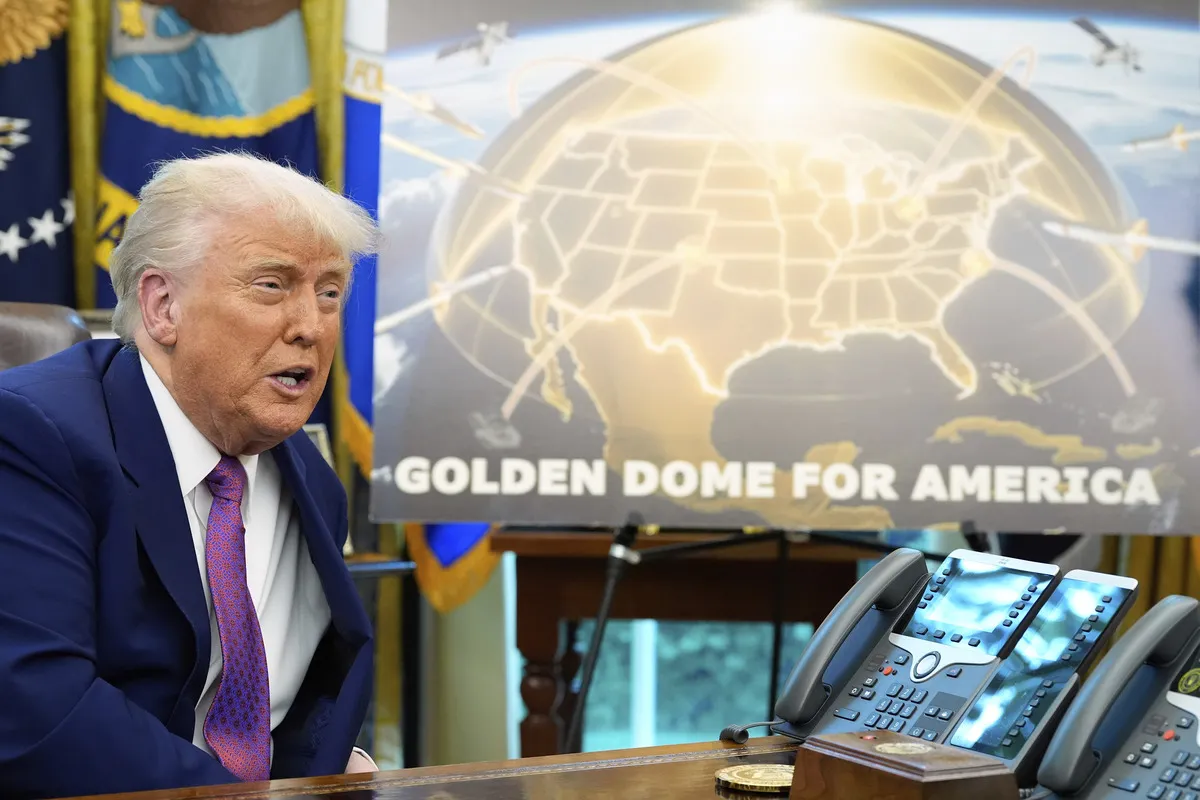
The U.S. has carried out the first major test of President Donald Trump's Golden Dome missile defense shield, according to Defense Secretary Pete Hegseth, who described the ambitious design as "real, powerful and on track."
The administration has said the Golden Dome will be ready to defend North America from advanced threats, like hypersonic missiles, by the end of Trump's term in office. It is essentially a web of trackers, sensors and interceptors to knock out drones and missiles heading for the U.S., even ones launched from space.
Hegseth said he had personally witnessed the test, which used an autonomous system to take out a "multitude of incoming threats."
Read More on News
...
U.S. forces used "next-generation technology to stop incoming drones and cruise missiles dead in their tracks," Hegseth said in a statement.
The Pentagon chief said U.S. forces used "cutting edge directed energy" in the test but didn't elaborate.
High-powered lasers are one type of directed energy weapon that can be used to intercept some threats, namely drones. The technology is still being developed, although Israel has said it has used prototype lasers in combat to intercept threats in the air.
Hegseth said the project had reached a "historic milestone" and the U.S. would be able to defend itself "more powerfully than ever before."
Why Does U.S. Need Golden Dome?
The White House started the development of the Golden Dome in January 2025, citing in an executive order the threat posed by missile attacks, including from hypersonic weapons Russia and China are developing.
Hypersonic missiles travel at more than five times the speed of sound and can maneuver mid-flight, meaning they're harder for air defense systems to intercept.
The White House described the threat of aerial attacks as "the most catastrophic threat facing the United States."
As it stands, the U.S. does not have a joined-up system for intercepting large-scale intercontinental ballistic missile (ICBM) strikes launched from Russia or China, although it would be able to take out the relatively small number of missiles that North Korea could fire at the U.S.
The Golden Dome is partly inspired by Israel's vaunted Iron Dome system, which the U.S. helped develop —although the Israeli system defends against short-range rockets, rather than barrages of long-range, fast-traveling missiles early on in their flight.
Trump has framed the Golden Dome system as the result of a program kicked off by President Ronald Reagan in the 1980s, popularly known as "Star Wars."
But the Golden Dome is likely to be incredibly expensive. The U.S. government has requested $1.5 trillion for the military budget in the 2027 fiscal year, partly to fund the Golden Dome.
This is a more than 40 percent increase on the current defense budget, and the U.S. is already the world's top defense spender.
The Congressional Budget Office—the nonpartisan agency that advises American lawmakers on funding—said last month that the Golden Dome will cost roughly $1.2 trillion over the next 20 years, a figure far above the initial $175 billion allocated for the project.
Hegseth said the test had been funded by Trump's One Big Beautiful Bill, referring to the sweeping tax cuts and spending changes signed into law last July.
Trump has floated the possibility that Canada will be covered under the Golden Dome, although Ottawa has not confirmed whether it will buy in to the project.
Currently, U.S. and Canadian defenses against long-range intercontinental ballistic missiles are handled by the bi-national North American Aerospace Defense Command.
Contact Newsweek editors on this story: Tobias Meyjes and Tony Phillips.
View 0 Comments
Submit Correction
View Editorial & AI Guidelines