
By Kenneth R. Rosen
0
Share
Newsweek is a Trust Project member
See more of our trusted coverage when you search.Prefer Newsweek on Googleto see more of our trusted coverage when you search.
Greenland has emerged as one of the world’s most strategically contested territories. The Arctic island’s vast rare-earth mineral reserves and location amidst newly opened polar shipping lanes are reasons U.S. President Donald Trump has long said that owning it is key for American security and economic interests. At the January World Economic Forum in Davos, after early threats of taking the territory by force and levying tariffs on European countries who stood in his way, Trump walked back those threats, but announced that talks were underway on a possible framework. In this exclusive excerpt from Polar War: Submarines, Spies, and the Struggle for Power in a Melting Arctic (Simon & Schuster), award-winning journalist Kenneth R. Rosen traces how a little-known 1941 agreement continues to shape Greenland’s sovereignty—and how Greenlanders’ struggle for identity, autonomy and dignity is unfolding amid mounting global pressure from Washington, Copenhagen and Beijing.

...
Greenland’s struggle for independence is not only cultural or economic, it is strategic. In 2025, when President Trump declared that “we need Greenland for national security purposes,” he echoed a lineage of imperial designs. But Greenland is already integral to U.S. defense—through Denmark, a NATO partner, and Pituffik Space Base, the American outpost at the northern edge of the island, which was enabled in part by one renegade diplomat.
Read More
Greenland, NATO and the Growing Risk of Conflict in the Arctic13 min read

In 1941, Henrik Kauffmann, Denmark’s ambassador to the U.S., defied his Nazi-occupied government. He declared that Denmark was under duress and therefore unable to govern its overseas colonies. Acting unilaterally, he signed an agreement “In the Name of the King,” transferring control of Greenland to the United States. He used Denmark’s U.S.-based gold reserves to fund Danish embassies across the Americas and Middle East. The move allowed the Allies to build Arctic air bases and weather stations, helping to shape the outcome of the Second World War.
Kauffmann’s agreement laid the foundation for what would become a permanent U.S. military presence. Greenland’s role in Western defense is not new. What is new is the language of ownership and transaction, of American rights to claim the island when those have historically remained with Denmark. “We don’t want America to play an oversized role,” a Danish diplomat told me in Copenhagen in 2023. “But we want all of our allies to bring Greenland to the West.” Today, interest in Greenland stems not only from geography but from geology: rare earth elements, minerals, uranium. Chinese-backed projects like the Kuannersuit [rare earth and uranium] and Isua [iron] mines were eventually shuttered. American interest crowded them out. “Over time, we’ve seen U.S. interest phase China out,” said Rasmus Leander Nielsen, head of the Nasiffik Center in Nuuk, the University of Greenland’s Center for Foreign & Security Policy.
A more forceful push by Trump’s State Department could unhinge the legacy of American cooperation and alignment with Greenland in Denmark. Trump’s renewed interest in Greenland was met with firm resistance from Danish Prime Minister Mette Frederiksen, who emphasized that Greenland is not for sale and called for a united European response to any U.S. pressure. The Trump administration planned to offer financial incentives to Greenlanders, proposing annual payments of $10,000 per resident to replace Denmark’s annual subsidy. Plans were announced to use social media to mimic the tactics of authoritarian countries seeking to sway the local populace. Vice President JD Vance visited Greenland to assert that U.S. protection would better serve Greenland’s security needs, especially against potential threats from Russia and China, though the vice president failed to note that Greenland’s security needs were already served by America. The Greenlandic public and Danish officials so roundly shunned the idea of a visit from anyone tied to Trump that officials could only safely visit U.S. Pituffik Space Base to give their stump speeches.
The flurry of activity in and around Greenland reminded me that the lesson of Janteloven, a Scandinavian social code that values conformity and discourages individualism, which the Danish failed to heed, was also being ignored by American officials. History or even a modest understanding of the ways by which nations’ interests dovetail today was never Trump’s strong suit. A real and very dangerous naïveté persists in his approach to Greenland, and the Arctic broadly.
At Inatsisartut, Greenland’s parliament, I meet with Ole Aggo Markussen, party secretary of Siumut, the dominant, social democratic party in the territory. He argues that with direct international flights and expanded tourism, the math of independence would change. But others in Nuuk express caution. One Danish official tells me Greenlanders “don’t want independence. They want benefits. They don’t stick to their promises.”

...
Some researchers in Nuuk are proposing an entirely new framework: to replace the Danish Law of Jante with the “Inuit Myth”—a worldview that centers on ecological stewardship and Indigenous self-governance. It is a radical rethinking of Arctic sovereignty, one that reverberates beyond Greenland to Alaska, Canada, Russia. For now, many I meet with across the country express hope and frustration, not least of all with Denmark’s inability to defend Greenland. In Ilulissat, a picturesque town framed by glaciers and overlooking a channel dappled with icebergs and ice floes, a vacation town for foreigners and Danish alike, where potato confit with crispy cod can be had for a steal, I meet Lars Erik Gabrielsen, who proudly takes me for a tour of the homes he has built over the years. Rarely are they for his countrymen, but rather for outsiders. “They’re cheating us,” Gabrielsen says of the Danish as we drive through town. “They expect they can own us.” The same could now be said of America.
There may be some hope of better relations between Danes and Greenlanders, between Greenland and the U.S., as younger generations of Danes who frequently come to the island nation for seasonal work learn more about the effects of their nation here. Rare is it that a ruling country’s citizens take more than just a paycheck from their foreign colonies, and in this case they also seem to take with them a newfound respect for their impacts here.
“I feel really embarrassed about it,” one Danish woman working as a server at Naleraq, a bar and restaurant in Ilulissat, tells me. “We treat them so awfully.”
Greenland is not seeking to be bought. Nor is it looking to be rescued. It is seeking dignity, cooperation and respect. Nicholai—a 32-year-old electrician originally from Ivittuut, an abandoned mining town on Greenland’s southwestern coast—perhaps more than most I came to know across Greenland, embodies this contradiction. He is tied to Denmark, dependent on its systems, yet skeptical of its promises. And still he hopes. Greenlanders believe in a future governed not by Denmark’s sameness but by their nation’s difference. The Inuit myth.

...
At a town square in downtown Nuuk, I happen upon Nicholai a month after meeting him in the country’s East. He is on a break and we embrace. We stand in the cold. He tells me the weather at Constable Point cleared eventually and that he made it to Ittoqqortoormiit. He visited homes, checked wiring, listened to the stories of those who lived through resettlement, though he knew those tales already. After a week, he returned to the patchwork itinerary that brought him home: Ittoqqortoormiit to Constable Point to Reykjavik to Copenhagen to Kangerlussuaq to Nuuk.
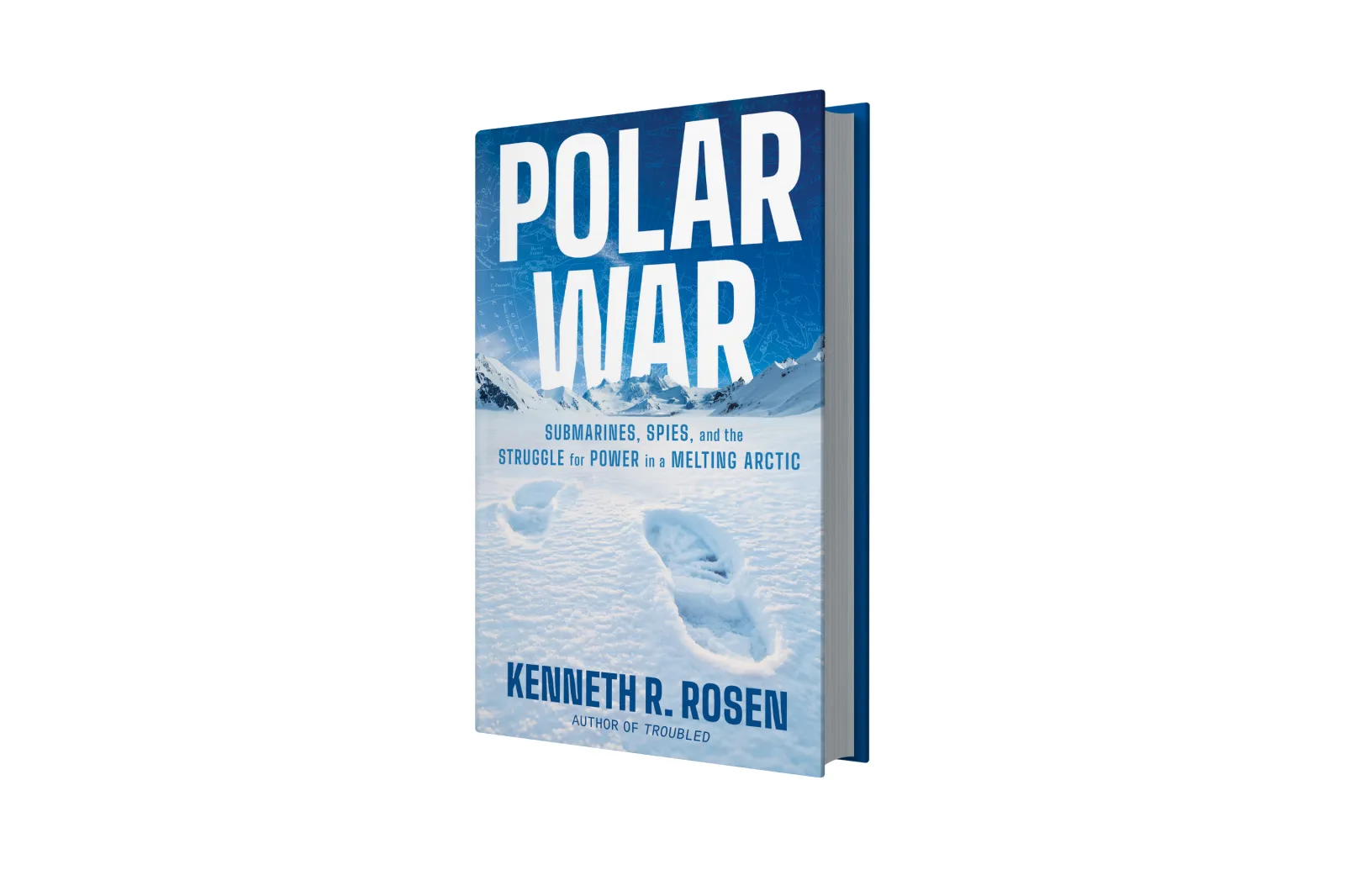
Courtesy of Simon & Schuster
Nicholai updates me on his partner and his children and his dream of taking over the electrician business. He reiterates a feeling prevalent even in the faint light of promised independence as it shone against the realities of interdependence and the machinations of foreign nations. “You never get higher than the Danes,” he says, noting that to look elsewhere for support and defense, if only for respect, seems like the nation’s only option. With the Danes, “we’re always lower,” he says. Though under the defense umbrella of NATO and the United States, Greenland is willing to accept protection from whomever is willing to invest in its future. Not those who threaten to invade it. But those who lift them up.
From POLAR WAR: Submarines, Spies, and the Struggle for Power in a Melting Arctic by Kenneth R. Rosen. Copyright © 2026 by Kenneth R. Rosen. Reprinted by permission of Simon & Schuster, LLC and Profile Books, UK.
View 0 Comments
Submit Correction
View Editorial & AI Guidelines