...



By Matthew Robinson, Amanda Greenwood, and Amanda Castro
0
Share
Newsweek is a Trust Project member
See more of our trusted coverage when you search.Prefer Newsweek on Googleto see more of our trusted coverage when you search.
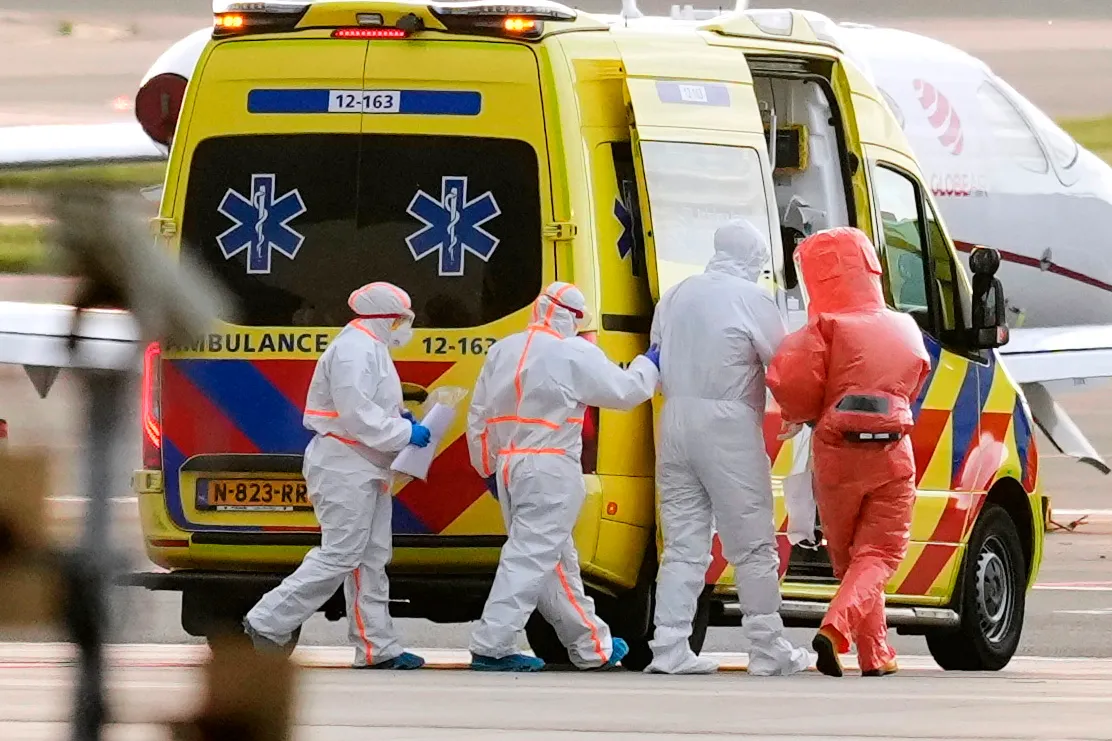
A Dutch flight attendant has been hospitalized with possible hantavirus after coming into contact with an individual infected on board the MV Hondius cruise ship, as two other passengers are also undergoing testing in Singapore.
The flight attendant was on board a KLM flight from Johannesburg to Amsterdam on April 25 when she encountered a Dutch woman who had been infected with the virus, the Dutch health ministry told local news outlet RTL News. The infected woman was not permitted to remain on the flight due to her health condition, and later died in Johannesburg, the airline said.
The flight attendant was later taken to Amsterdam UMC hospital, where she is being kept in isolation and has been tested for hantavirus. She is reported to be experiencing mild symptoms.
Read More on News
Health authorities are now tracing contacts from the flight. The Dutch public health service (GGD) is notifying passengers and advising them to monitor for symptoms, which can take anywhere from a few days to up to 60 days to develop, with most cases emerging within two to four weeks.
...
Singapore Cases Under Investigation
Two Singapore residents who were on board the MV Hondius are also currently being isolated at the country's National Centre for Infectious Diseases, and have been tested for the virus.
"Their test results are pending. One has a runny nose but is otherwise well, and the other is asymptomatic. The risk to the general public in Singapore is currently low," Singapore's Communicable Diseases Agency (CDA) said on Thursday.
Both men, aged 65 and 67, were also on the same flight from St Helena to Johannesburg as the infected Dutch passenger, who later died.
If the men test negative, they will face a 30-day quarantine—the maximum incubation period.
Outbreak Linked To Cruise Ship
The cases are tied to a wider outbreak on the Dutch-flagged MV Hondius, which has been linked to multiple infections and deaths.
The World Health Organization (WHO) said on Thursday that eight cases of hantavirus had been reported, and five had been confirmed.
Tedros Ghebreyesus, the WHO chief, said that more cases may appear over the coming weeks due to the incubation period of the virus.
The outbreak involves a rare strain of the virus known as the Andes variant. Unlike most forms of the virus—which are typically spread through contact with rodent droppings or urine—this variant can be transmitted between people, though experts stress that transmission is uncommon and usually requires close contact.
The WHO has said the overall public health risk remains low.
Is Hantavirus In The US?
According to the WHO, hantavirus is not new to the United States. Cases are reported every year, typically linked to exposure to infected rodents—most commonly in rural areas, such as forests, farms, and fields where rodents are more common.
At least four U.S. states are monitoring people who have returned home from the MV Hondius. One Virginia traveler who was on the ship "is currently in good health, not showing any signs of infection, and is under public health monitoring," the Virginia Department of Health told Newsweek.
Residents in three other states—Georgia, California and Arizona—who were aboard the ship are also being monitored after returning home, The New York Times reported on Wednesday. None has shown signs of illness, officials said.
WHO Urges Calm as Passengers Report Distress
The World Health Organization sought to reassure the public on Thursday as officials addressed growing concern over passengers aboard a quarantined ship and the wider implications of the emerging hantavirus outbreak.
During the briefing, infectious‑disease epidemiologist Dr. Maria Van Kerkhove acknowledged reports of passengers struggling with fear and uncertainty. “We’ve seen videos of passengers in distress. We hear them,” she said, noting that the Director‑General has been in direct contact with the ship’s captain. She added that while the situation is “quite frightening,” morale has improved since the vessel began moving again. WHO emphasized that both medical and psychosocial support are being prioritized for those on board.
WHO panelist Anaïs Legand reiterated that there is currently no approved medical countermeasure for hantavirus, stressing that early, intensive supportive care remains the most effective way to save lives.
Addressing geopolitical tensions following the U.S. withdrawal from the WHO, Tedros Adhanom Ghebreyesus warned that “viruses don’t care about our politics” and urged countries to work together. He said both the U.S. and Argentina, now affected by the outbreak, may come to “reconsider their positions” as the importance of global cooperation becomes clearer.
WHO officials also pushed back against comparisons to the early days of COVID‑19. “This is not COVID, this is not influenza; it spreads very, very differently,” Van Kerkhove said, noting that infections so far occurred among people in close contact within a confined setting.
Dr. Abdi Mahamud, incident manager for WHO’s Western Pacific region, said the organization expects the situation to remain contained if public‑health measures are followed. “We believe this will be a limited outbreak,” he said. “We don’t anticipate a pandemic.”
Hantavirus Case in Israel Confirmed as European Strain, Not Tied to Cruise Outbreak
Israel has confirmed its first hantavirus case in years, after a patient tested positive for a European strain of the virus, according to reporting by Maariv. The individual, who had traveled in Eastern Europe several months ago, sought medical care after developing symptoms consistent with hantavirus infection.
Health officials say the patient’s condition is stable. They have not required intensive care or strict isolation but remain under medical observation. An initial antibody test indicated exposure, and a subsequent PCR test confirmed the diagnosis. Details about the patient’s identity, residence, or treatment location have not been released.
While hantavirus infections are rare in Israel, past cases have been linked to travel in South America. This latest infection is unrelated to the Andes strain driving the international response to the outbreak aboard the MV Hondius polar expedition ship. The European strain detected in Israel is typically transmitted from rodents to humans and is not known for person‑to‑person spread.
View 0 Comments
Submit Correction
View Editorial & AI Guidelines