Newsweek/Getty Images/Photo-illustration by Newsweek/Getty

By Anna Rahmanan
0
Share
Newsweek is a Trust Project member
See more of our trusted coverage when you search.Prefer Newsweek on Googleto see more of our trusted coverage when you search.
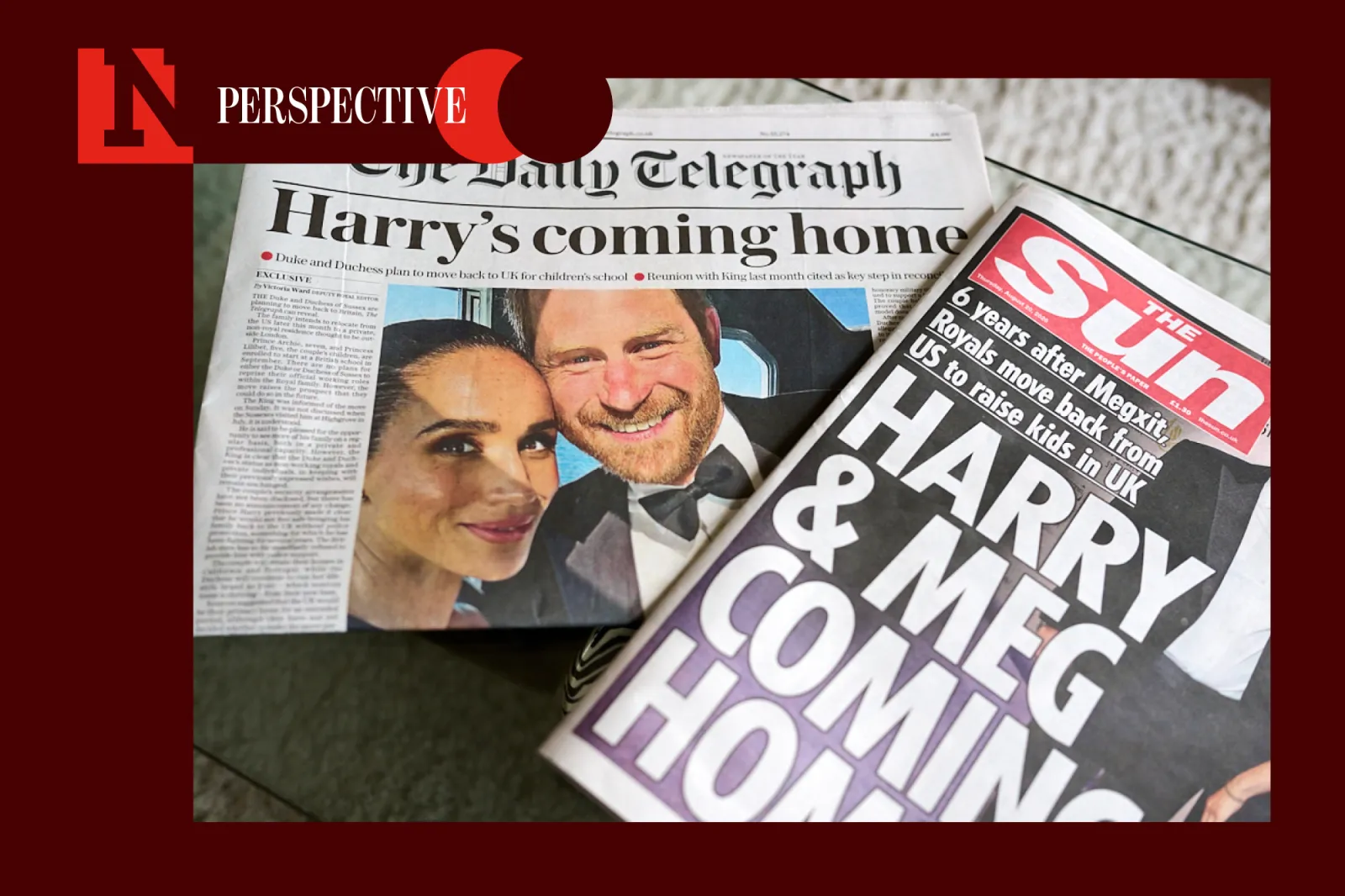
Prince Harry and Meghan Markle have returned to Britain six years after escaping a country they said had become intolerable, only to find that many of the pressures they described in 2020 now seem less like royal peculiarities than features of British life.
The Duke and Duchess of Sussex arrived in the United Kingdom with their children on Wednesday for an extended stay, while remaining outside the ranks of working royals and retaining their home in California.
Their timing is, to say the least, interesting: when Harry and Meghan announced their retreat from royal life on January 8, 2020, they spoke carefully of wanting financial independence and enough “space” to raise their son while dividing their lives between the U.K. and North America.
Read More on News
They were leaving, though nobody could know it then, on the lip of a national rupture. Within weeks came COVID-19; within a year Britain had completed its departure from the European Union’s single market; then came the energy-price shock, falling living standards and a period of political disorder that would bring four prime ministers in six years. The country the Sussexes left was already angry and divided, but the one they have returned to is poorer, less trusting and more visibly strained.
What emerged afterward from Harry and Meghan’s own account was darker. Harry said the British press had become toxic, described racism as a significant factor in leaving the country and told Oprah Winfrey that the couple had spent years asking the royal institution for help. Six years later, the striking thing is how much of the language once attached to their very peculiar royal crisis—feeling trapped, unheard, exposed and badly served by powerful institutions—now has echoes far beyond palace walls.
The Country They Left Got Poorer
January 2020 turns out to be an unusually revealing date from which to measure Britain's decline. The Sussexes left just before the pandemic, the completion of Brexit, the European energy shock and a prolonged squeeze on living standards. Sure, Britain was hardly alone in absorbing those blows, but the before-and-after comparison is striking.
At the end of 2019, real household disposable income per person stood at £6,377 (about $8,669). In the first quarter of 2026 it was £6,295 (about $8,558), according to the Office for National Statistics: Britons on this measure were still slightly poorer in real terms than when the Sussexes left.
Related Story

Let’s Be Honest, Harry and Meghan Were Never Going to Last in America
Daily life feels sharply different, though: food prices were 38 percent higher in July 2026 than in January 2020, rising from an index level of 104.1 to 144.0. Falling inflation doesn’t really make up for those accumulated increases, especially when analyzed alongside other factors, like public services: England's elective NHS waiting list stood at 4.4 million in December 2019, with 1,467 cases waiting longer than a year. By June 2026, the list had reached 7.3 million treatment pathways, including 105,711 waits longer than 52 weeks.
To be clear, Britain is not in ruin. The economy is larger than it was in 2020 and employment remains high by historical standards but, oddly enough, although the country has continued to grow in aggregate, it feels much less prosperous in ordinary life.
The Britain Harry and Meghan returned to is therefore richer on paper than the one they left, yet in several of the places where people encounter the country most directly—the supermarket, the hospital waiting room, the household budget—it has acquired the texture of decline: more expensive and less reliable.
That has all had a political consequence because six years of feeling poorer while paying more and waiting longer have helped turn dissatisfaction with particular institutions into something more akin to a loss of confidence that the institutions themselves can still deliver.
From Royal Dysfunction to National Distrust
Some of the Sussexes’ complaints were highly particular: palace officials, the bargain between royalty and the British press, and racist and sexist treatment of Meghan in parts of the media and online since 2016.
Their broader complaint, though, was about institutions that seemed unresponsive and unwilling to help when asked. Six years later, that feeling has traveled far beyond palace gates.
A July 2025 study from non-profit research agency More in Common UK on British attitudes found that seven in 10 people believed the country was on the wrong track, while 87 percent said they had little or no trust in politicians. Researchers described a public worn down by financial pressure and successive crises, increasingly willing to “roll the dice” on political alternatives.
The parallel only goes so far, of course: a prince’s dispute with palace courtiers is obviously different from a voter waiting months for a hospital appointment or watching governments cycle through leaders.
But the underlying sensation is recognizable: the Sussexes left saying, in effect, that the institution around them would not listen to or protect them. They return to a country where growing numbers of people appear to have reached a similarly bleak judgment about institutions of their own.
A More Fragmented Britain
Britain was hardly harmonious when Harry and Meghan left, and politics revolved around a single consuming question: leave or remain?
What has changed is that the anger is now harder to organize: In 2020, 74 percent of Britons told King’s College London and Ipsos that the country felt divided. By late 2025, that had risen to 84 percent. The share seeing Britain as divided by “culture wars” rose from 46 percent to 67 percent over the same period.
Yet the old Brexit divide itself has weakened. The country has not become less divided so much as divided along more lines at once, including immigration, public services, living standards, culture and the competence of government itself.
Harry and Meghan therefore return to a country whose politics is less defined by one great argument than by a collection of grievances with no obvious place to go. The Britain they left was polarized. The Britain they have returned to is fragmented.
View 0 Comments
Submit Correction
View Editorial & AI Guidelines