Getty Images

By Newsweek Contributors
0
Share
Newsweek is a Trust Project member
See more of our trusted coverage when you search.Prefer Newsweek on Googleto see more of our trusted coverage when you search.
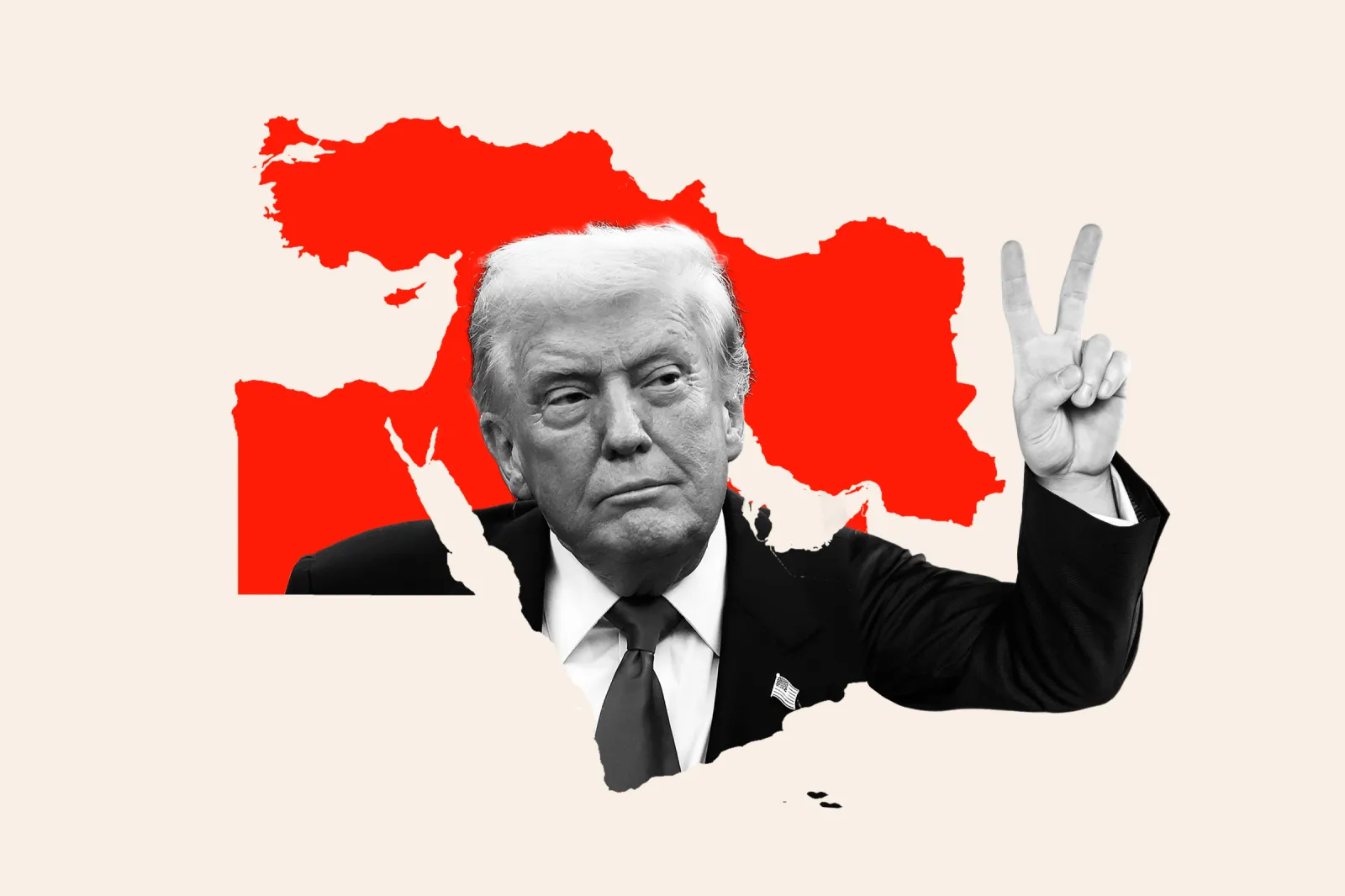
From trillion-dollar investments in the U.S. pledged by Saudi Arabia to an unstable ceasefire deal between Israel and Hamas, President Donald Trump has once again made the Middle East a priority, as he did in his first administration. Has President Trump ushered in a new era of peace in the Middle East? Newsweek contributors Paul du Quenoy and Faisal Kutty debate:
Paul du Quenoy: President Trump is actively ushering in a new era of peace in the Middle East. He prudently backed Israel’s successful operations against Hamas, Hezbollah, the Houthis and other terror groups. He has restored and strengthened containment of Iran, through both Israeli military action and direct strikes that neutralized Iran’s nuclear program. Guided by Trump’s pledge not to interfere in internal politics, Saudi Arabia and the Gulf States have pledged trillions in business deals and foreign investment in the U.S. and appear to be moving toward general acceptance of the Abraham Accords. Even in Gaza, long identified as the crux of all problems in the Middle East, Trump’s sponsored cease-fire is holding, albeit imperfectly, while the U.N. Security Council just approved his peace and development plan.
Faisal Kutty: No, President Trump has not ushered in a new era of peace in the Middle East—he has simply rebranded ongoing violence as diplomacy. The “ceasefire” he touts has been violated hundreds of times, with continued Israeli bombardment, mass starvation and blocked humanitarian aid documented across Gaza. His U.N.-endorsed Gaza plan installs a foreign-controlled “Board of Peace” and military force rather than advancing genuine Palestinian self-determination. Even Israel’s far-right coalition rejects the plan’s faint gestures toward statehood. Peace cannot be claimed while 69,000 Palestinians lie dead, Gaza remains in ruins and the region is being held together by coercion, not consensus.
Read More on Opinion
...
Paul du Quenoy: In Gaza, the war that raged for nearly two years has stopped beyond minor and retaliatory strikes. Even if that were not the case, the major terror groups are radically reduced in effectiveness, their sponsor in Tehran is denuclearized and contained, more countries are signing or preparing to agree to peace, investment is flowing and Russia and China have fled the scene.
Faisal Kutty: The claim that "the war has stopped" is contradicted by documented facts: Israel has launched nearly 500 attacks during the so-called ceasefire, killing hundreds. Starvation, blocked aid and mass displacement continue unabated. Trump’s U.N. plan simply replaces one external authority with another—a U.S.-chaired "Board of Peace" and a foreign stabilization force—not genuine self-determination. Iran is not "denuclearized," and Israel’s governing coalition openly rejects any path to Palestinian statehood. These are the dynamics of deepening instability, not peace.
Paul du Quenoy: The Gaza ceasefire is admittedly imperfect but the full-scale war that raged there since October 2023 is over, as are the mass deaths on both sides. Hardly anyone outside the former foreign policy establishment believes a two-state solution is necessary for larger regional peace. The other Arab-majority states, including historic outliers like Syria, are actively prioritizing peace diplomacy under Trump’s leadership. Iran remains isolated, with its forward positions demolished and its nuclear capability nil.
Faisal Kutty: Calling the situation "peace" overlooks that the ceasefire has produced neither safety nor stability. Essential aid remains blocked, U.N. agencies face operational constraints and humanitarian conditions continue to deteriorate. The region is hardly unified behind Trump: Israel’s own government rejects any reference to Palestinian self-determination, a sine qua non for peace, while Russia and China abstained and advanced rival Security Council proposals. Syria’s engagement reflects geopolitical necessity, not reconciliation. And the claim that Iran’s nuclear capability is "nil" has no evidentiary basis.
Paul du Quenoy: Under President Trump’s wise and productive leadership, the Middle East is in every measurable way more pacific than it was not only a year ago, but at any other time this century and for most of the last century. Building on the enormous success of his first administration, which saw the first Arab-Israeli peace treaties in 26 years and the effective restraint of Iran and the Taliban, he has forged new political and commercial ties with numerous regional powers, reduced multiple terrorist groups to near impotence, severely diminished Iran’s military power, eliminated Tehran’s strategic hegemony over the Levant and Red Sea region, excluded Russian and Chinese strategic competition and created a path to peace between Israel and Palestine that, while not perfect, has stopped the general war and enjoys the approval of the international community and United Nations. The region’s future includes trillions in trade and development, harmonious intraregional ties and unchallenged orientation toward the U.S., the first large-scale modus vivendi with Israel since that country was founded nearly eight decades ago and a broad reduction in terrorism and non-state violence. And all of this was delivered not by the failed appeasement of neoliberal internationalism or the misguided nation-building of neoconservatism but by the America First principles of Donald Trump.
Faisal Kutty: President Trump has not created a new era of Middle Eastern peace but rather a repackaging of a patchwork of unresolved crises presented as progress. Across the region, the core political conflicts remain intact: Iran is neither reintegrated nor verifiably “denuclearized,” Syria’s engagement reflects pressure rather than reconciliation and Lebanon and Yemen remain deeply unstable. Even the much-touted economic realignments rest on fragile leader-to-leader bargains, not durable institutions. Peace built on threats, coercion, or the exclusion of key parties from the process cannot endure. Saudi Arabia’s calculations are driven by necessity, not shared vision, and the Abraham Accords have delivered no meaningful conflict resolution. True regional peace requires legitimate political pathways—not transactional arrangements atop persistent volatility.
Paul du Quenoy is president of the Palm Beach Freedom Institute.
Faisal Kutty is a Toronto-based lawyer, law professor and frequent contributor to The Toronto Star*.*
The views expressed in this article are the writers' own.
View 0 Comments
Submit Correction
View Editorial & AI Guidelines