...

By Ian Randall
Deputy Science Editor
0
Share
Newsweek is a Trust Project member
See more of our trusted coverage when you search.Prefer Newsweek on Googleto see more of our trusted coverage when you search.
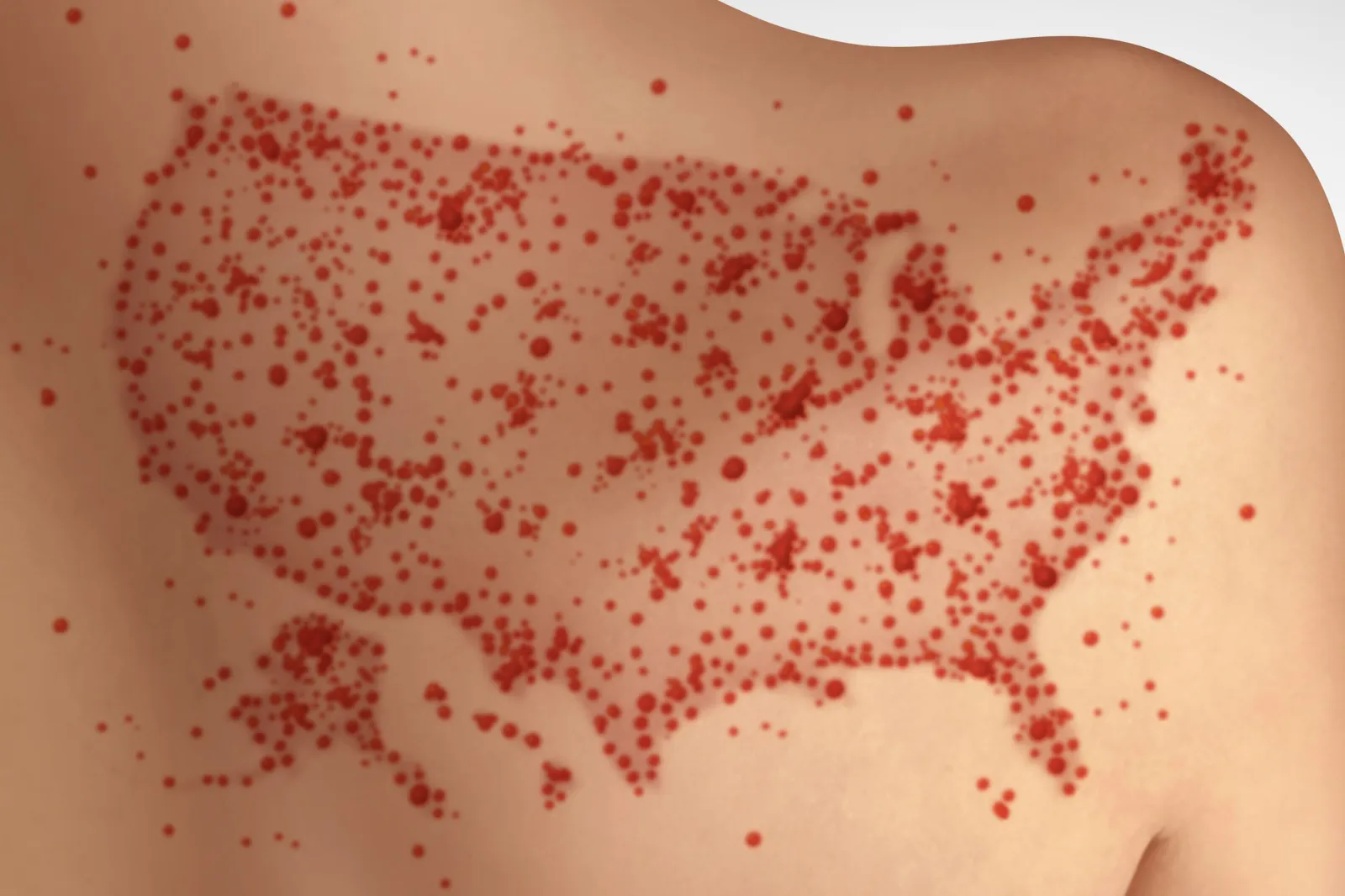
Eliminated a quarter of a century ago in the U.S., measles may be on track for an "unfathomable" comeback within the next two decades.
This is the warning of a study led by epidemiologists from Stanford University who modeled the impact of decreasing vaccination rates on the spread of the infectious disease.
Already, waning levels of immunity have led to significant outbreaks within the states—such as the recent episode in Texas that saw more than 620 cases, 64 hospitalizations and the deaths of two children.
Read More
Ozempic May Lower Risk of Alzheimer’s and Dementia4 min read

Trendy Ice Baths Change Your Body’s Cells, Physiologists Reveal3 min read

Chewing Gum Releases Microplastics Into Your Mouth, Scientists Warn5 min read

"While the effects of declining vaccination won't be immediate, we could eventually see the return of awful complications from diseases that most clinicians today have not encountered thanks to decades of successful immunization," said Professor Nathan Lo in a statement.
"With measles, we found that we're already on the precipice of disaster. If vaccination rates remain the same, the model predicts that measles may become endemic within about 20 years," added Professor Mathew Kiang.
"That means an estimated 851,300 cases over 25 years, leading to 170,200 hospitalizations and 2,550 deaths."
The epidemiologist continued: "It's worth emphasizing that there really shouldn't be any cases at this point, because these diseases are preventable.
"Anything above zero is tragic. When you're talking about potentially thousands or millions, that's unfathomable," Kiang said.
...
In the year 2000, the World Health Organization (WHO) declared that the measles had been eliminated from the U.S.
However, vaccination rates have recently been falling in the U.S.—a problem that worsened during the COVID-19 pandemic.
"We've seen a worrisome pattern of decreasing routine childhood vaccinations. There was a disruption to health care service during the pandemic, but declines preceded this period and have accelerated since then for many reasons," noted Lo.
"People look around and say, 'We don't see these diseases. Why should we vaccinate against them?' There's a general fatigue with vaccines.
"And there's distrust and misinformation about vaccine effectiveness and safety," Lo said.
In their study, Kiang, Lo and colleagues ran large-scale simulations to explore how measles and three other infectious diseases—diphtheria, polio and rubella—could spread across the U.S. under various levels of childhood vaccination.
"Specifically, we wanted to look at some key diseases that have been eliminated from the U.S. through vaccination, which means they're not spreading within the country on an ongoing basis," said Lo.
The four diseases in question, he added, "can have awful complications, like lifelong paralysis, birth defects and death."
In its analysis, the team simulated the entire population of the U.S., factoring in such properties as age, level of immunity, state of residence and vaccine status.
The models, Lo said, assumed that the diseases are introduced to the United States by travelers returning from abroad—typically unvaccinated U.S. citizens.
Measles Explained
Measles is a viral disease known for often causing a rash—made up of large, flat spots and raised bumps—that starts on the face and neck and spreads down the body.
The rash is preceded by around three to five days by symptoms including conjunctivitis, dry cough, fever and runny nose and watery eyes.
According to the CDC, "measles can cause serious health complications, especially in children younger than 5 years of age. Common complications are ear infections and diarrhea. Serious complications include pneumonia and encephalitis."
Doctors recommend two doses of the measles, mumps and rubella (MMR) vaccine to protect against infection. Individuals who think they or their children may have contracted measles should call a health care professional.

...
Measles is highly infectious, with researchers estimating that (in a fully susceptible population) one person with the disease could infect up to 20 others.
"Folks who are unvaccinated are most at risk of infection and the awful complications," said Lo.
"That includes babies, especially those between the ages of 6 and 12 months, who have waning antibodies from their mothers, but are not yet eligible for their first dose of an MMR vaccine."
In addition, people who are immunocompromised are also at higher risk.
"Right now, so many people are immune through vaccination that diseases don't spread far," Lo said, adding: "But if vaccinations decline over a longer period, you start to see outbreaks increase in size and frequency.
"Eventually you see sustained, ongoing transmission, meaning these diseases become endemic—they become household names once again."
Taking a conservative approach based on the average vaccination levels between 2004 and 2023, the team found that, if the status quo is maintained, measles (but not the other three diseases) could become endemic within 20 years.
Should vaccination rates fall by even 10 percent, Kiang said, "measles cases would skyrocket to 11.1 million over the next 25 years."
And if immunization rates were halved, the U.S. could see some 51.2 million cases of measles, 9.9 million cases of rubella, 4.3 million cases of polio and 200 of diphtheria.
"This would lead to 10.3 million hospitalizations and 159,200 deaths, plus an estimated 51,200 children with post-measles neurological complications, 10,700 cases of birth defects due to rubella and 5,400 people paralyzed from polio," Kiang added.
In this nightmare scenario, the models predicted, measles would become endemic in less than five years, rubella in less than 20, and polio would have a roughly 50 percent chance of becoming endemic in some 20 years.
The models also revealed differences at the state level; Massachusetts, for example, has high vaccination rates, and was found to be at a lower risk across all the models. In contrast, both California and Texas—which see a lot of arriving travelers and have seen decreasing vaccination rates—were found to be at higher risk.

...
Part of the problem with measles is that it is one of the most-infectious diseases known, meaning that widespread immunity is needed to keep it from spreading.
"Also, the MMR (measles, mumps and rubella) vaccine has become particularly controversial, partly due to a history of fraudulent medical research that raised safety concerns; it has been conclusively shown that there is no link with autism," said Lo.
In addition, the team notes, measles is more common than diphtheria, polio and rubella around the world, meaning that travelers are more likely to bring it back to the U.S.
"Travelers importing a disease are like matches, and U.S. under-vaccination is the tinder," said Kiang. "With measles, you're throwing a lot of matches in—and eventually something is going to happen."
"I would encourage parents who aren't sure about vaccination to discuss this with their pediatrician and believe in our health-care providers," said Lo.
The researchers say they hope that their findings will be useful both for individuals, but also officials, to understand what will happen if vaccine rates continue to decline.
"With measles, we're right on the cusp. Increasing vaccination levels by just 5 percent brings the number of measles cases down safely away from returning to endemic levels," Lo added.
He said: "These are the kinds of small percentages that can really be a tipping point. It's empowering that a small segment of the population can make a difference here."
Do you have a tip on a science story that Newsweek should be covering? Do you have a question about measles? Let us know via science@newsweek.com.
Reference
Kiang, M. V., Bubar, K. M., Maldonado, Y., Hotez, P. J., & Lo, N. C. (2025). Modeling reemergence of vaccine-eliminated infectious diseases under declining vaccination in the US. JAMA. https://doi.org/10.1001/jama.2025.6495
View 0 Comments
Submit Correction
View Editorial & AI Guidelines