
...

Brooke Diaz for Life Extension
Content Editor
0
Share
Newsweek is a Trust Project member
See more of our trusted coverage when you search.Prefer Newsweek on Googleto see more of our trusted coverage when you search.
What's the best age to start a healthy aging routine? Whatever your current age happens to be, of course.
Whether you've just graduated college or are enjoying your retirement years, there's no time like right now to start your longevity strategy.
Getting a head start is always ideal, but if your youth involved more partying and processed foods than mindfulness and fresh kale, it's never too late to turn things around, according to Stephen Tapanes, PhD, scientist at Life Extension.
Read More on Health
...
"Staying healthy is a multidimensional effort that stems from the pillars of optimal health," Dr. Tapanes explained. People of every age can benefit from those five pillars:
- Sleep
- Nutrition
- Exercise
- Stress management
- Regular blood work
Pursuing healthy aging, however, is going to look a little different for a 20-year-old than it will for a 60-year-old.
Not to worry: Dr. Tapanes has a decade-by-decade health guide designed to support vitality, today, tomorrow, and for many years to come.
At a Glance:
- Explore longevity tips to help your body age gracefully, whether you're in your 20s, 30s, 40s, 50s, 60s, or beyond.
- Stress, hormonal and cognitive changes can impact your health as you age.
- Quality sleep, stress management, balanced nutrition, and staying active are crucial habits for longevity, regardless of your age.
In Your 20s: Build a Strong Foundation
Your 20s are a time of growth, change, and self-discovery. It's also the perfect opportunity to lay the foundation for long-term health.
Here's what Dr. Tapanes recommends:
- Create your sleep routine: Now that you're no longer pulling all-nighters to cram for exams, you can start establishing good sleep hygiene. "Aim to get 7-9 hours of quality sleep each night. It allows your body to rest and renew, which is important to help recover and keep your body going," advised Dr. Tapanes. "Setting a regular wake/sleep schedule, even on weekends, is crucial to a healthy nighttime routine."
- Build a consistent exercise schedule: Make sure your weekly workouts include cardio, mobility and strength-training. "Each week, aim to get 75 minutes of vigorous-intensity exercise, 150 minutes of moderate-intensity exercise, or a combination of the two," recommends Dr. Tapanes. "And doing two or more days of resistance training to tone and maintain muscle groups." You can complement your efforts with fitness supplements that help support muscle mass and encourage healthy recovery.
- Get baseline lab work: Get physicals every year, and schedule annual lab tests to start tracking your blood count, chemistry panels, thyroid function and hormone balance.
- Make a plan to meal plan: Takeout is convenient, but being your own chef means you control what goes into each meal—more delicious, nutrient-rich, whole, organic foods and minimal sugars and processed ingredients. Batch cook on weekends so that you can brown-bag healthy lunches all week long.
- Build stress resilience: "Supporting a healthy stress response is imperative for your health span," Dr. Tapanes explained. Finding ways to manage stress in your 20s is key to aging well. Spend more time in nature, journal, meditate, cuddle your dog, take a dance class—whatever helps you feel at peace.
- "Adulting" means excellent oral hygiene: It's not just about having a pretty smile. Did you know oral health has been linked to heart health? Visit your dentist biannually and don't forget to brush and floss.
- Limit habits that negatively impact well-being: While it's tempting to drink alcohol, binge junk food, and forgo sleep, it's in your best health interests to limit the experiences that don't support wellness. Your future self will thank you.
In Your 30s: Don’t Let Stress Derail Your Routine
Ah, the 30s: that pivotal decade. Your career and family life likely are suddenly in sharp focus, and you might feel like you no longer have free time for exercise and meal prep—but don't give up now.
"In your 30s, you'll want to buckle down on the habits you've built," Dr. Tapanes noted.
In addition to keeping up with the routines you've already established (or starting them back up again, if you let them lapse), you'll want to add these to the list:
- Quality sleep is still your goal: Sleeping seven to nine hours every night remains key to your overall well-being. Of course, if your 30s include parenting little ones and/or work stress, this may no longer seem feasible, but don't lose sight of this goal. Dr. Tapanes recommends pairing off nighttime childcare responsibilities with your partner so you each have a time to catch up, and consider sleep support such as melatonin if the issue isn't kids but run-of-the-mill occasional sleeplessness.
- Maintain the meal prep: It's not uncommon for busy thirtysomethings to give up on healthy meal prep, picking at their kids’ macaroni and cheese, or splitting a pizza with their roommate or partner instead of eating a balanced dinner. Rather than throwing in the towel (or apron), this is the time to finesse your culinary chops, Dr. Tapanes advised. Try new options that appeal to picky palates and get the whole household involved in batch-cooking. "Train your kids to be your sous chefs." he added.
- Be more intentional with your workout routines: Women should make sure they're getting strength training in addition to cardio to keep those muscles (and bones) strong. Men, on the other hand, tend to focus on strength, but should be careful not to neglect mobility. Functional exercises are a great way to tone muscles and develop a full range of motion.
- Put a focus on fertility: This is true whether you're trying to conceive or are actively avoiding pregnancy, because your fertility reflects your overall health status. For women, irregular cycles and spotting can let you know when something's amiss. If babies are on the agenda, start taking a prenatal vitamin, ideally before you conceive.
In Your 40s: Be Proactive
A new decade, a new set of potential pitfalls: your 40s are a time when life's demands and some beginning signs of aging can make you feel off-kilter.
That's why taking proactive actions early is so important for people approaching mid-life, according to Dr. Tapanes.
Keep up with your longevity routine and make room for some new healthy habits:
- Build muscle mass for metabolic health: Your muscles play a critical role in how your body burns energy, stores fat, and balances blood sugar levels, Dr. Tapanes explained. Strength training, like powerlifting, targets all areas of your body, helping you tone and maintain muscle mass. Add resistance bands or a weighted vest to your routine to engage muscle function.
- Care for your joints: Full range of motion is lotion for your knees and joints. Consider taking joint supplements for additional nourishment. Dr. Tapanes recommends building warm-ups and cool-downs into the start and finish of your workouts.
- Get serious about fiber: "People often ignore the gut's need for fiber," Dr. Tapanes said. But having adequate fiber intake helps you maintain your weight, supports digestive health and may even benefit your heart health. Add more leafy greens, nuts and seeds, legumes, and berries to your meal plan. A fiber supplement is also a great way to get your daily dose.
- Ladies, prepare for perimenopause: "At 40, it's common for women to not feel like their usual selves," said Dr. Tapanes. Changes in sleep patterns, sex drive, and an onset of uneasiness are to be expected, as the body prepares for menopause in later years. Now is an excellent time to explore hormone balance supplements with the guidance of your gynecologist.
In Your 50s: Health Screenings Galore
Once you're in your 50s, it's time to kick your longevity strategy into high gear. "This is the decade when you want to partner with your doctor and get screenings, and if anything is concerning, be proactive about treatment," Dr. Tapanes advised.
- Don't skip life-saving tests: Between colonoscopies, mammograms, stress tests, and other routine exams ordered by your physicians, you may feel much of this decade is spent being poked and prodded. "Early detection is key to staying healthy in your 50s and beyond," Dr. Tapanes pointed out.
- Mind your vision and hearing: Protect your hearing by steering clear of loud music, venues and noises. Make sure your eye prescriptions are up to date, as this is a decade when your vision may change.
- Check in on your bones: Screenings for bone density are extremely important for women. Take bone supplements to keep standing tall.
- Build a menopause strategy: Menopause brings physical and mental changes that infringe on your sleep, sex drive, metabolism and overall health. Your gynecologist can help you adjust lifestyle habits, and explore options for hormone replacement regimens and menopause support supplements.
- Male hormone health matters, too: "At 50, men may feel that keeping up with good sleep, exercise, and stress management is more challenging," said Dr. Tapanes. Speak with your doctor about hormone replacement regimens and adding a testosterone supplement to your routine.
- Keep the number on the scale in check: "For some people in their 50s, maintaining a healthy weight can be challenging," said Dr. Tapanes. While healthy eating habits (reducing sugar, increasing protein and fiber), regular exercise, staying hydrated and sufficient sleep are crucial. Your doctor or dietitian can also help you understand your body composition, and lifestyle changes that can help you stay on track.
In Your 60s and Beyond: Keep Your Brain in the Game
As you enter your 60s, cognition is key to living your golden years in the best light—and so is community, which is important for your mental health and sense of purpose.
- Challenge your brain: "Keeping the brain active enhances your mental health and productivity," explained Dr. Tapanes. Volunteer, enroll in online courses, join a book club, or download a mentally challenging puzzle app to keep your noggin sharp. Adopt a mindfulness or gratitude practice to keep a positive outlook in life.
- Stay social: "The importance of cultivating close, meaningful relationships is often overlooked," Dr. Tapanes stated. "Maintaining healthy social connections and a social circle can help support brain health." In fact, numerous studies have found an association between social networking and cognitive health and function.
- Manage stress in novel ways: Stress doesn't exit stage left as soon as you hit retirement, unfortunately. Consider activities like yoga, tai chi and even forest bathing to ensure you're keeping an even keel—and as a bonus, meeting new people.
- Support healthy testosterone levels: "At 60, men experience a significant change in testosterone levels," said Dr. Tapanes. This hormonal change can impact everything from mood to muscle mass, to weight and energy levels, so it's crucial to monitor testosterone and other sex hormones. Focus on nutrition and lifestyle habits and speak with your doctor about testosterone-supporting supplements to help promote healthy testosterone levels.
Healthy Aging Supplements by Decade
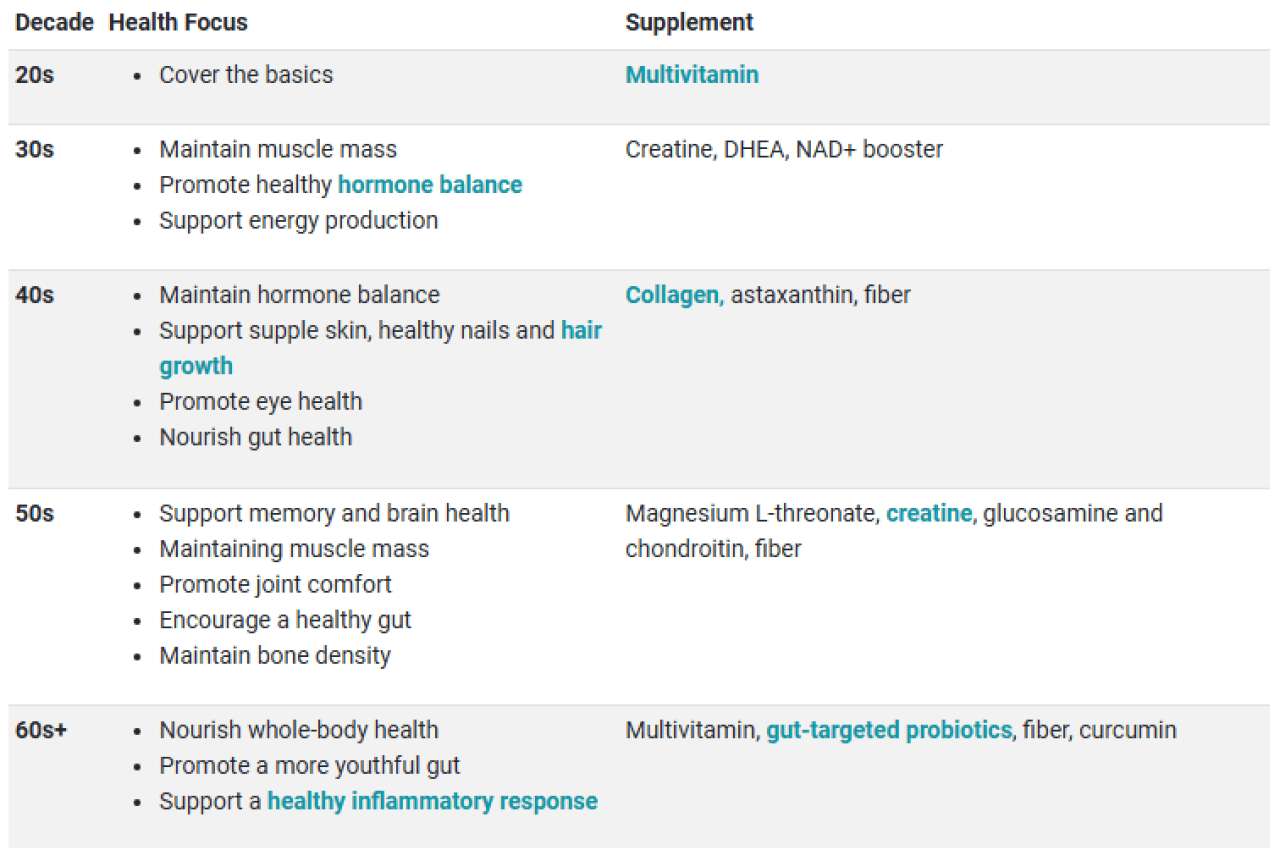
As your age changes, so do your nutritional needs. "We can support different aspects of our health by curating our dietary supplement strategy," Dr. Tapanes explained.
Here's a chart of age-specific supplements that can help you stay healthy each decade.
Core Supplements for Every Decade
While age-specific vitamins and supplements are worth noting, Dr. Tapanes recommends making these dietary supplements non-negotiable in your healthy aging routine.
- Vitamin D3: The sunshine vitamin is crucial for brain, heart and bone health, and helps promote a robust immune system.
- Magnesium: From nerve to muscle health, to heart, brain and bone support, magnesium is an essential supplement for aging well at every decade.
- Fish oil: To help maintain already-healthy cholesterol levels (pivotal for a healthy ticker), cognitive function and joint comfort, you want to keep omega-3 fatty acids in your healthy aging routine.
- B vitamins: Keep your body energized and your mind sharp with B vitamins (all eight of them). Choose a B-complex supplement that delivers biologically active forms to help your body get the "Bs" it needs to thrive.
- CoQ10: Coenzyme Q10 is an antioxidant that's involved in mitochondrial function and cellular energy production, but levels decline over time. Fuel high-energy organs, like your heart, brain, liver and kidneys with a CoQ10 supplement.
At What Decade Do You Age Faster?
The field of healthy aging is still new, but it provides insight into when aging accelerates. While more research is needed, one study showed that rapid periods of change average around the ages of 44 and 60.
But, as Dr. Tapanes explained, aging is an amalgamation of physiological changes that directly impact our overall health.
"Understanding the changes our bodies go through as we age is a critical step in potentially extending our health span," he added.
What Is Biological vs. Chronological Aging?
Your chronological age is based on the number of years you've traveled around the sun. It's an unchangeable number (boo).
However, as Dr. Tapanes explained, biological age reflects the accumulated biological stress on your DNA and body and can be changed for the better with lifestyle and diet choices (yay).
Ditching alcohol, smoking and sugars, swapping processed foods for a whole-foods diet, getting uninterrupted sleep, exercising regularly, nurturing relationships, and adding supplements to support your telomeres (the protective ends of your chromosomes), can all swing the pendulum positively for your biological age.
What Is the #1 Predictor of Longevity?
While there is no singular predictor of lifespan, certain assessments can paint a clearer picture of the years to come.
Factors like social connections, self-rated health, exercise fitness and VO2 max testing (the maximum amount of oxygen your body can use during intense physical activity) have all been studied and considered predictors of longevity.
Of course, what you eat also matters. "Nutrition is a crucial piece of the aging-well puzzle," Dr. Tapanes said.
"Adding longevity foods, which are nutrient-rich foods that support health span, is an excellent way to help add more life into your years."
How To Tell if You’re Aging Well
If you're staying engaged, intentional and connected—mentally and physically—chances are you're on the path to aging gracefully.
The state of your skin, the balance between your mental and gut health, the speed you heal, and your physical activity level are also great indicators.
And finally, regular bloodwork and other tests done by your doctor can all point to how you're progressing decade by decade.
Key Takeaways
- It's never too early or too late to start a healthy aging strategy.
- Restful sleep, regular exercise, mental stimulation, and social connections are imperative factors in aging well, especially as we reach our older decades.
- Balanced nutrition and lifestyle choices, including stress management supplements, can positively influence our biological age, adding more life into our years.
This story was produced by Life Extension and reviewed and distributed by Stacker.
View 0 Comments
Submit Correction
View Editorial & AI Guidelines