...

By Jordan King
Reporter
0
Share
Newsweek is a Trust Project member
See more of our trusted coverage when you search.Prefer Newsweek on Googleto see more of our trusted coverage when you search.
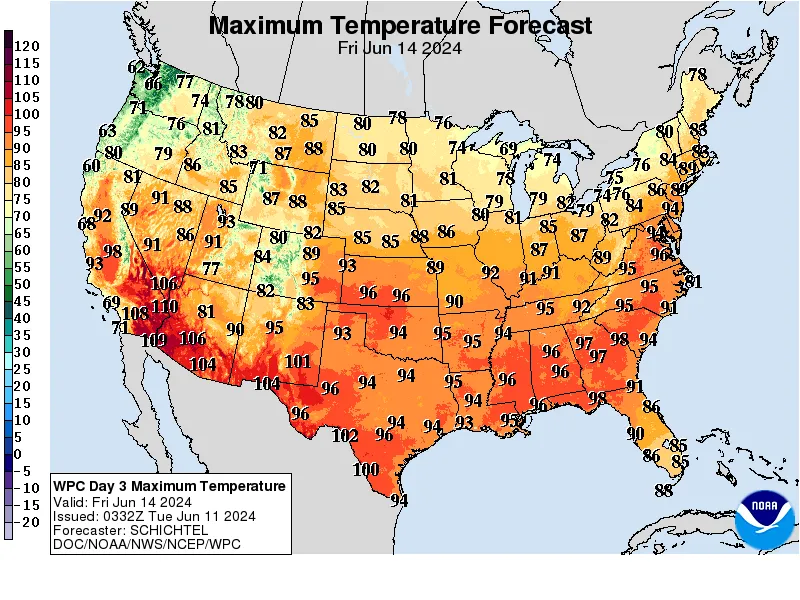
The National Weather Service has released a map showing "sizzling temperatures" hitting the country this week.
Last week, southwestern states were under excessive heat warnings. Now, heat starting in the West is expected to move to the Midwest by Wednesday before spreading to the southern and eastern parts of the country.
Read more: Emergency Funds: How to Build One and Where to Keep It
Read More
Arizonans Advised to Avoid Alcohol, Caffeine Amid Blistering Heat3 min read

With Heat Rising, Climate Progress Is at Grave Risk in the 2024 Election | Opinion4 min read

Texas City Issues Swimming Pool Advisory as It Risks Running Out of Water3 min read

There are multiple severe heat warnings and watches in place for almost every day this week, with some places set to see highs of 100 to 107 degrees Fahrenheit.
When the heat index—which measures how hot it feels outside when relative humidity is combined with the air temperature—is between 103 and 124 degrees, the NWS provides a classification of "danger."
This category, the second-most severe after "extreme danger," means "heat cramps or heat exhaustion likely, and heat stroke possible with prolonged exposure and/or physical activity," the NWS said.
Major cities that have been classed as in the "danger" zone include Laredo and Brownsville, Texas, where the heat index is forecast to be 103 degrees or above for the next week.
Corpus Christi, Texas, is under the same alert—except over Friday, Saturday and Sunday, when the index is expected to dip slightly to between 100 and 102 degrees. San Antonio is set to reach 103 degrees next Tuesday.
Read more: Find the Right Type of Savings Account for Your Needs
In Arizona, cities that could see days of 103 degrees and above in the next week include Phoenix, Mesa, Chandler, Gilbert, Glendale, Scottsdale, Peoria and Tempe.
Florida's Key West and Tallahassee can also expect days in the "danger" zone—next Monday and Tuesday for the former and Wednesday and Sunday for the latter.
Missouri's Kansas City and Topeka and Kansas City, Kansas, can each expect to see one day of "danger"-level heat.
Read more: Average Savings Account Rates
On the heat index, the classification below "danger" is "extreme caution"—temperatures between 90 and 103 degrees—which is shown in orange on the map. People in places with this warning can expect "heat stroke, heat cramps, or heat exhaustion possible with prolonged exposure and/or physical activity."
...
Temperatures between 80 and 90 degrees are classed as "caution," meaning "fatigue possible with prolonged exposure and/or physical activity."
On its website, the NWS explains why humidity can be especially dangerous in hot temperatures.
The agency said: "When the body gets too hot, it begins to perspire or sweat to cool itself off. If the perspiration is not able to evaporate, the body cannot regulate its temperature.
"When the body gets too hot, it begins to perspire or sweat to cool itself off. If the perspiration is not able to evaporate, the body cannot regulate its temperature. Evaporation is a cooling process.
"When perspiration is evaporated off the body, it effectively reduces the body's temperature. When the atmospheric moisture content (i.e. relative humidity) is high, the rate of evaporation from the body decreases. In other words, the human body feels warmer in humid conditions."
Forecasters advised people under heat warnings this week to "drink plenty of fluids, stay in an air-conditioned room, stay out of the sun, and check up on relatives and neighbors."
They continued: "Do not leave young children and pets in unattended vehicles. Car interiors will reach lethal temperatures in a matter of minutes.
"Take extra precautions when outside. Wear lightweight and loose-fitting clothing. Try to limit strenuous activities to early morning or evening. Take action when you see symptoms of heat exhaustion and heat stroke."
View 0 Comments
Submit Correction
View Editorial & AI Guidelines