10
Loading video...

By Ellie Cook
Senior Defense Reporter
0
Share
Newsweek is a Trust Project member
See more of our trusted coverage when you search.Prefer Newsweek on Googleto see more of our trusted coverage when you search.
Resurfaced maps showing the heavy Cold War bombardment of Laos have fed the controversial legacy of diplomatic giant Henry Kissinger following his death.
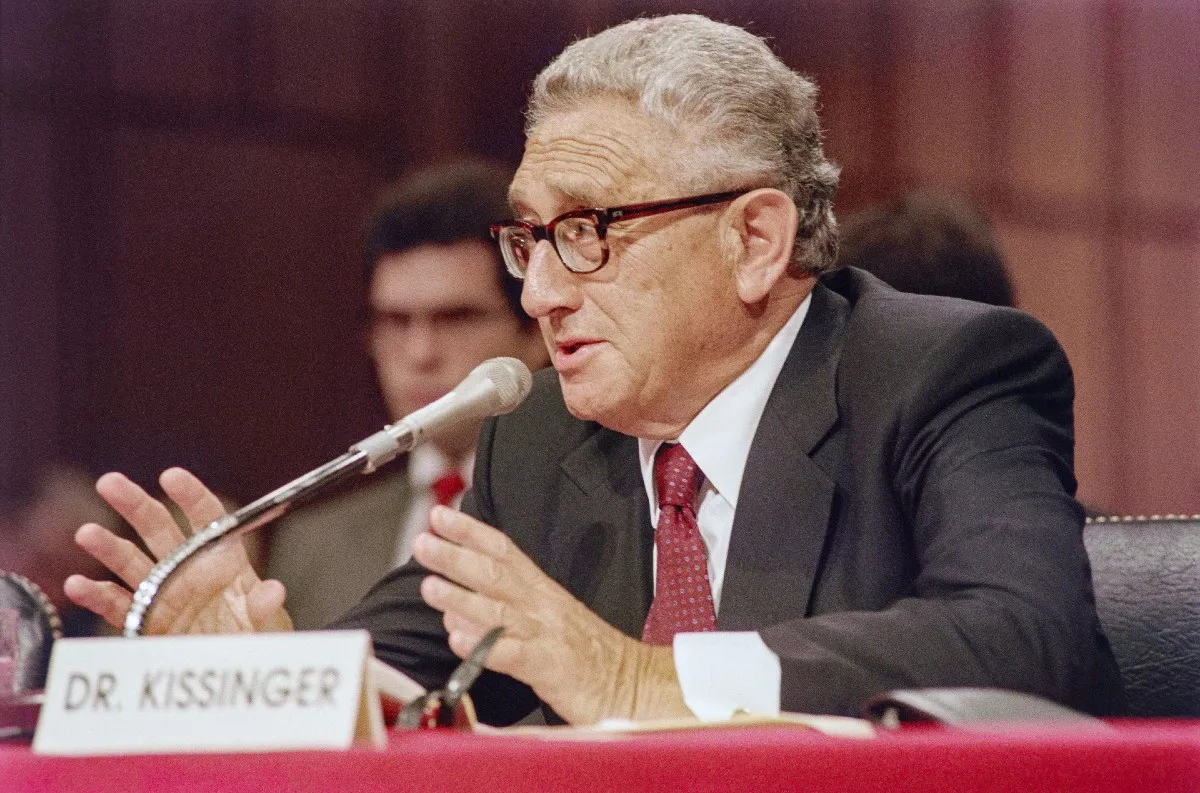
Kissinger, a former secretary of state and national security adviser who is credited with shaping decades of U.S. foreign policy, died at his Connecticut home aged 100 on Wednesday.
Kissinger "played central roles in the opening to China, negotiating the end of the Yom Kippur War in the Middle East, and helping to bring America's role in the Vietnam War to a close," the diplomat's international geopolitical consulting firm said in a statement on his passing.
Read More
Kissinger Remembered in China as “Old Friend” as Tributes Sweep Social Media3 min read

Henry Kissinger, Dead at 100, on China, Israel and Nuclear War4 min read

Henry Kissinger, Pelé and the Deal that Changed American Soccer: “My God!”6 min read

The influential diplomat won the 1973 Nobel Peace Prize along with Vietnamese diplomat Le Duc Tho "for jointly having negotiated a cease-fire in Vietnam in 1973." The latter declined the prize.
But as tens of thousands of U.S. soldiers died in Vietnam, anger in the U.S. was also spurred on by the extensive bombing of neighboring countries Laos and Cambodia.
...
The U.S. was attempting to disrupt a logistics chain — known as the Ho Chi Minh trail — running from Laos into Vietnam, which was used by North Vietnamese forces.
Laos is the most bombed country in the world. Between 1964 and 1973, the U.S. dropped more than 270 million bombs on the country, which had a population of around 3 million at the time.
U.S. aircraft dropped a new wave of bombs on Laos every eight minutes for nearly 10 years on average.
In 2016, former U.S. President Barack Obama said the U.S. had dropped more than two million tons of bombs in Laos between 1964 and 173, which is "more than we dropped on Germany and Japan combined during all of World War II."
"Villages and entire valleys were obliterated," he said during a visit to the country. "Many of the bombs that were dropped were never exploded."
An estimated 80 million unexploded bombs still litter the nation, including cluster munitions that can pose a danger to civilians many years after they are dropped.
"Given our history here, I believe that the United States has a moral obligation to help Laos heal," Obama added.
Maps recirculating online in the aftermath of Kissinger's death once again emphasized the complicated legacy of the towering political force in the midst of tributes.
"Kissinger's legacy," one X user wrote, resharing a map appearing to detail the U.S. bombing campaign across Laos.
Kissinger, who was born in Germany in 1923, fled with his family from Nazi Germany and arrived in the U.S. in 1938. He became a U.S. citizen in 1943, and served in the U.S. military before making his way in the height of Cold War politics under Republican Presidents Richard Nixon and Gerald Ford. Even after leaving office, he continued to be an influential voice among America's leaders.
Kissinger leaves behind his wife, Nancy Maginnes Kissinger, two children and five grandchildren.
View 0 Comments
Submit Correction
View Editorial & AI Guidelines