...

By Micah McCartney
Reporter
0
Share
Newsweek is a Trust Project member
See more of our trusted coverage when you search.Prefer Newsweek on Googleto see more of our trusted coverage when you search.
A new database of Chinese newspapers tracks the intensity of Communist Party propaganda used to support "ethnic harmony" in what critics say amounts to suppression of minority cultures.
One standout example is "铸牢中华民族共同体意识" ("forging a strong sense of community for the Chinese nation"), a party slogan championed by President Xi Jinping and now synonymous with assimilation efforts.
The phrase is all too familiar to Soyonbo Borjigin, a journalist from the Inner Mongolia Autonomous Region, who recently launched a platform that tracks party propaganda efforts by scraping a database of nearly 700,000 articles from 20 provincial papers and two national ones since 2023.
Read More on World
Before leaving China for the United States, Borjigin and his colleagues at the Inner Mongolia Daily were put through a 30-day re-education program.
"During one session, the instructor asked us to reflect on the character 铸 ("to forge" or "to cast") and what it meant. The answer they gave us was that it was a metaphor for ethnic fusion, like molten steel being cast into a single mold," he told Newsweek. "The implication was clear: distinct ethnic identities were to be melted down and recast into one."
Later, when Borjigin traveled to the eastern city of Nanjing, he noticed the slogan was absent from day-to-day life. "That confirmed what PropagandaScope's data now shows at scale: this campaign is disproportionately concentrated in minority regions," Borjigin said.
...
Compared with the national People's Daily, this slogan was amplified more than 15 times by the Xinjiang Daily, the party newspaper in the far western region of Xinjiang, home to the Muslim Uyghurs. The Tibet Daily and Inner Mongolia Daily saw their amplification increase by 9.5 and 8 times, respectively.
China recognizes 56 ethnic groups, including the Han, which comprise more than 90 percent of the country’s population of about 1.4 billion. For decades, many minority groups were accorded a greater degree of cultural autonomy. However, since the 2010s, Beijing has stepped up these Sinicization efforts as Xi sought greater control over ethnic policy.
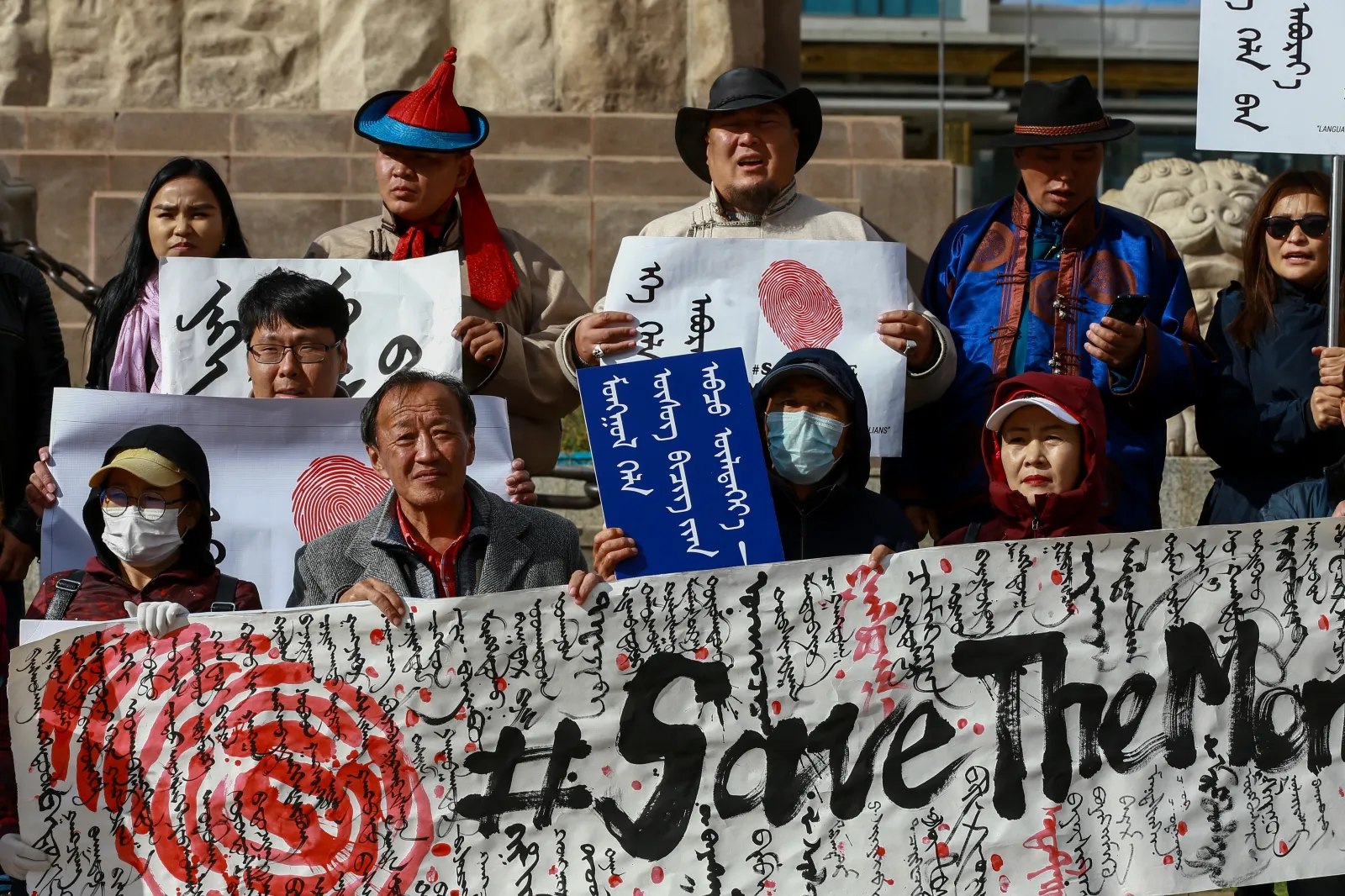
Resistance has been met with crackdowns, as seen in Inner Mongolia in 2020, when thousands were detained after protesting the rollout of a Mandarin-only education policy.
On March 12, China passed the Law on Promoting Ethnic Unity and Progress during the annual session of China’s rubber-stamp parliament. The law aims to “fully promote and popularize” Mandarin, the national language. Children across China are to be instructed in Mandarin from preschool through secondary education, whereas before they were permitted to study in their native tongues, such as Tibetan or Uyghur, a language widely spoken in Xinjiang.
Local governments are called on to build “inter-embedded” communities, encouraging mixed residence among ethnic groups and weaving these goals into urban planning, housing policy, employment, and social services. The law also provides for punishment for parents deemed to instill in their children ideas considered harmful to “ethnic unity,” a broadly worded term rights groups say has frequently been used against minorities who resist Chinese Communist Party policies.
Human Rights Watch Associate Asia Director Maya Wang said the law cemented existing "deeply abusive" practices and mobilized China's bureaucracy toward the goal of cultural assimilation.
Chinese officials dispute that the law is being used to suppress minorities.
"The law clearly stipulates that 'All ethnic groups in the People's Republic of China are equal,' that 'The outstanding traditional cultures of all ethnic groups constitute integral parts of Chinese culture,' that 'The State respects and safeguards the learning and use of the spoken and written languages of ethnic minorities,' and that 'Mutual learning and integration among the cultures of all ethnic groups are encouraged,' Liu Pengyu, spokesperson for the Chinese Embassy in the U.S., told Newsweek.
" We hope foreign friends will view China’s ethnic policy in an objective and correct way, and avoid misinterpretation and distortion."
View 0 Comments
Submit Correction
View Editorial & AI Guidelines