...

By Andrew Stanton
Reporter
0
Share
Newsweek is a Trust Project member
See more of our trusted coverage when you search.Prefer Newsweek on Googleto see more of our trusted coverage when you search.
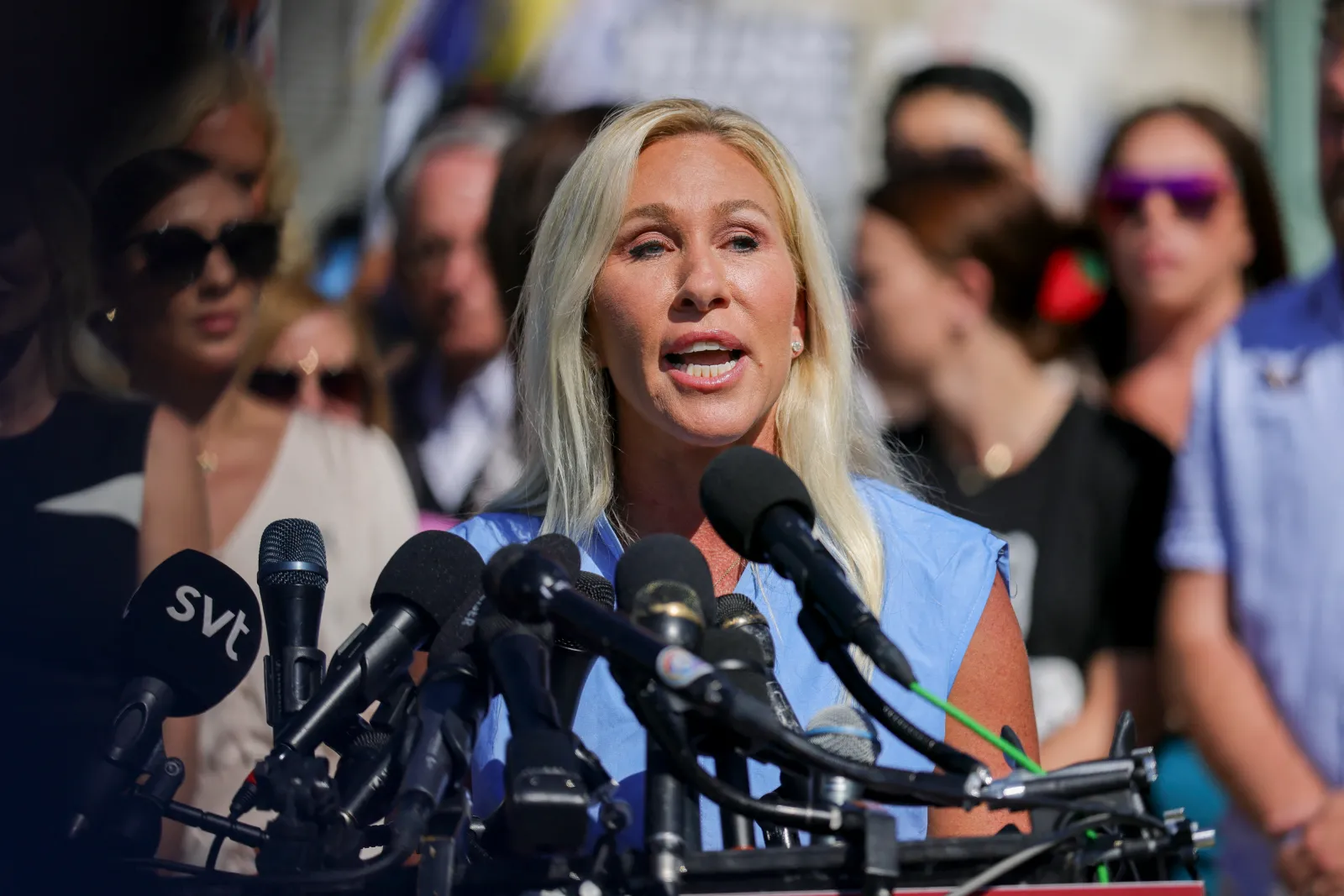
GOP Representative Marjorie Taylor Greene’s resignation from Congress in January will raise the possibility that Republicans could lose their razor-thin majority next year.
Newsweek reached out to the Republican and Democratic national committees for comment via email.
Why It Matters
Republicans currently hold a 219-213 makeup in the House of Representatives, a historically narrow margin that has created headaches for leadership in the past. Keeping both wings of the GOP—the party's most conservative members, such as Greene, as well as more centrist Republicans representing districts that have a more Democratic tilt—has not always been an easy task.
Read More on Politics
Greene, of Georgia, announced Friday she will resign from Congress on January 5, 2026 following her falling out with President Donald Trump over the release of the Epstein files. That will temporarily leave vacant a seat in a reliably Republican district—at least until the special election is held to replace her, lowering Republicans’ margin to 218-213. The outcome of several other special elections could further complicate math for Republicans in the coming months.
What to Know
Greene warned in her resignation that she believes the Republican Party is on track to lose their majority in the 2026 midterms, when Democrats are hopeful about a 2018-style "blue wave" fueled by Trump’s falling approval rating.
The chances of Republicans losing their majority before the election remain low, as such a shift in the balance of power would be unprecedented, but Greene’s exit does raise the possibility.
"Democratic control before the midterms remains remote but not entirely out of the question," Costas Panagopoulos, a political-science professor at Northeastern University, told Newsweek. "There would have to be a perfect storm of events to unfold in order for that to happen. That said, it’s conceivable or at a minimum, some type of split majority—at least a temporary split majority that does not put one party or the other in the majority.
...
Democrats are favored in two of the three upcoming special elections. One is in Texas to replace the late Representative Sylvester Turner who died in March, and the other in New Jersey to replace Governor-elect Mikie Sherrill, who last week resigned from her seat in the House of Representatives. The Texas special election is set for March, while the New Jersey race is set for April.
If Democrats win both of those, Republicans’ majority would be at 218-215 after Greene’s resignation.
Stephen Farnsworth, political science professor at the University of Mary Washington, told Newsweek the "big question" is whether other Republicans will also resign from Congress early.
"President Trump has sought to marginalize Congress over the past year, and Speaker Johnson has cooperated," he said. "Trump's decisions to ignore congressional budget decisions when it suits him angers at least some elected officials, who think Congress should stand up for the legislative branch against executive encroachment."
Democrats would also need to win the upcoming special election in Tennessee to have a chance at winning the majority. This race is viewed as competitive, but Republicans are favored. The seat, vacated by former Representative Mark Green earlier this year after he decided to retire from Congress, backed Trump by more than 20 points last year.
But a large overperformance isn’t entirely out of the question, even if it’s not particularly likely.
Democrats have performed well in special elections this year. In the special election for Arizona’s 7th Congressional District, for instance, Adelita Grijalva won by 39 points, while former Vice President Kamala Harris won the district by 22 points last November. In the special election for Virginia’s 11th Congressional District, Democrat James Walkinshaw won by about 50 points after Harris won by 34. Some state legislative races have seen even stronger showings for Democrats. In Rhode Island, a Democrat outperformed Harris by more than 50 points.
Polls do give Republican candidate Matt Van Epps a lead over Democratic candidate Aftyn Behn in the Tennessee race, and it has drawn significant funding from both major parties. The forecaster Sabato’s Crystal Ball rates the race as "Likely Republican." The outcome of the race could hinge on whether voters in that district who have backed Trump in the past are frustrated with him or the economy and choose to stay home or defect to Democrats, Panagopoulos said.
"There’s no telling what could happen if Democrats in the district are energized to show up on Election Day and Republicans stay home," he said.
If Democrats eke out a victory, the Republican majority would shrink to 217-216. This means any other vacancy through a retirement or death would leave the House of Representatives completely split at 216-216.
However, this would likely only be temporary until the special election to replace Greene. Republicans are going to be favored in the overwhelmingly conservative district. GOP Republican Brian Kemp hasn’t announced a date yet for the election, but Republicans will be looking for a quick turnaround on the election to prevent strain on the House majority.
What Happens If Control of the House Is Split?
Control of a party has never flipped in the middle of a Congressional session.
If that were to occur, the two parties would likely have to come to some sort of "power sharing agreement," Panagopoulos said. That could mean one party gets to elect the speaker, while the other remains influential in other key ways. If no agreement were to be reached, that could leave open the room for complications.
Even if control stays with Republicans, Greene’s resignation will make it more difficult to advance part of Trump’s conservative agenda until that seat is filled in the special election next year.
What People Are Saying
Greene wrote Monday on X: "Everyone just runs their mouths but results are the only thing that matter to the American people. Smears, lies, attacks, and name calling is childish behavior, divisive, and bad for our country. Memes and red meat rants do nothing. Actions speak louder than words. Be quiet, be kind, be humble and fix the real problems that are crushing Americans. Not foreign country’s problems. Not the donor’s problems. The American people’s problems that both political parties created and dumped on the American people."
Costas Panagopoulos also told Newsweek: "Given the razor thin majority Republicans have in House right now, anything that compromises that in any way, however small, makes it more difficult for Republicans to get legislation passed. At the same time, it also could potentially inspire other Republicans to push back against Trump or Johnson in the House and possibly even cause other members to reconsider not only their position on issues but also their tenure in the House. Who knows what that could look like."
Fox News reporter Chad Pergram wrote on X: "The Senate majority has flipped a couple of times in the middle of a Congress. The House majority has never switched in the middle of a Congress. That may not be the case now. But the tenuous hold on power has for the GOP has been the story of the House since the 2022 midterms. It’s one of the tightest majorities in history. And it wouldn’t take much to shift power."
What Happens Next
Greene’s resignation goes into effect on January 5, 2026. Every single House seat is up for election in November 2026, as Democrats are increasingly optimistic about their chances of victory.
Update 11/26/2025 11 a.m. ET: This article was updated with additional information.
View 0 Comments
Submit Correction
View Editorial & AI Guidelines