10
Loading video...

By Sam Stevenson
Associate News Editor
0
Share
Newsweek is a Trust Project member
See more of our trusted coverage when you search.Prefer Newsweek on Googleto see more of our trusted coverage when you search.
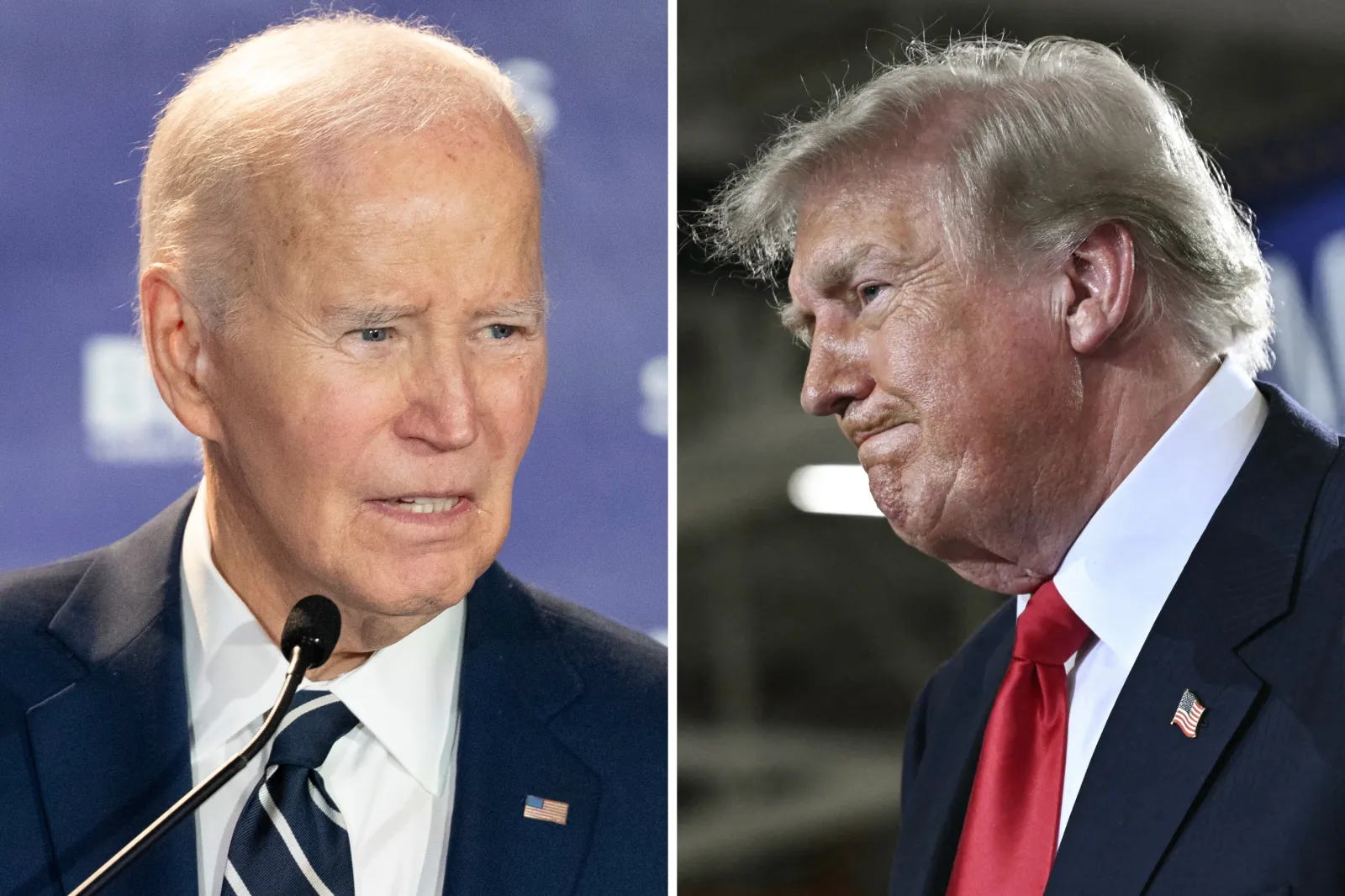
President Donald Trump’s approval rating “has improved somewhat over the last few weeks,” according to Nate Silver’s Silver Bulletin tracker, putting him slightly ahead of Joe Biden at the comparable point in his White House term.
But a Reuters/Ipsos comparison tells a more mixed story: Trump is at the same approval level Biden had at this stage, while drawing higher disapproval.
A new Reuters/Ipsos survey put Trump at 37 percent approval and 61 percent disapproval, a negative 24-point spread (or net approval rating)—calculated by subtracting those who approve from those who disapprove.
Read More on Politics
At the comparable point in Biden’s first term, an Ipsos presidential approval tracker conducted July 25-26, 2022, also put Biden at 37 percent approval, with 58 percent disapproving.
That means a term-aligned Reuters/Ipsos comparison is less a story of Trump clearly outperforming Biden than one of convergence: Biden began much higher and fell sharply. In contrast, Trump began lower and remained in a narrower, consistently negative band.
The White House has consistently rejected the idea that Trump’s approval numbers reflect weakness in his presidency.
“No other President in history has accomplished more for the American people than President Trump, who is working tirelessly to create jobs, cool inflation, increase housing affordability, and more,” Davis Ingle, a White House spokesman, said in a statement.
“The President has already made historic progress not only in America but around the world, and this is just the beginning as his agenda continues taking effect.”
Newsweek contacted Biden’s office for comment via its website on Tuesday morning outside of regular working hours.
Two Measures Tell Slightly Different Stories
Trump and Biden are at the same approval level when aligned by days since inauguration, according to data from the Reuters/Ipsos tracker poll.
But Nate Silver’s Silver Bulletin tracker tells a somewhat different story because it is a polling average rather than a single poll or single pollster trend line.
According to its latest figures, Silver Bulletin put Trump at a net approval of negative 17.4, an improvement from his second-term low of negative 20.2 in May.
Senior elections analyst Eli McKown-Dawson wrote for the website that Trump was “actually slightly more popular than Joe Biden was at the equivalent point,” with Biden at negative 19.2 and Trump at negative 17.4.
It means Trump is marginally less underwater in that tracker than Biden was at the same point.
Silver Bulletin lists its presidential approval tracker as measuring how popular Trump is, alongside approval ratings for presidents since Harry Truman in the final months of World War II.
...
Reuters/Ipsos Shows a Harsher Snapshot
The newest Reuters/Ipsos poll gives a tougher picture than the average.
The July 24-26 survey found Trump at 37 percent approval and 61 percent disapproval.
That was an improvement from the June 18-22 Reuters/Ipsos reading, which put him at 34 percent approval and 64 percent disapproval, but it still left him with nearly three in five Americans disapproving of his presidency.
The poll also fits a longer weakening trend. Reuters/Ipsos showed Trump beginning his second term at 47 percent approval and 41 percent disapproval from January 20-21, 2025, a positive 6-point spread. By July 2026, that had become a negative 24-point spread.
The July 2026 Reuters/Ipsos survey sampled 1,246 U.S. adults nationwide and had a margin of error of 3 percentage points in either direction, according to Reuters.
Why Averages and Single Polls Differ
The difference between Silver Bulletin and Reuters/Ipsos is not necessarily a contradiction. It reflects the difference between a polling average and a single pollster’s trend.
A single poll captures one field period, one sample and one methodology. A polling average blends multiple surveys, which can smooth the volatility caused by timing, sample composition, question wording and pollster effects.
Reuters says Reuters/Ipsos polls use Ipsos’ KnowledgePanel, a representative sample of Americans aged 18 and older selected through postal address-based sampling.
Respondents are polled online, and those without internet access are provided internet service and a tablet at no cost, according to Reuters.
Reuters also says its data are weighted to reflect U.S. Census benchmarks including gender, age, race, Hispanic ethnicity, education, household income and region, and may also be weighted for political composition.
That methodology matters because a 3-point change can be politically meaningful without proving that public opinion has fundamentally shifted.
Trump has improved from the June Reuters/Ipsos low, but the broader picture is still a presidency operating underwater.

...
The Iran War Is Part of the Approval Story
The newest Reuters/Ipsos numbers arrived alongside weak public support for the war on Iran.
Reuters reported that just one in three Americans supported the conflict, the lowest reading in Reuters/Ipsos polling since the early days of the five-month-old war.
Reuters also reported that 69 percent of Americans, including four in 10 Republicans, said Trump had not “clearly explained the goals of U.S. military involvement in Iran.”
That matters because foreign policy can quickly become domestic politics when voters connect it to costs, gasoline prices and presidential focus.
Gasoline prices have been averaging just over $4 a gallon nationwide, up from about $3 before the war began on February 28.
Contact Newsweek editors on this story: John Fitzpatrick and Yannick Demoustier.
View 0 Comments
Submit Correction
View Editorial & AI Guidelines