...


By Aliss Higham and Hugh Cameron
0
Share
Newsweek is a Trust Project member
See more of our trusted coverage when you search.Prefer Newsweek on Googleto see more of our trusted coverage when you search.
Elon Musk’s SpaceX finally went public at a valuation of around $1.96 trillion Friday, a move that quickly pushed the aerospace company into major stock indexes—and into millions of Americans’ 401(k) portfolios through index funds.
Because major index funds automatically track stock benchmarks like the Nasdaq-100, SpaceX becoming part of the public stock market will mean that everyday investors gain exposure to the company whether they choose to or not, through 401(k)s and other passive funds.
Index providers have recently eased long-standing eligibility rules that once limited how quickly newly public companies could be added to benchmarks tracked by retirement funds.
Read More on News
...
How SpaceX Could Impact Your Retirement Portfolio
Benchmarks such as the Nasdaq 100 are built to track groups of publicly listed companies, and funds that follow them are required to mirror those holdings precisely. That includes exchange-traded funds (ETFs) and retirement products such as target-date funds and total-market index funds.
With SpaceX beginning to trade on Friday, its presence in retirement portfolios will depend less on individual investors' choices and more on how index funds replicate their benchmarks.
Scott Richie, an investing expert at Stoculator, told Newsweek that index funds are designed to “hold whatever the index holds, nothing more and nothing less,” including broad retirement products that track the entire market.
Richie said funds tracking the CRSP US Total Market Index are designed to hold nearly all listed U.S. companies. Once SpaceX is added, “every fund that tracks CRSP buys it right alongside, weighted by its size,” he said.
Richie added that this is not an active decision by fund managers but “the total-market index doing exactly what it’s built to do: own the whole market, which will now include SpaceX.”
SpaceX Prepares for Listing With Record-Breaking IPO
Ahead of Friday's trading, SpaceX set its price and valuation—and established itself as one of the world’s largest companies—with a record-setting IPO.
A filing with the Securities and Exchange Commission (SEC) on Thursday showed the company raised $75 billion by selling 555.6 million shares at $135 each—a deal that valued SpaceX at around $1.77 trillion. This $75-billion sale surpasses the previous record, held by the energy giant Saudi Aramco, which raised just shy of $30 billion when it went public in 2019.
When the company began trading Friday, the shares were up 11 percent at $150 each, leading to a market value of $1.96 trillion.
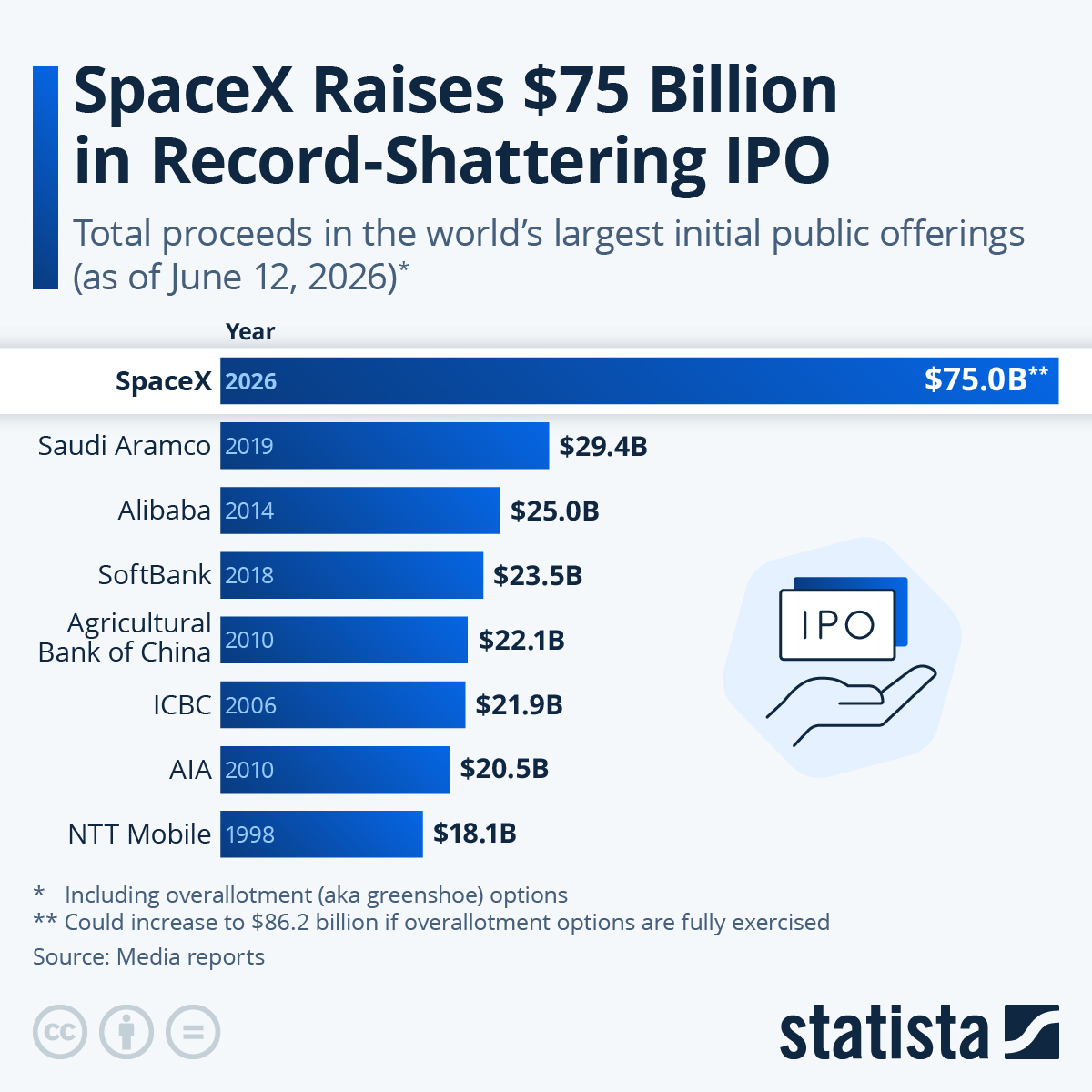
With this market capitalization, SpaceX was already the eighth most valuable company on the planet even before trading began, narrowly beating Aramco and sitting behind Broadcom. However, share price fluctuations over the coming days and weeks could nudge it higher—or lower—in the rankings.
Is SpaceX IPO a Good Investment?
While trading appears heavily oversubscribed, some have questioned whether the loss-making company is as safe an investment as this enthusiasm would suggest, and whether its imminent inclusion in index funds can be justified given lingering governance questions.
According to an analysis by The Motley Fool, the rosiest scenario could see SpaceX deliver returns of up to 30 percent annually, provided its Starlink satellite services continue growing at a healthy rate.
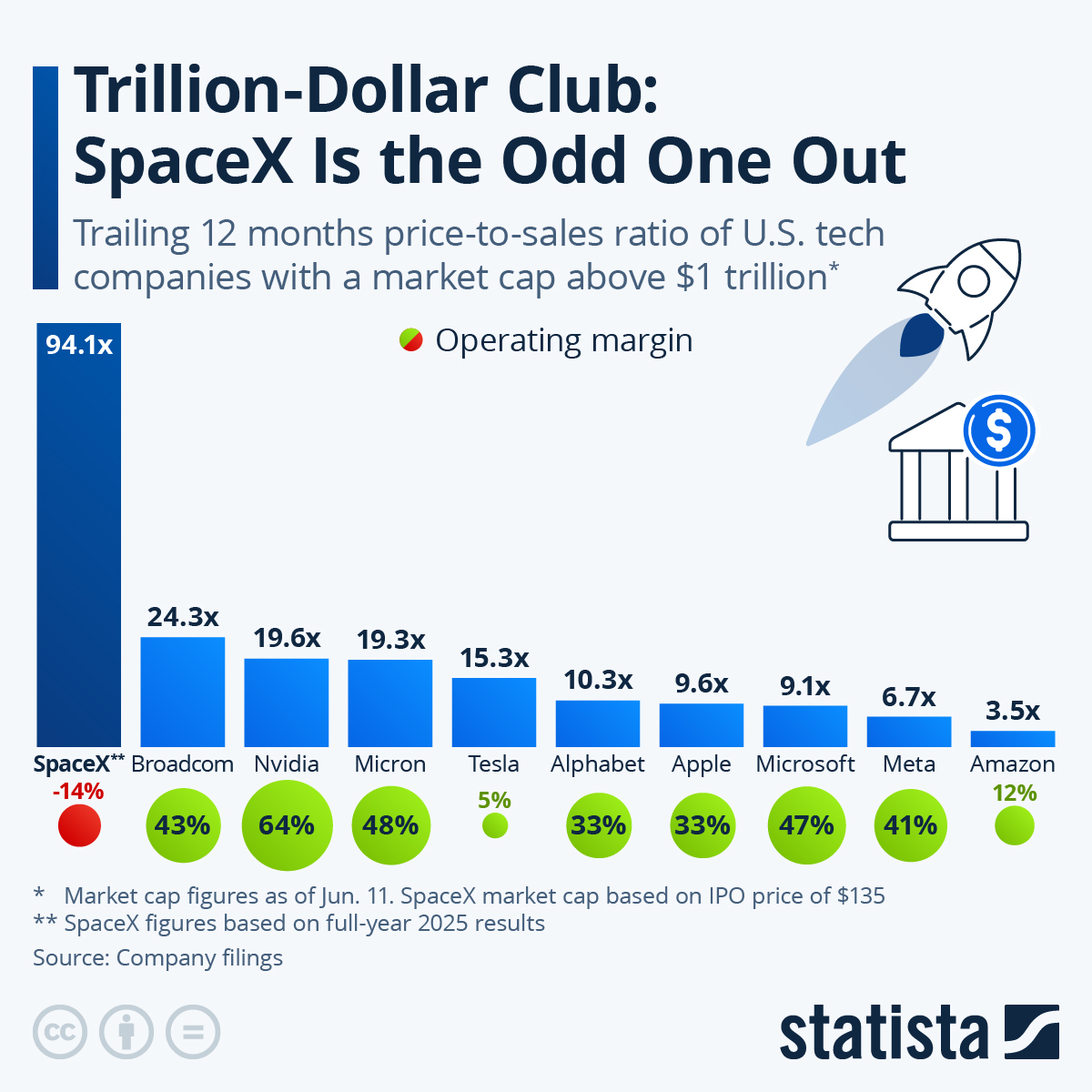
In the prospectus filed in early June, SpaceX said that its revenues rose to $4.7 billion in the first quarter from $4.1 billion a year prior. In 2025, revenue rose 33 percent year-over-year to $18.7 billion. However, the company still recorded a net loss of $4.3 billion in the most recent quarter, comparable to the $4.9 billion it lost through the entirety of last year.
And given the earnings disparity with its trillion-dollar peers, some have doubted its appeal for retail and institutional investors.
Another idiosyncrasy is its pricing. The $1.8 trillion IPO valuation means SpaceX is valued at close to 100 times its yearly revenue. According to the financial services firm Fidelity, this is well above the norm for megacaps, with Nvidia valued at around 21.5 times its sales, Micosoft at 12.3 and Apple at about seven.
And earlier this month, Morningstar analysts said a more realistic valuation would be around $780 billion.
“The company faces substantial risks related to strategic execution, technological evolution, market dynamics, regulations, AI buildout, and key-person dependency,” they wrote, adding that the share price would likely be “overvalued” while acknowledging the upside potential for Starlink.

...
And governance of the company has also emerged as a key issue. In a recent letter to SEC Commissioner Paul Atkins, Democratic Senator Elizabeth Warren cited fears about SpaceX’s structure, which she said could grant its CEO “an unprecedented level of power” and leave investors with “with significantly fewer rights than those traditionally offered to purchasers of public shares.”
Warren said that SpaceX’s IPO demanded “careful SEC review and attention to investor needs.” She went on to request that regulars probe the disparity between its sales and valuation and whether this puts individual investors and those invested through index funds “at risk.”
What Is Free Float?
SpaceX has already secured fast-track inclusion in major benchmarks, including the Nasdaq-100 and Russell 1000, meaning passive funds tracking these will, within days, feel the effects of its market impact.
However, the S&P 500 elected not to shorten its eligibility window for newly listed companies. This means those holding funds which track the world’s largest stock index won’t profit—or suffer—from SpaceX’s inclusion for a year.
But regardless of its inclusion, some say a detail about the portion of the company’s shares actually available for public trading will limit its overall effect.
"A critical factor to keep in mind is free float," Alex Michalka, Wealthfront's vice president of investment research, told USA Today. "This measures the number of shares actually available for public trading, as opposed to total market capitalization, which counts every share in existence."

...
SpaceX is reportedly “floating” only about 5 percent of its shares, meaning its weighting in an index will be smaller.
“A good example is Saudi Aramco. When it floated less than two percent of its shares in 2019, it became the largest listed company in the world by valuation,” explains Peter Wicks, a financial adviser at the U.K. accounting firm Cooper Parry. “However, because only a small proportion of shares were publicly available, relatively few investors saw the company appear among the largest holdings in their portfolios.”
Richie told Newsweek most savers would not need to take any action, describing the exposure as “a very small part of what you own, not a big new bet.” With only about 5 percent of SpaceX initially trading, he added that, “inside a broad index fund, it's a tiny piece, not a core holding.”
Richie added that investors already hold similar indirect exposure across diversified portfolios. “You’ll own a little SpaceX the same way you already own a little of hundreds of companies you’ve never thought about,” he said.
“For most retirement savers it's neither a big positive nor a big danger,” Richie added.
“A small slice of any single company, up or down, won't make or break your retirement.”
Larger Market Impact
Even if retail investors see only limited exposure, the addition of a company the size of SpaceX can still trigger large-scale trading across index-tracking funds.
SpaceX is poised for inclusion in the Nasdaq-100 with a significant initial weighting once it becomes eligible. Funds that track that index must then buy shares in proportion to that weight.
Asher Rogovy, chief investment officer at Magnifina, LLC, told Newsweek this creates a chain reaction across portfolios. He said that “every index fund tracking it then has to buy a matching amount of the stock, simply because of their rules.”
To fund those purchases, index managers typically sell small portions of other holdings. Rogovy said that means the impact is spread across the rest of the market, not just the new entrant.
“The bigger SpaceX is, the more they have to sell,” he said. Because these adjustments follow public index rules, he added, the timing and scale of trading can be anticipated by other market participants.
“Since the rules dictate what the funds must trade and when, their market activity is very easy to predict,” Rogovy said.
“Earlier traders can step in ahead of the funds and obtain better prices.
"The net effect is upward pressure on SpaceX, and downward pressure on everything else in the index.”
View 0 Comments
Submit Correction
View Editorial & AI Guidelines