...

By Anna Rahmanan
0
Share
Newsweek is a Trust Project member
See more of our trusted coverage when you search.Prefer Newsweek on Googleto see more of our trusted coverage when you search.
When it comes to soccer, the familiar American pattern is easy to mock: the World Cup arrives, casual viewers learn a few player names and suddenly become experts, bars fill up, social media turns into a sea of armchair coaches and, once a winner is crowned, the domestic version of the game returns to a much smaller audience.
In 2026, that every-four-years soccer fever was as real as ever. By the end of June, 44 percent of registered voters said they had watched at least a few World Cup matches, while Gallup found before the tournament that four in 10 U.S. adults planned to tune in.
But perhaps more interesting than the viewing numbers was the way the World Cup itself evolved to appeal to those temporary fans. Sunday's final featured FIFA's first-ever World Cup Final Halftime Show, a clear sign that the governing body was willing to make global soccer speak the language of American sports entertainment.
Read More on Analysis
In other words, while the United States once again followed its familiar script of briefly becoming a soccer nation, FIFA departed from its own. Faced with both the opportunity and pressure of hosting a North American tournament, the organization reshaped its biggest event to be more legible to American audiences, subtly Americanizing the World Cup in the process.
America’s Soccer Fever
Soccer has gained ground in the United States, especially among younger adults. YouGov found that the share of Americans who said they actively followed soccer rose from 8 percent in mid-2022 to 12 percent in 2026, with the figure among 18-to-34-year-olds rising from 13 percent to 22 percent over the same period.
Still, there is a ceiling. Gallup found that 27 percent of U.S. adults identified as professional soccer fans before the tournament, compared with 54 percent for professional football, and its long-running favorite-sport measure put soccer at 5 percent in 2023. Pew Research Center found in 2023 that 53 percent of Americans called football “America’s sport,” while 3 percent chose soccer.
Those numbers do not mean American soccer interest is fake, they just mean that the World Cup’s U.S. audience is built for a mega-event more than a weekly habit.
Consider these statistics: Gallup found that 40 percent of U.S. adults planned to watch at least some of the World Cup, but only 27 percent identified as fans of professional soccer, and just 5 percent named soccer as their favorite sport to watch. The gap is between Americans willing to sample soccer as a global mega-event and Americans who treat the sport as a regular allegiance.
That distinction makes the 2026 tournament less a conversion story than an event story: the World Cup can make soccer feel unavoidable in the United States for a month without making soccer central to American sports culture afterward.

The Halftime Show
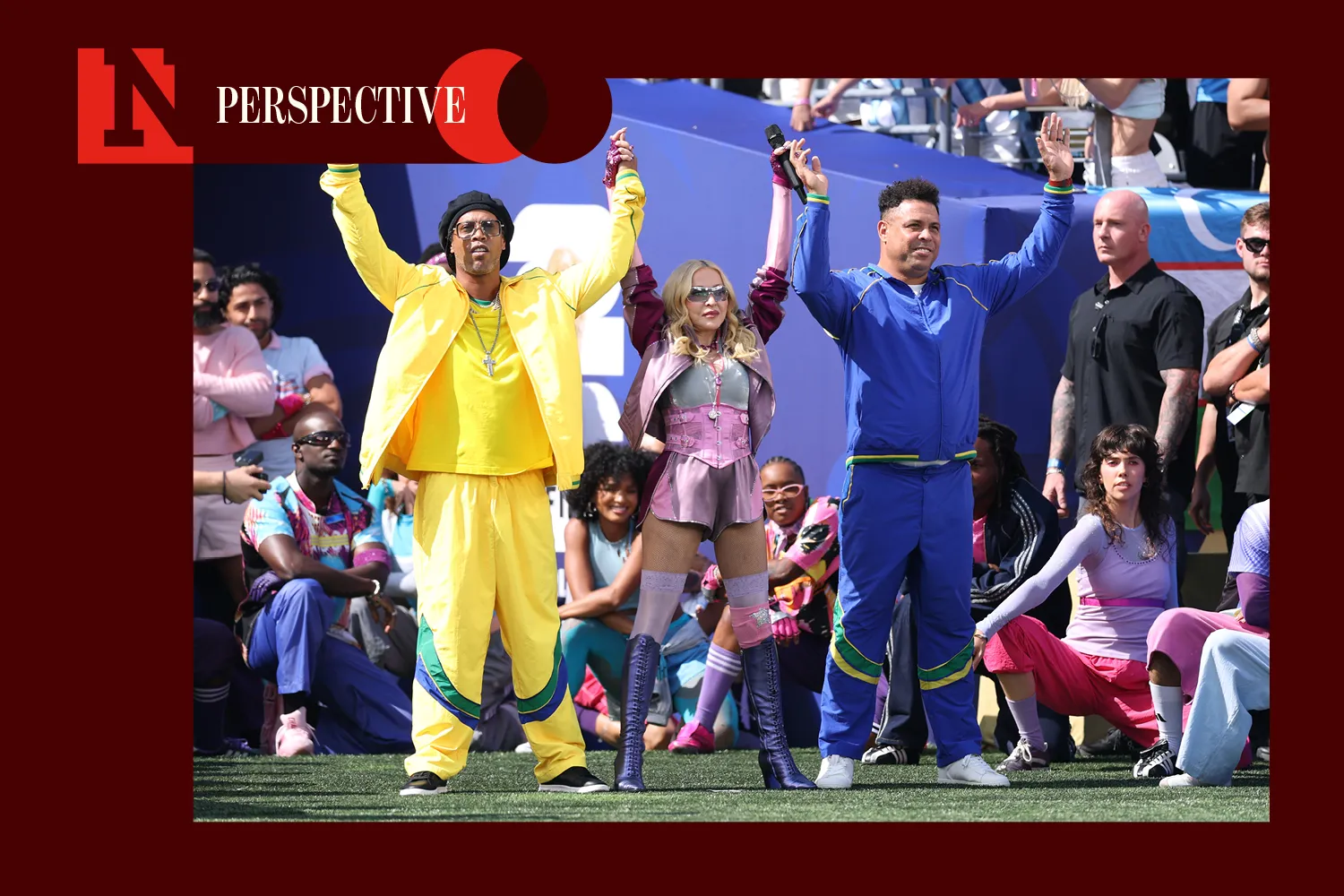
FIFA debuted its first-ever World Cup Final halftime show this year, an unmistakable nod to the Super Bowl and perhaps the clearest sign yet that the tournament was adapting to its American host.
The 11-minute performance at New York New Jersey Stadium featured Justin Bieber, Madonna, Shakira, BTS, Burna Boy, Gustavo Dudamel and the PS22 Chorus, with production by Global Citizen, Live Nation and Done + Dusted. It was a celebrity lineup seemingly designed to lure in even those who couldn't care less about soccer but would happily tune in for the music.

...
Although Spain's victory was the sporting event of the day, the final also became a celebrity showcase, a fundraising platform (FIFA say the tournament raised over $50 million for Global Citizen's education fund), a broadcast spectacle and a cultural product designed to reach well beyond soccer's traditional audience.
Those are not traditionally European soccer instincts, at least not as the game has been packaged for the past few decades. They are, however, quintessentially Super Bowl instincts.
American sports have long turned downtime into entertainment, commercial inventory and cultural moments.
The World Cup, typically held up by soccer purists as the exception to American-style sports packaging, embraced that same logic on its biggest stage—perhaps because it was played on American soil or perhaps because FIFA recognized that expanding the tournament's reach meant borrowing from the country's attitude toward sporting events as global entertainment plays.
Hydration Breaks
The same shift appeared during matches, where FIFA introduced mandatory three-minute hydration breaks midway through each half in every game, regardless of weather. FIFA described the policy as a player-welfare measure, with officials saying the breaks were designed to give players and referees time to cool down and rehydrate.
Although that explanation certainly makes sense given the summer season, the practice also created new advertising windows.
FIFA gave broadcasters permission to air commercials during the mandatory breaks, including full cutaways to ads or split-screen formats with official partners, while requiring coverage to return before play resumed.
For viewers raised on NFL broadcasts, NBA timeouts and March Madness ad breaks, the idea that soccer could stop predictably for three minutes did not feel alien.
For viewers raised on soccer’s flowing clock, though, it was a small but symbolic breach and yet another example of the Americanization of the event. FIFA simply made the World Cup an easier-to-sell product, just like the NFL has done with the Super Bowl.
Politics Also Entered the Camera Shot
In an era when politics increasingly bleeds into entertainment (and vice versa) it felt fitting that the country's biggest sporting export would package its politics the same way.
President Donald Trump became part of the tournament's story before the final after he called FIFA President Gianni Infantino following U.S. forward Folarin Balogun's red card against Bosnia and Herzegovina. To the surprise of Belgium's soccer federation, the U.S.'s following opponent, and many observers, i.e., the world, FIFA would lift Balogun's automatic suspension.

...
Trump was also impossible to miss during the final itself: he handed out awards, appeared on stadium screens during the national anthem and stood alongside Spain's players as they celebrated with the trophy.
It resembled a distinctly American form of political theater: the head of state woven directly into the television spectacle, part host, part guest star, part lightning rod for controversy.
To be fair, the World Cup has always absorbed the politics, business culture and performance habits of its host nations and FIFA has operated as a commercial powerhouse for decades.
What felt different in 2026 was not that entertainment or politics were present, but that American forms of both sat at the center of the tournament's biggest moments.
The halftime show shared top billing with Spain's victory rather than serving as a footnote, presidential appearances and made-for-TV hydration breaks weren't background details, they became part of the way the World Cup presented itself to the world.
Now What?
FIFA took the American love of spectacle and sold it back to the United States through a sport that many Americans still treat as foreign.
But was that a one-off concession to the host market or the start of a new World Cup template? The 2030 tournament will be hosted by Morocco, Portugal and Spain, with centenary matches in Uruguay, Argentina and Paraguay. If the halftime-show logic and ad-friendly pauses travel there, 2026 will look like a rehearsal but if they do not, it will look like FIFA simply knew how to work the room in North America.
Either way, the lesson is uncomfortable for a country used to assuming it sets the terms: America did not make soccer bigger. Soccer learned how to sound American.
View 0 Comments
Submit Correction
View Editorial & AI Guidelines