10
Loading video...

By Jennifer Wignall
Senior Editor, Print and Digital
0
Share
Newsweek is a Trust Project member
See more of our trusted coverage when you search.Prefer Newsweek on Googleto see more of our trusted coverage when you search.
For more than two decades, Albania did the unglamorous work in their bid to join the European Union: overhauling its courts, vetting judges and opening negotiation “clusters” with Brussels in rapid succession.
Then Jared Kushner went for a swim.
On a yacht trip off Albania’s Adriatic coast, Ivanka Trump described how she and her husband Kushner came across the turquoise shallows of the Vjosa-Narta lagoon and unspoiled Sazan Island—and began imagining a luxury resort there.
Read More on World
What followed was not simply a pitch. The legal and political conditions needed to build it were soon put in place. The site itself was among the most heavily protected stretches of coastline in the Mediterranean. The Vjosa-Narta lagoon, home to flamingos and more than 200 migratory bird species, sits inside a designated protected landscape; Sazan Island lies within Albania’s only marine and terrestrial national park.
...
The Flamingo Revolution
Under the country’s 2017 Law on Protected Areas, large-scale tourism construction in both was effectively barred. That changed in February 2024, when Prime Minister Edi Rama’s parliamentary majority passed an amendment permitting five-star resorts inside protected areas—regardless of what their founding decrees allowed. Later that same year, Atlantic Incubation Partners, a company linked to Kushner’s Affinity Partners, was granted “strategic investor” status for a $1.4 billion resort on that land.
The sequence of events has drawn scrutiny from opponents of the project. In early June, residents demonstrated in Vlorë, the closest city to the lagoon, under banners reading “Hands off the lagoon” and “Albania is not for sale”—protests that quickly became known as the “Flamingo Revolution.” Protests have since spread to the capital, Tirana, and beyond, with solidarity marches held internationally. The issue driving them: whether Albania’s rules were rewritten to fit the project, rather than the other way around.
Blerjana Bino, executive director of the Center for Science, Innovation and Development in Tirana, argued that the movement has evolved beyond a dispute over a protected area. What began as a campaign to defend the Vjosa-Narta lagoon, she said, has become a broader protest over governance, transparency and public accountability in Albania.
“It is one of the largest citizen-driven mobilizations Albania has seen in years, and its significance lies precisely in the fact that it has not been organized through party structures,” she told Newsweek.
Albania’s EU ambitions now face pressure on two fronts. By late 2025, officials were confident that membership by 2030 was within reach—the closest the country had ever come to its European goal. But environmental compliance and the rule of law are core conditions of accession—and the Kushner-backed project has raised questions about both.
European lawmakers made their position explicit. In a resolution passed on June 17, the European Parliament called on Tirana to repeal the 2024 amendments to its Law on Protected Areas, impose an immediate moratorium on construction inside protected areas and ensure full compliance with EU nature protection standards.
Kushner's Private Equity Firm
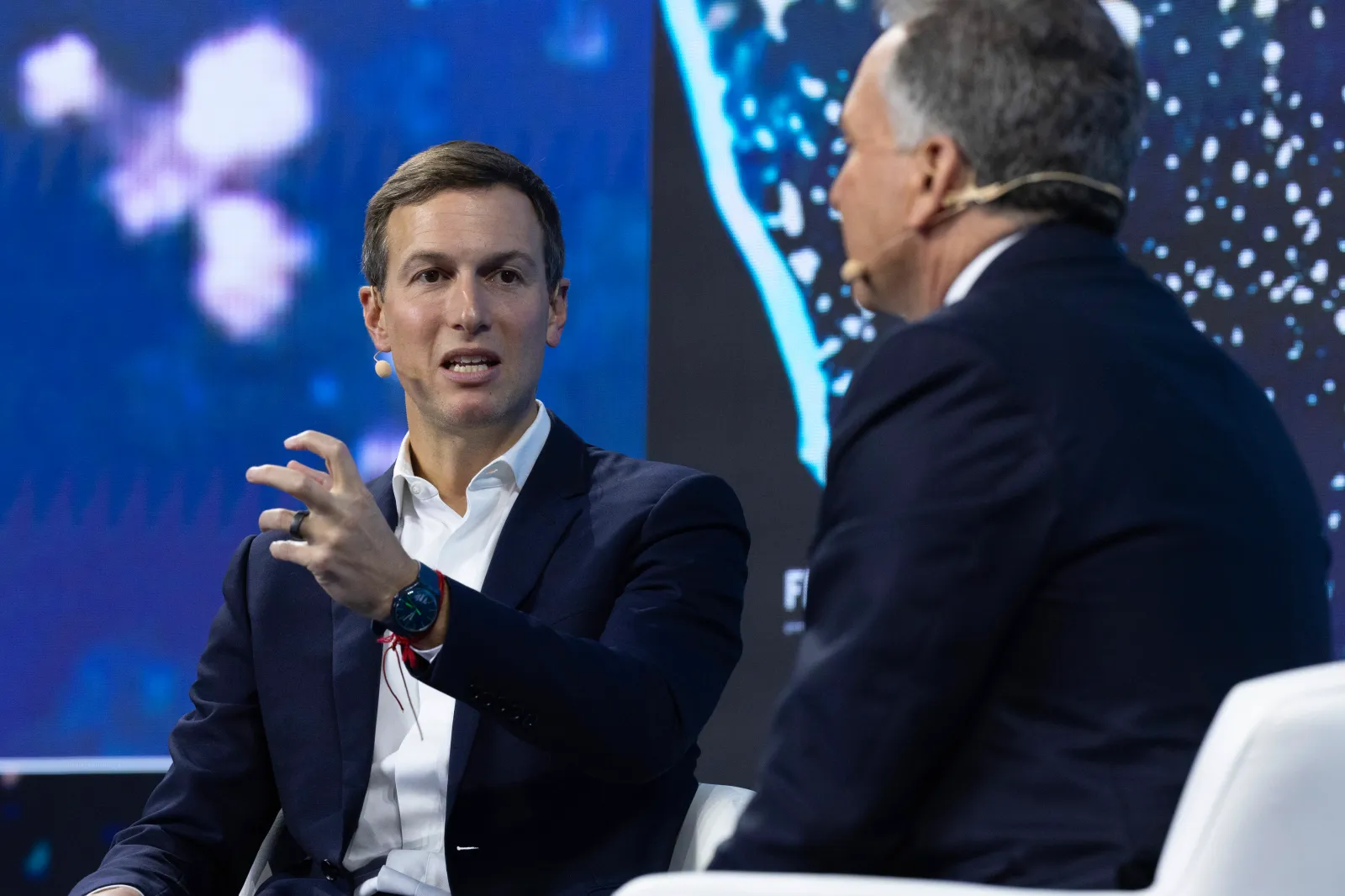
Kushner is not betting his own fortune on a Balkan resort. His private equity firm, Affinity Partners, manages roughly $6.16 billion, including about $2 billion from Saudi Arabia’s Public Investment Fund, the sovereign wealth vehicle controlled by Crown Prince Mohammed bin Salman. Additional capital has come from investors in Qatar and the United Arab Emirates.
Even as he raised this capital, Kushner returned to a diplomatic role under President Donald Trump as a peace envoy, giving him a prominent role in U.S. policy in Iran, Ukraine and Gaza.
In March 2026, Senator Ron Wyden of Oregon, and Representative Robert Garcia of California, both Democrats, opened an inquiry into whether Kushner’s diplomatic activity has been kept separate from his private fundraising.
The following month, Maryland Representative Jamie Raskin, a Democrat, broadened that scrutiny, framing it more bluntly: “You cannot both be a diplomat and a financial pawn of the Saudi monarchy at the same time.”
The congressional inquiries have yet to produce formal findings. But they have established the core question now shadowing the Albania deal: where does the boundary lie between public authority and private leverage—and has it been meaningfully enforced?
In Albania, anti-corruption prosecutors have also taken notice. The Special Structure Against Corruption and Organized Crime, or SPAK, has opened an investigation into how key parcels around the lagoon changed hands and how the 2024 legal amendments were structured. Among the issues under scrutiny are disputed land valuations and the role of intermediaries in assembling plots ahead of the development. Authorities have already frozen accounts linked to one company involved in land acquisitions near the site.
The issue for investigators is not simply whether laws were changed, but how those changes were made and who benefited from them. Dr. Beatrice Mosello, a senior research fellow at Chatham House, an international policy institute based in London, told Newsweek the structural problem predates the Kushner project.
Albania’s 2015 Strategic Investments Law, she said, “is designed to attract foreign investment by granting selected projects fast-track administrative procedures, but in practice it can also risk limiting scrutiny and potentially bypassing key environmental assessment requirements expected under EU standards.”
When negotiations reach Chapter 27—the EU’s environmental and climate rules—she warned, that legal architecture is likely to come under sustained EU pressure.
The EU Test
By the time Brussels intervened formally, the political risk was no longer abstract. The June 17 resolution stopped short of naming Kushner or the Trump family, but its target was clear. The intervention signaled that what began as a local development dispute had escalated into a test case for Albania’s EU trajectory. Facing mounting pressure, Rama has sought to reframe the controversy. On X, he dismissed the protests as “hysteria,” claiming demonstrations had never exceeded 8,000 participants even at their peak and accusing international media of inflating the story.
The Albanian Foreign Ministry told Newsweek that no final project had been approved and no final project was under construction. Rama has also pitched the project in environmental terms, promising a “net positive” outcome with “approximately 25 percent more trees and green space than exists today.”
At another point he accused Iran of waging a “hybrid war” of disinformation against the resort, without providing evidence. Tehran flatly rejected the charge. Iran’s Foreign Ministry dismissed Rama’s claim as baseless, with a spokesman scoffing that “perhaps they will say the flamingos were Iranian security agents.”
The attempt to cast the controversy as a foreign disinformation campaign did little to dampen opposition at home. The protests have continued—and broadened—suggesting the backlash is rooted not in foreign interference but in domestic anger at how the deal was struck.
The collision of political access, foreign capital and public land is now being examined on both sides of the Atlantic. In Washington, lawmakers are probing whether political access and private capital have been improperly intertwined. In Brussels, officials are asking whether Albania’s legal reforms can withstand political pressure.
The answers may determine more than the fate of a single resort. They go to a simpler question: Who bears the risk when power and profit converge?
In this case, the consequences will be felt first in Albania.
View 0 Comments
Submit Correction
View Editorial & AI Guidelines