10
Loading video...

By Alice Gibbs
Senior Reporter
0
Share
Newsweek is a Trust Project member
See more of our trusted coverage when you search.Prefer Newsweek on Googleto see more of our trusted coverage when you search.
Lake Mead remains near its lowest level on record as the state of Nevada and the Southern Nevada Water Authority launch a legal challenge to a new federal plan governing the Colorado River, arguing it would impose disproportionately steep water cuts on the state while sparing some upstream neighbors from mandatory reductions.
The plaintiffs on Monday became the first parties to challenge the Interior Department's newly finalized operating framework in court.
The plan will govern river operations after the current guidelines expire at the end of 2026 and is intended to address growing pressure on water supplies across an already drought-stricken West.
Read More on Weather
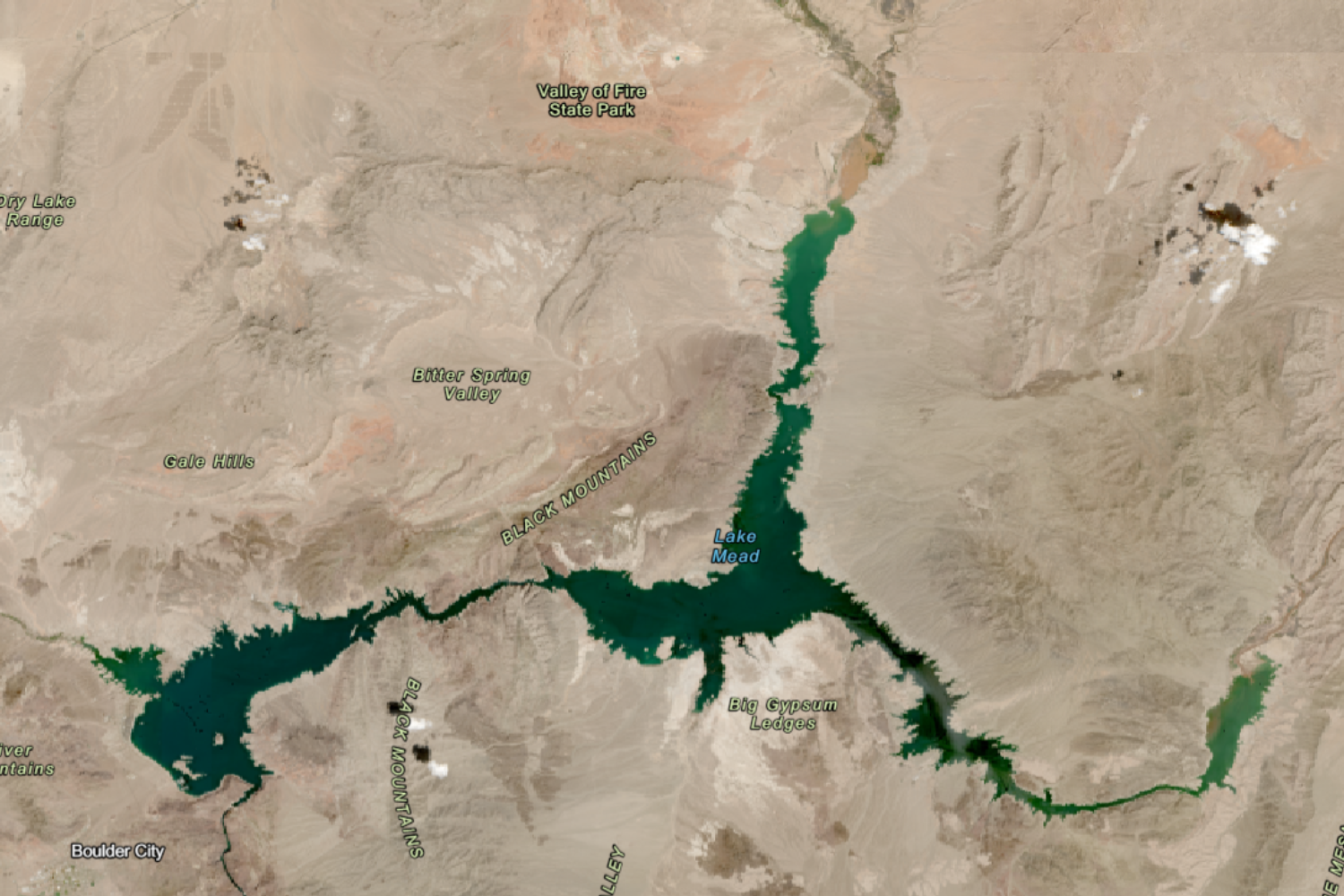
The lawsuit comes as Lake Mead, the nation's largest reservoir, sits roughly 190 feet below full pool and near its lowest level since it was first filled in the 1930s.

How Low Is Lake Mead, Lake Powell?
As of August 24, Lake Mead's water level stood at approximately 1,039.3 feet above sea level, according to monitoring data, placing it 189.7 feet below its full-pool elevation of 1,229 feet. NASA reported this as the lowest level recorded since Lake Mead was filled in 1937.
Meanwhile, Lake Powell, the nation's second-largest reservoir, is also under severe stress. Levels have fallen to about 22 percent full and dropped below its previous record low, reaching an elevation of 3,518.79 feet above sea level on August 23.
The reservoir's declining level has become one of the most visible signs of long-term stress on the Colorado River Basin, a system that supplies drinking water to approximately 40 million people and irrigates around 5 million acres of farmland in the western United States.
NASA said prolonged drought, below-average snowfall, rising temperatures and continued demand from cities and agriculture have contributed to shrinking water supplies across the Colorado River Basin.
Together, Lakes Mead and Powell are central to managing water deliveries across seven Western states, making their declining levels a major concern for communities, industries and farmers throughout the region.

...
Why Nevada and Southern Nevada Water Authority Are Suing
The plaintiffs argue the federal framework places an unfair burden on Lower Basin states by requiring significant reductions in their Colorado River withdrawals while not imposing equivalent mandatory cuts on Upper Basin states including Colorado, Utah, Wyoming and New Mexico.
Kathryn Sorensen, director of research and professor of practice at the Kyl Center for Water Policy at the Morrison Institute, said the dispute ultimately centers on who will bear the burden of water shortages in an increasingly strained Colorado River system.
"At a very basic level, the dispute is over who gets to use water in the Colorado River basin and who doesn't," Sorensen told Newsweek.
She said the Colorado River has long been overallocated and that persistent drought has intensified pressure on the system.
"There simply isn't enough water in the Colorado River basin to do all of the things we want to do with it," Sorensen said. "We must make painful choices about the uses of water that should be sustained and the uses that must fall by the wayside."
Sorensen said the legal fight is likely to create additional uncertainty for water users across the Southwest but does not mean residents should expect immediate disruptions to household supplies. "I do not expect tap water shortages," she said.
In announcing the lawsuit, Nevada Governor Joe Lombardo said Southern Nevada could lose more than 70 percent of its Colorado River allocation under the plan's most severe shortage scenarios. Nevada receives an annual allocation of 300,000 acre-feet of Colorado River water, but state officials say the new framework could reduce that amount by as much as 213,556 acre-feet.
"Under the proposed plan issued by the Department of the Interior, southern Nevada could lose more than 70 percent of its already meager Colorado River allocation while the Upper Basin states of Colorado, Utah, New Mexico, and Wyoming are not required to contribute a drop," Lombardo said in a statement on Monday. "This isn’t about political posturing—this is a matter of survival for a community that represents about two-thirds of our state’s citizens and the lion’s share of its economy."
Southern Nevada Water Authority General Manager John Entsminger has similarly argued that conservation alone cannot absorb cuts of that magnitude. Southern Nevada used nearly 212,500 acre-feet of Colorado River water in 2024, while the framework could leave the region with less than 86,500 acre-feet annually in the driest scenarios.

...
In the complaint, the plaintiffs argue the plan violates the Administrative Procedure Act, the National Environmental Policy Act and longstanding Colorado River agreements known as the "Law of the River." They also contend federal officials failed to adequately assess the economic consequences the proposed cuts could have on Southern Nevada. The lawsuit asks a federal court to set aside the Interior Department's newly adopted management plan and prevent it from being implemented while the dispute is resolved.
Newsweek reached out to the State of Nevada and Southern Nevada Water Authority’s attorneys via email for comment.
Rhett Larson, Richard Morrison Professor of Water Law at Arizona State University, said Nevada's decision to file first reflects both the state's heavy dependence on the Colorado River and its extensive conservation efforts.
"Southern Nevada is highly dependent on the Colorado River and is also remarkably efficient, meaning that it has a lot to lose in absorbing any cuts and is a poster child for conservation," Larson told Newsweek.
Larson said Nevada's procedural arguments under the National Environmental Policy Act and Administrative Procedure Act appear particularly strong, though some of its water-law claims are less tested in court.
"In my opinion, Nevada's legal arguments are strong, particularly on the NEPA and APA side," he said.
He added that the lawsuit could ultimately affect operations at Lakes Mead and Powell if a court temporarily halts implementation of the Bureau of Reclamation's new operating plan. However, Larson said a more likely outcome may be that existing operations continue while the legal challenge moves through the courts because the short-term framework largely reflects agreements already reached among Lower Basin states.
Larson added that additional legal challenges are likely. "Additional lawsuits are highly likely, including from other states as well as tribal, industrial, and agricultural users," he said.
The Department of the Interior has said the framework is designed to help ensure reliable operations of the Colorado River system through 2036.
"The Department has a responsibility to ensure the Colorado River system remains reliable and resilient for the millions of Americans, communities and industries that depend on it," Secretary of the Interior Doug Burgum said in a statement on July 31. "This framework provides the flexibility to respond to changing hydrologic conditions while preserving the opportunity for the Basin States to continue working toward durable, consensus-based solutions."
The Department of Interior told Newsweek it does not comment on litigation.

...
Could Other States Follow Nevada's Lead?
Nevada's lawsuit may be the first legal challenge to the Interior Department's new framework, but it may not be the last.
Arizona has previously described litigation as a last resort, but officials have said they are prepared to defend the state's water allocation if necessary. If Arizona pursues its own challenge, Nevada's lawsuit could become the opening move in a broader legal fight over how future Colorado River shortages are distributed across the West.
Doug MacEachern, communications administrator at the Arizona Department of Water Resources, told Newsweek the agency is reviewing Nevada's complaint.
"We are evaluating Nevada's complaint and are working on a proper course of action moving forward," MacEachern said, adding that Arizona has already published its response to the Interior Department's Record of Decision and discussed its position during a recent meeting of the Arizona Reconsultation Committee.
Update, 08/26/26 03:59 a.m. ET: this story was updated with additional information.
Contact Newsweek editors on this story: John Fitzpatrick and Gray R. Thomas
View 0 Comments
Submit Correction
View Editorial & AI Guidelines