...

By Tom O'Connor
Deputy Editor, National Security and Foreign Policy
0
Share
Newsweek is a Trust Project member
See more of our trusted coverage when you search.Prefer Newsweek on Googleto see more of our trusted coverage when you search.
As President Donald Trump presses on in a joint military campaign with Israel against Iran, his other top Middle East partners are bearing the brunt of the Islamic Republic's strikes and growing increasingly concerned over a lack of clarity on the White House's war plan as well as a perceived prioritization of Israel's defense and interests over their own.
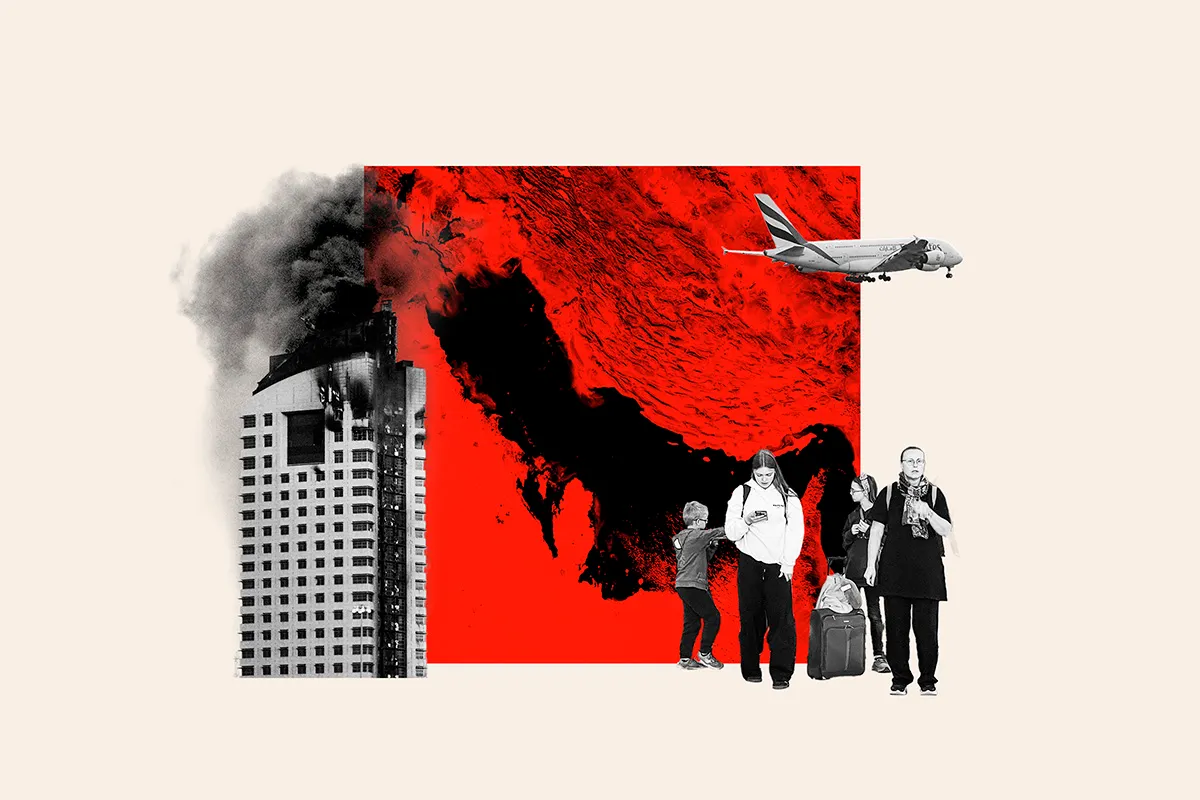
Located just across the Persian Gulf from Iran, the six Arab states of the Gulf Cooperation Council (GCC)—Bahrain, Kuwait, Oman, Qatar, Saudi Arabia and the United Arab Emirates (UAE)—have absorbed hundreds of Iranian missile and drone attacks.
Despite a stunning interception rate, impacts and substantial damage have been reported across U.S. and host-nation military bases, oil and gas sites and civilian infrastructure, including airports, seaports, hotels and apartment buildings.
Read More on World

...
The Iranian barrages show little sign of slowing and the Islamic Republic, potentially galvanized by the selection of new Supreme Leader Mojtaba Khamenei as successor to his slain father, has only hardened its rhetoric of raising the cost of conflict as Trump's messages shift between doubling down on strikes and nearing an end to the conflict.
With the future of the otherwise largely prosperous Arabian Peninsula at stake and global implications, Newsweek has spoken with analysts hailing from all six GCC states who are seeking answers on a U.S.-Israeli-led conflict their governments campaigned to avoid in the first place.
"Confusion is an understatement. We haven't seen that level of vagueness, contradictions, and it speaks to an administration that's not aware of the type of campaign that they've entered into," Bader Al-Saif, assistant professor at Kuwait University and associate fellow at the Chatham House's Middle East and North Africa Program, told Newsweek.
"It's quite something for me, because it comes from people who ferociously attacked U.S. involvement in Iraq 20 years ago, and they're getting themselves into something that can arguably be worse, because this is not contained within one space," Al-Saif said.
"You saw the repercussions with the energy prices in the last two days. It took a statement from Trump to say that it was going to be a quick war to settle down. How long is that going to last? No idea."
An Oasis Under Fire
The intensity of the conflict comes in stark contrast to the relative tranquility enjoyed by the GCC states for much of their history over the past century.
While Saudi Arabia and the UAE had been previously targeted on occasion by Yemen's Iran-aligned Ansar Allah (also known as the Houthi movement) during earlier phases of the Yemeni civil war that erupted in 2014—and Kuwait had been invaded directly by Saddam Hussein's Iraq at the onset of the first Gulf War in the early 1990s—this prevailing reputation for peace and security, bolstered by substantial oil wealth, helped promote the development of the GCC as a growing hub for business and travel in recent decades.
This status was blossoming rapidly in recent years, with high-profile sports and entertainment events, rapid economic diversification and, in some cases, cautious secular reforms, even as much of the rest of the Middle East was plunged into conflict with the war in Gaza sparked by a Hamas-led attack on Israel and the ensuing intervention by Iran's Axis of Resistance coalition.
For the first time since the beginning of this boom, however, foreigners are fleeing in large numbers, spurring uncertainty for projects like Saudi Crown Prince Mohammed bin Salman's Vision 2030.
"The tourism and aviation sectors—both pillars of the Gulf’s economic transformation—have been directly hit," Abdulaziz Al-Khamis, a prominent Saudi journalist and researcher, told Newsweek.
"Since the start of the war on February 28, more than 19,000 flights have been canceled across seven major airports in the Middle East, a number later reported to have risen to nearly 40,000 cancellations, with widespread paralysis of air corridors. Airlines like FlyNas have been forced to operate only limited, exceptional flights."
"This means that the war not only threatens passenger traffic but also undermines confidence in the region as a safe space for investment, leisure, and business—precisely what projects like Vision 2030 need to succeed," Al-Khamis said.
Meanwhile, the GCC's economic backbone of energy production is also under direct fire, which, paired with Iran's attempts to close off trade through the Strait of Hormuz chokepoint—through which 20 percent of the world's crude oil and natural gas trade passes—is quickly compounding regional and international disruption to the point where "even countries that financially benefit from higher oil prices could lose strategically if the war drags on."
One Saudi source, speaking on background, described to Newsweek Riyadh's official position as being that "the Kingdom of Saudi Arabia maintains open and active channels of communication with the United States at all levels of government, and that dialogue continues."
"Throughout," the Saudi source added, "the Kingdom has consistently advocated for diplomatic solutions to regional security challenges, including the current conflict."
Abraham Discord
There are also geopolitical frictions emerging from the conflict as even with the deployment of U.S. assets to defend GCC states, suspicions grow that Israel was being prioritized by the Trump administration.
"I believe there is genuine and growing frustration in some Arab capitals, not necessarily because anyone expects complete alignment in defense mechanisms between Israel and the Arab states, but because the difference in clarity, speed, and political messaging has become glaring," Al-Khamis said.
"Many in the Gulf see the U.S. as capable of providing direct and immediate support when Israel is at the heart of the equation, while its approach to the security of Arab partners appears more ambiguous and more tied to the tactical moment than to a declared strategic commitment."
The result, he said, may not push GCC states toward dissolving the partnership with the U.S. altogether, but "to recalibrate the relationship: demanding clearer guarantees, building greater self-reliant defense capabilities, and diversifying security and diplomatic partnerships," as well as "the erosion of trust that Arab interests are taken as seriously as Israeli interests."
This is also felt in the UAE and Bahrain, the two GCC states to establish diplomatic ties with Israel in a deal overseen by Trump during his first administration in 2020. The deal, known as the Abraham Accords and also backed by Sudan and Morocco, promised to usher in a new chapter of regional peace and promote mutual interests.
Trump, who considers the Abraham Accords as a key part of his legacy, has sought to take advantage of his close ties with GCC states to expand them, namely by bringing in Saudi Arabia, which was engaged in quiet talks with Israel before the eruption of the Israel-Hamas conflict in October 2023. Even amid the war in Gaza, Trump has often tapped into his positive rapport with the Gulf to seek closer cooperation.
Thus Mohammed Baharoon, director general of the Dubai Public Policy Research Center, said it came as a "surprise" that Trump decided to launch a joint war with Israel against Iran knowing full well the impact on the GCC states. The U.S. focus on neutralizing Iranian threats posed to Israel, however, came as less of a shock given the experience of recent Iran-Israel confrontations.
"The priorities of the military campaign were obvious and they were not different from the two previous spats of attacks between Iran and Israel," Baharoon told Newsweek.
"This campaign focused primarily on Medium Range Ballistic Missiles (MRBM) launchers and stocks, particularly the hypersonic (that is why we haven't seen great use of them in this operation so far), which are the ones that can reach Israel. The focus on shorter range missiles and drone production facilities didn't start until the end."
Yet these shorter-range capabilities constitute some of the potent and elusive threats to critical civilian infrastructure across the GCC, including those tied to "not only energy, which affects the global economy, but water desalination facilities that affect our life," Baharoon said, all while "the end game of the war (strategic outcome) is still not clear; military outcomes are also changing."
Mahdi Ghuloom, a Bahraini researcher serving as junior fellow in geopolitics at Observer Research Foundation Middle East in Dubai, argued that the growing blowback and uncertain course of the conflict indicate a lack of foresight and planning on the part of the U.S. and Israel, a factor that has played into the GCC's reluctance to wage any offensive operations against Iran and instead rely on boosting requests for greater defensive support from Washington and beyond.
"It is becoming evident that the U.S. and Israel were ill-prepared to wage a war against Iran in so far as the impact it has on the GCC," Ghuloom told Newsweek.
"There is a risk perception that Trump could end the war and leave the Gulf more exposed to Iranian threats, which partly explains the decision not to join the war directly yet by the GCC. Trump has proven to be an actor no one knows that well and one can expect frustrations with his administration, though that will not extend to disrupting the strategic ties with the U.S."
"The threats existing by Iran are already serious, and though it is partly American defense systems that have mitigated against Iranian attacks, there is a need to double down on these defenses and for all our allies to come heed the call to help defend our nations, now and in the future through military supply and other means," Ghuloom said. "That is why we see France, South Korea and others’ roles being celebrated during this war."

...
Damage Control
Even with broader regional and international consequences looming, the core focus of the GCC's collective resolve is being devoted to immediate economic needs.
"Tourism will likely be negatively affected in the short term but the economic priorities now are ensuring stable flow of products and services for citizens and residents, not necessarily catering to tourism," Ghuloom said. "However, as demonstrated before the war, the Gulf will do all it takes to establish stability and continue development projects that eventually will restore tourism levels to pre-war levels and more."
That said, he added, "it may also take some time to restore connectivity and flow of flights back to pre-war levels."
In comments shared with Newsweek on background, a Bahraini official said that “the Gulf states deem enduring regional stability essential to global economic equilibrium."
"The ongoing conflict has fueled volatility in energy markets, disrupted maritime security, and strained industrial sectors and investor confidence," the Bahraini official said. "Yet, our economies’ resilience will endure: we remain resolute in sustaining stable energy supplies and restoring confidence in global markets that have depended for decades on our reliability to deliver."
“At this moment our paramount objective is to contain the conflict’s spillover," the Bahraini official said. "Gulf nations are profoundly invested in economic diversification—through education, healthcare, fintech, AI, tourism as a cultural conduit, and robust industry and infrastructure for our people’s prosperity and welfare. Instability obstructs these ambitions, driving our insistent call for de-escalation and diplomatic solutions."
Newsweek has also reached out to other GCC state representatives as well as the U.S. State Department for comment.
Since the formation of the GCC in 1981 and in some ways since the U.S. first established an informal security partnership with Saudi Arabia toward the end of World War II in 1945, Washington has been viewed as the de facto guarantor of the Gulf's stability, a cornerstone not only for regional ambitions but global development given its centrality to the international energy market.
This relationship has undergone periods of tension and divergence of interests over the decades. But the current war marks the first time this arrangement has been comprehensively tested in the form of a sustained conflict in which the GCC is being directly attacked at length, sparking historic scrutiny toward the White House's approach both prior to and throughout the U.S.-Israeli campaign.
“The Gulf states value their strategic partnerships with the United States and acknowledge its enduring commitment to regional security," one Gulf security adviser told Newsweek on background. "That said, Gulf states, naturally anticipate that the safety of their populations and energy infrastructure remains a core element in any regional strategy—genuine alliance demands a vigilant balance of shared vulnerabilities, lest allies bear disproportionate risks."
"We hope for greater clarity on the expectations of objectives of these military operations and the measures in place to avert escalation that could engulf the wider region," the Gulf security adviser said. "In times of crisis, transparency and close coordination among partners are indispensable. Quiet concerns persist in the Gulf over the management of escalation dynamics, as the focus lies not on the confrontation itself but on mitigating spillover threats, especially to vital energy assets.”

...
Diplomacy Failed
Compounding GCC exasperation is the level of effort dedicated in the lead-up to the conflict to avoiding it, with full recognition of the likely consequences.
Qatar, in particular, had already been caught twice in the crossfire of regional strife over the past year. The country was first subject to an Iranian missile strike at America's largest military installation in the Middle East—Al Udeid Air Base, in response to the U.S. bombing of Iranian nuclear facilities during the 12-Day War in June—and then in September hit by an Israeli airstrike targeting a meeting of senior Hamas officials in Doha amid Gaza ceasefire talks in September.
Having played a leading role in mediating those negotiations, Qatar, like many fellow GCC members, held out hopes of a regional de-escalation following the Gaza peace plan rolled out by Trump shortly after the Israeli strike in Doha. As tensions mounted in recent months, Qatar joined GCC nations in once again appealing for a diplomatic solution to the ultimately unsuccessful U.S.-Iran nuclear talks.
"The war option was not the preferred choice among Gulf states broadly speaking," Majhoob Zweiri, an academic and senior analyst in Middle East politics based in Qatar, told Newsweek. "Some countries firmly believed that diplomacy was working and could succeed. These states viewed the crisis as one between Washington and Tehran—but that is not the case. This is the Israeli prime minister’s war, waged in the context of what I would call his 'elimination of enemies' campaign, which he launched as part of his response to the events of October 7th."
"For that reason, diplomacy was never going to succeed under Israeli pressure," Zweiri said. "If there were voices in favor of military action, they likely believed with confidence that Washington could carry out a limited operation without collateral damage. But on the whole, it has become increasingly clear that serious miscalculations are unfolding day by day—regarding both the nature and strength of Iran’s response, and the instability that this war is laying the groundwork for."
Now, he argued, "there is no doubt that frustration is growing among Washington’s regional partners over what they see as America’s blind drift toward Israel, with little regard for its partners’ interests—particularly given the far-right government in Israel that rejects any effort toward a political settlement on the Palestinian question."
"The Trump administration’s unlimited support for [Israeli Prime Minister Benjamin] Netanyahu’s government deepens suspicions about America’s self-styled offshore balancing role, which calls on allies to shoulder greater responsibilities in the region, yet ultimately bends to whatever serves Israel’s interests," Zweiri said. "This war was never about the nuclear program—it is Netanyahu’s war on multiple fronts, and he has managed to draw the Trump administration into fighting it on his behalf, leaving America’s own economic interests and those of its partners exposed to Iranian strikes with precious little support in return."
Al-Saif, the Kuwaiti professor, asserted that "the Gulf states have made themselves clear and loud to the American administration, our partners in the U.S. over the course of the year, and especially since the hit in Doha last June by the Iranians."
"It was clear to us that the Iranian administration was not going to let go of striking the Gulf. It was clearly communicated, and that was clearly communicated back to the U.S. administration," Al-Saif said. "So, as they have been ramping up, as it seems, further war, with all this infrastructure and assets and facilities that were brought in, it's surprising to me that they're surprised that they didn't expect the hits on the Gulf, and hence they prioritized Israel in that case."
"And that just speaks to, what I would call, short-sightedness," he added. "They haven't consulted with their own generals, maybe, or they haven't done their proper internal assessments. But this was clear to us, and we've been prepared."
Not even Oman, a famously neutral nation that led the charge in mediating the short-lived nuclear negotiations between Washington and Tehran, has enjoyed diplomatic immunity from Iranian strikes in response to the U.S.-Israeli war, giving new life to long-held suspicions regarding the extent of U.S. security guarantees.
"There is already a growing discussion in the Gulf about the degree of balance in Washington’s security commitments between its Arab allies and Israel," Abdullah Baabood, an Omani academic serving on the board of directors of the Gulf International Forum, told Newsweek. "While the U.S. affirms its commitment to Gulf security, the attacks and violations of sovereignty suffered by some Gulf states have raised doubts among governments and the public about the extent of this commitment."
"Furthermore," he added, "certain developments in the current war, such as the targeting of energy facilities or the absence of a clear political discourse explaining the war’s objectives and limits, may raise questions among the public and political elites about the clarity of the U.S. strategy."
Ultimately, Baabood said, "the Gulf states view this war primarily from one perspective: that it is not their war and they should not be drawn into it."
"However," he added, "the longer it lasts, the greater its cost to regional stability and economic development, even for countries not directly involved."
Update 3/12/26 7:39 a.m. ET: This article has been updated to include additional comments, information and images.
View 0 Comments
Submit Correction
View Editorial & AI Guidelines