10
Loading video...

By Billal Rahman
Immigration Reporter
0
Share
Newsweek is a Trust Project member
See more of our trusted coverage when you search.Prefer Newsweek on Googleto see more of our trusted coverage when you search.
The Trump administration could soon equip federal immigration agents with gloves capable of delivering electric shocks during physical confrontations, according to a Department of Homeland Security (DHS) procurement notice.
The devices—known as the G.L.O.V.E., or Generated Low Output Voltage Emitter—are manufactured by Kentucky-based Compliant Technologies LLC, and are marketed as a tool to help officers gain control of resistant individuals during close-range encounters.
Immigration and Customs Enforcement (ICE) intends to spend up to $20 million on thousands of the devices for Homeland Security Investigations (HSI) and Enforcement and Removal Operations (ERO) personnel, with deliveries expected by March 2027.
Read More on News
"ICE is constantly assessing the needs of our officers in the field to ensure they have the tools and equipment necessary to safely arrest and remove criminal illegal aliens from our country," a DHS spokesperson told Newsweek. "Every decision is made with careful consideration and appropriately reviewed to ensure that any technology ICE utilizes is consistent with all applicable law enforcement policies and standards."
"Our officers are highly trained in de-escalation tactics and regularly receive ongoing use of force training."
The plan drew concern Wednesday, amid the agency already having faced scrutiny around its agents' use of force over the past year.
"My biggest concern is transparency," Claire Trickler-McNulty, a former USCIS and ICE official told Newsweek. "Before deploying these, ICE should release its training materials and any data on the risks associated with use, so the public and Congress can actually evaluate what's being adopted and how."
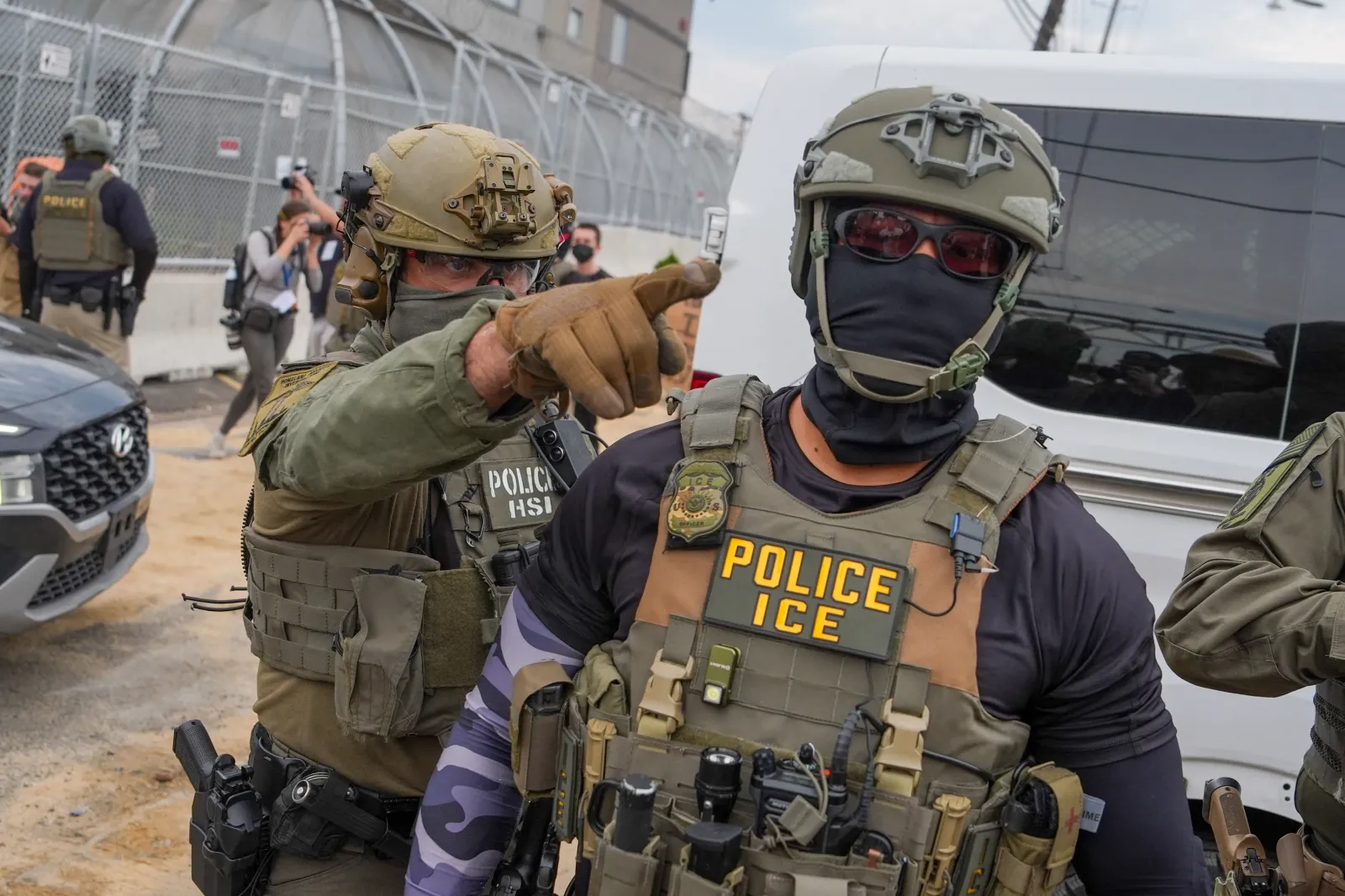
...
What Is the G.L.O.V. E.?
Compliant Technologies describes the G.L.O.V.E. as a wearable "conductive distraction and de-escalation device," that functions as a standard patrol glove until activated. The company says the device is intended for law enforcement, corrections, security, military and emergency medical personnel.
Officers can activate the device using a switch located on the glove. It can then deliver an electrical stimulus to an individual's skin, which is intended to distract or interrupt muscle movement and gain compliance.
The company says the device typically achieves compliance within seconds and leaves no lasting marks.
It adds that no more than two gloves should be applied at one time, and generally for no longer than 15 seconds unless circumstances require additional force to gain control.
The device must make direct skin contact and is not effective through clothing or hair.
Manufacturer's Warnings
The manufacturer says the gloves should not be used as punishment or in response to verbal noncompliance alone.
It also warns officers against using them on certain higher-risk individuals, including children, pregnant women, the elderly and disabled people.
How Could ICE Use Them?
DHS has not publicly detailed how ICE officers will operationally deploy the gloves. The procurement notice identifies HSI and ERO, two main components of ICE personnel, as the intended users, but it does not specify particular enforcement scenarios.
John Peters, president of the Institute for the Prevention of In-Custody Deaths, told The Associated Press (AP) he could envision officers using the gloves during arrests, removals from vehicles, residential operations and inside detention facilities when individuals resist officers' commands.
Trickler-McNulty said she was skeptical about how much sense the gloves would make for ICE field enforcement efforts.
"They're largely duplicative of the drive-stun mode already available on the Tasers ICE carries," she told Newsweek. "And because the glove looks like an ordinary glove, a person won't know it's carrying a current, which means it's more likely to escalate an encounter than de-escalate one, since the individual has no way to anticipate or comply.
"There's also a real tactical downside that officers have mentioned to me, that while wearing the glove, you can't readily use your firearm or another less-lethal option, which can put the officer in a worse position."
Related Story

Thank You for Your Service…Now Get Out of America
Have the Gloves Been Used Before?
Yes. While ICE's proposed purchase appears poised to become the largest acquisition of the technology, the devices have already been used by some law enforcement and correctional agencies. AP reported that the gloves have been deployed in recent years by certain jails and police departments.
Compliant Technologies says that since the CD3 technology used in the gloves was introduced in December 2018, there have been "no documented injuries resulting from the direct use" of the devices. The company states that its products are designed to be non-lethal and noninjurious and that they do not leave burns, marks or scars.
Civil liberties advocates have nevertheless raised concerns about the planned ICE deployment. Jenn Rolnick Borchetta of the American Civil Liberties Union told AP that the public should have little confidence that ICE officers would consistently use the devices appropriately.
Compliant Technologies founder and CEO Jeff Niklaus is a retired U.S. Army Chief Warrant Officer Four who served a 20-year military career that included deployments supporting operations in Somalia, Iraq and Afghanistan, according to his company biography. After retiring from military service in 2006, he worked as a contractor for the U.S. Department of State's poppy eradication program in Afghanistan and later became an EMS helicopter pilot in Kentucky.
How Does the G.L.O.V.E. Compare to a Taser?
Unlike a Taser, which can be fired from a distance, the G.L.O.V.E. is intended for hands-on encounters. Compliant Technologies markets it as a "conductive distraction and de-escalation device." Its user manual says the device can generate up to 380 volts. Modern TASER devices are commonly described as producing up to 50,000 volts in an open circuit, though the voltage can drop to about 2,000 volts under load.
Questions That Remain
Several key questions remain unanswered, including how many gloves ICE intends to purchase, how officers will be trained to use them, what reporting requirements would accompany deployments and whether the agency plans to issue additional guidance beyond the manufacturer's recommendations.
Fatal Encounters With ICE Agents

...
The projected procurement of the gloves comes at a time when ICE has faced increased scrutiny, particularly over a series of fatal encounters involving federal immigration agents during the Trump administration's immigration enforcement campaign. Last month, agents fatally shot Lorenzo Salgado Araujo, a 52-year-old Mexican construction worker, during an attempted vehicle stop in Houston, and Johan Sebastián Durán Guerrero, a 25-year-old Colombian man, during an operation in Biddeford, Maine.
In both cases, DHS said agents opened fire after the men used or attempted to use their vehicles as weapons, a characterization disputed by relatives, witnesses and advocates. The shootings followed earlier incidents that have also drawn attention, including the deaths of Minneapolis residents Alex Pretti and Renee Good earlier this year and the March 2025 fatal shooting of 23-year-old U.S. citizen Ruben Ray Martinez by a Homeland Security Investigations agent on South Padre Island, Texas.
"Under President Donald Trump and Secretary Mullin, ICE is targeting the worst of the worst," the ICE spokesperson told Newsweek. "Since Day One, ICE law enforcement has been delivering on President Donald Trump’s promise to the American people to arrest and deport criminal illegal aliens including murderers, rapists, pedophiles, gang members, and terrorists."
"Nearly 70 percent of ICE arrests are of dangerous illegal aliens charged or convicted of a crime in the U.S. While ICE law enforcement works to remove these public safety threats from American communities, they’re also facing a 1,300 percent increase in assaults, a 3,300 percent increase in vehicle attacks, and an 8,000 percent increase in death threats," the spokesperson said.
Contact Newsweek editors on this story: Matthew Robinson, Dan Gooding, and Tony Phillips.
View 0 Comments
Submit Correction
View Editorial & AI Guidelines