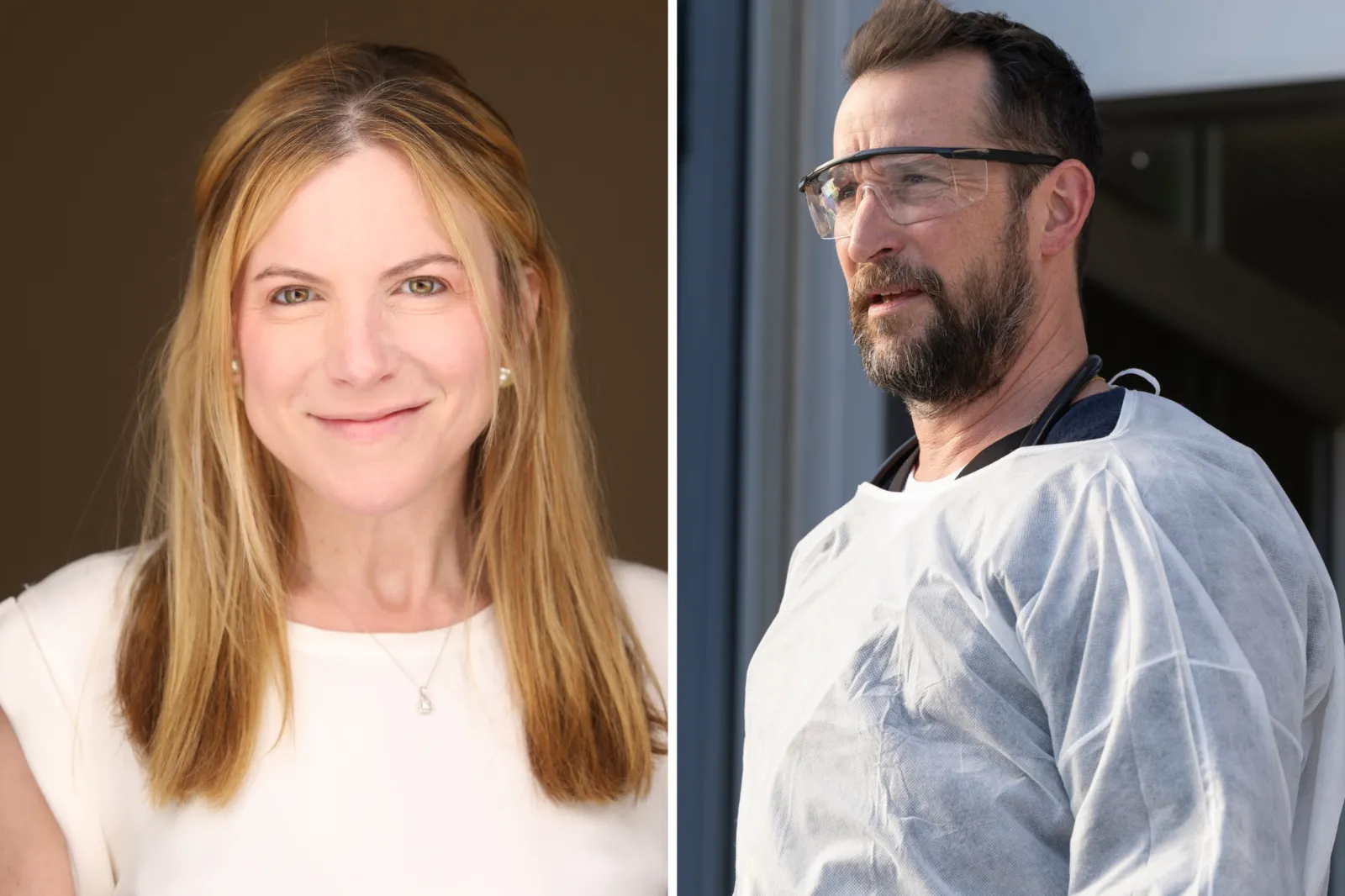
Courtesy Emily Boss/ Max/Warrick Page

By Emily Boss
0
Share
Newsweek is a Trust Project member
See more of our trusted coverage when you search.Prefer Newsweek on Googleto see more of our trusted coverage when you search.
I’ll admit that when I first started The Pitt, a fast-paced medical drama on HBO Max, I had to turn it off. As a surgeon, I’m in the hospital enough, and it felt too much like work. I appreciated the show’s medical accuracy, and, as a teen of the 1990s, I am naturally a Noah Wyle fan, having watched his star rise on ER. But I felt like I was witnessing on the screen all the worst cases a doctor could see over the course of their career, and that wasn’t my idea of enjoyment. That said, given the show’s recent Golden Globes nominations as well as a new season approaching, I decided to give it another try.
On the second go-around, I was moved by a few threads and their likeness to my lived experiences as a surgeon for over two decades. [Spoiler alert: Do not continue reading if you want to be surprised by every case and outcome in the show.]
I’m an ear, nose and throat surgeon. One story on The Pitt hit particularly close to home: a patient bleeding from the throat after having his tonsils removed. It was a dramatic scene. There was blood everywhere; the emergency doctors needed to secure the patient’s airway with a breathing tube, and surgery was required to stop the bleed.
Read More on My Turn
My Husband Froze His Eggs Before He Transitioned. Now I’m Having His Baby6 min read

I Was Single at 37 and Had Given Up on Love—One Message Changed Everything10 min read

I Thought Going Gray Meant I’d Stopped Caring about My Looks. Then the Compliments Started6 min read

I’m grateful the show’s writers highlighted this case. Tonsillectomy is one of the most common major surgeries performed on children. If you are a parent, maybe your child or one of their friends has had one. While tonsillectomies are generally safe, about 2-5% of children who get them bleed from the throat afterward, according to research, which often requires another surgery. In rare circumstances, as seen on the show, bleeding after tonsillectomy can be very severe, even fatal.

...
The good news is that there’s a medication that can curb bleeding and sometimes prevent emergency surgery (it was used by doctors on the show), and newer surgical techniques can also dramatically lower risks. The bad news is that many hospitals and surgeons do not yet routinely use these therapies or surgical approaches. This storyline also brought up another issue: a lack of accountability across specialties and hospitals. After an intern calls the head and neck surgeon on call (ouch! That’s my specialty) about the bleeding patient before him who had initially received care elsewhere, he hangs up the phone and repeats what he was told: “They say it’s not their job to fix another hospital’s problem.” Would the message be so blunt in real life? I’m not sure. But passing the buck is all too common. This lack of accountability stresses the system and harms patients. I’m often called in to care for medically complex children who can’t access appropriate care elsewhere, even when their care was initiated at another institution. I hope the star power and narrative strength of The Pitt drives health systems to do the work to adopt safer, uniform care practices.
On the show, not every patient is saved, which is part of what distinguishes it as an honest reflection of medicine. Take the tragic story of a child who drowned in a backyard pool. Her cold body was brought into the emergency department. The team made dramatic efforts to save her as the frantic, devastated parents watched. I appreciated that the show’s writers had lead doctor Robby (Noah Wyle, my hero) tell the parents directly, without euphemisms, that their daughter had died and the team was going to stop their resuscitation attempts.
In real life, I typically meet children like that young drowning victim later in their hospitalization after they have been partially resuscitated, sometimes left with severely limited brain function and mobility for the remainder of their lives. My team is called in to place a breathing tube in the neck, a tracheostomy, to allow for long-term ventilation. The story underscores the complexity of survival versus meaningful survival, and shows how definitive, skilled, empathic communication can shape a family’s choice and experience.
In another case, a doctor missed a diagnosis because she had neglected to perform a pelvic exam, perhaps wrongly assuming that the patient’s symptoms were due to her obesity. The writers chose one of the most thoughtful and kind doctors to make the mistake, emphasizing that bias is implicit—everyone has biases they don’t even recognize.
My own research shows that parents of children with obesity think doctors respect their families less, even when the way the doctors communicate is objectively the same as with families of normal-weight children. This case calls out the significance of obesity bias and reinforces how stigma and stereotypes affect care, more routinely than one would think.
Finally, The Pitt also exposes how doctors treat one another. The most triggering dynamic for me on the show was between a senior male resident and a junior female intern. In a moment of frustration, he openly berates her, undermining her competency and decision-making in front of an entire stunned and silent team.
I’ve lived that moment. Early in my career, a senior physician stormed into the operating room, shouting at me about a staffing process he disagreed with. Like in The Pitt, the exchange occurred before an entire room of nurses, trainees and even the patient and their family, all who were silent and caught off-guard. I was left physically shaking and mentally distracted, which was far from ideal for the patient at hand about to undergo surgery.
The messy truth that The Pitt exposes here is that despite advances in professionalism and training on how to treat patients and colleagues as people, these hierarchies, cultural rifts and gender dynamics still surface in health care.
The Pitt features a host of complex cases and (mostly) realistic medicine. Beyond its clinical accuracy, the show reflects the systemic barriers and humanity that influence health care delivery every day. As a surgeon, I can attest to the reality and pervasiveness of these themes.
I hope The Pitt improves the culture of health care delivery. But I’m also hoping for something else from season 2: a reunion for Wyle with an appearance from Juliana Margulies or George Clooney.
Emily Boss, MD, MPH, is a surgeon scientist who researches how communication between families and doctors shapes surgical decisions and helps bring evidence-based care into routine practice. She is the director of pediatric otolaryngology and a professor of otolaryngology—head and neck surgery, pediatrics, and health policy and management at Johns Hopkins University.
All views expressed in this article are the author's own.
Do you have a personal essay you want to share with Newsweek? Send your story to MyTurn@newsweek.com.
View 0 Comments
Submit Correction
View Editorial & AI Guidelines