...

By John Feng
China Editor
0
Share
Newsweek is a Trust Project member
See more of our trusted coverage when you search.Prefer Newsweek on Googleto see more of our trusted coverage when you search.
Chinese state-backed engineers have spent eight months completing the foundations of a new military base in the contested South China Sea under the constant watch of U.S. satellites.
Work to turn the once submerged Antelope Reef into China’s next permanent military complex in the disputed Paracel archipelago—also claimed by Vietnam—began last fall, just months after President Donald Trump’s return to the White House.
U.S. administrations including Trump’s own once were highly critical of China’s strategy of formalizing longstanding maritime claims via rapid land reclamation. Today, Beijing’s island-building campaign is accelerating with apparent impunity for the first time in a decade.
Read More on World
Chinese leader Xi Jinping, who is due to visit the United States in 30 days’ time, appears to be capitalizing on a period of limited consequences and minimal U.S. presence to reinforce China’s geostrategic footprint in the region—and likely is betting on Trump not to press him on the activity next month.
No One Does It Like China
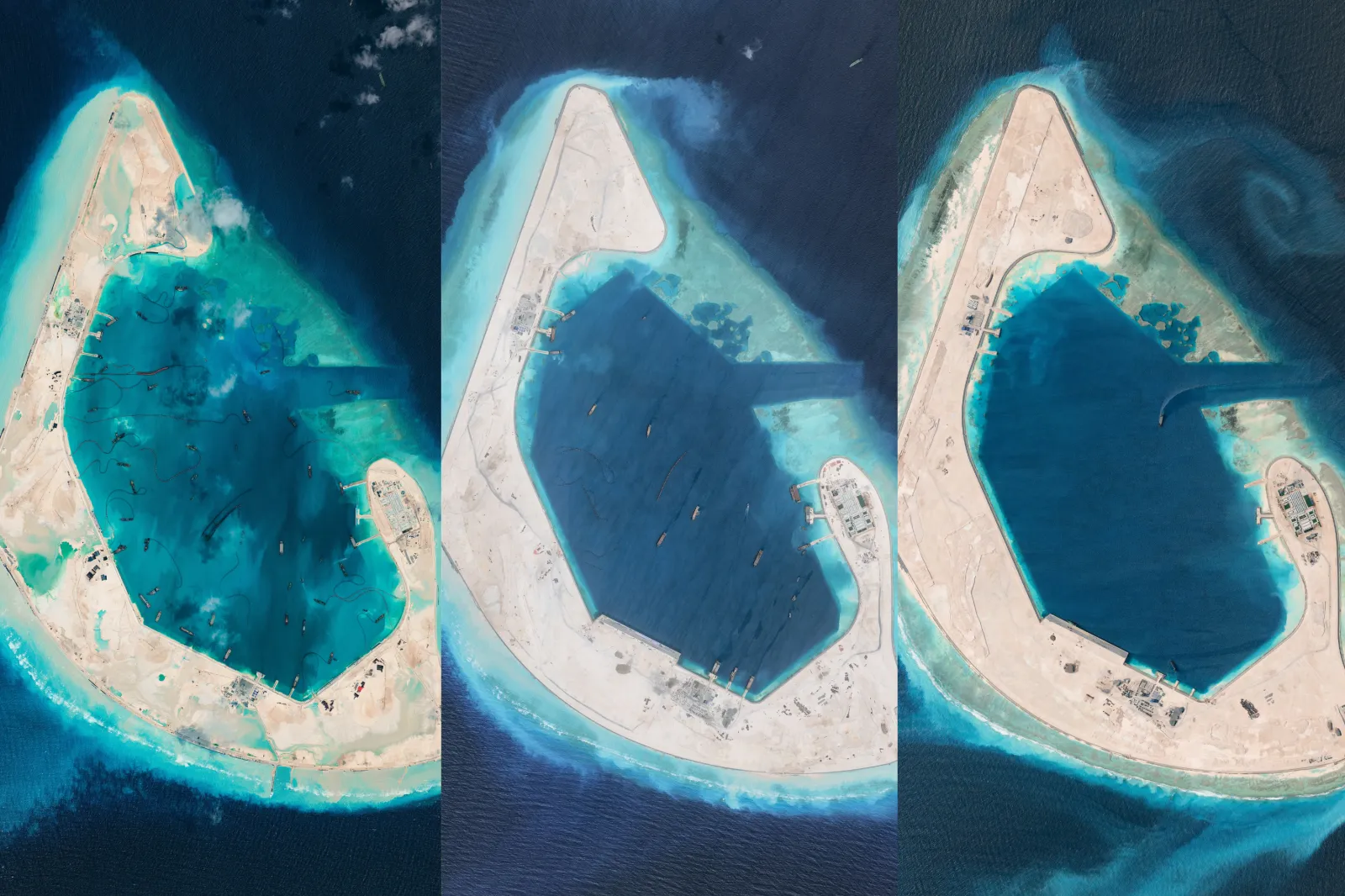
High-resolution satellite imagery provided by the Colorado-based spatial intelligence firm Vantor captured some of the breakneck progress made by nearly two dozen dredgers through spring and early summer.
The photos showed floating pipelines on the surface of the lagoon pumping building material onto the surrounding reef, which was turned into solid ground in a matter of months.
By mid-July, the interior of Antelope Reef had become a multi-pier harbor with a deep water port where at least one Chinese Coast Guard vessel had docked in June, according to the images supplied to Newsweek.
On the eastern end of the reef, near an entrance carved into the lagoon, is a developed area that likely serves as the administrative headquarters, according to the Asia Maritime Transparency Initiative at the Center for Strategic and International Studies.
Vantor photos captured the presence of housing, greenery, vehicles and a helipad at the complex, while construction material and heavy lift equipment remained around the human-made island.

...

...

...

...

...

...

...
1 of 7
No one builds like China—skyscrapers, cars, ships and especially islands.
China’s fleet of dredgers is the largest in the world, and it has years of experience turning contested underwater atolls into what the former leader of the U.S. Pacific Command, Admiral Harry Harris, called the "great wall of sand."
But sand is only half the story at some of the largest bases in the South China Sea.
On Woody Island, China’s administrative center in the Paracel Islands, layers of chopped-up rock and coral are topped with hardened concrete to support fighter jets and nuclear-capable bomber operations.
China’s state-owned construction companies and their subsidiaries replicated that base-building success in the Spratly island group in the eastern end of the South China Sea, where at least three Chinese outposts have been fully militarized, Adm. John Aquilino, another PACOM commander, said in 2022.
Researchers at AMTI believe China means to build a full-length airstrip measuring up to 10,000 feet at Antelope Reef, which could become China’s largest island base in the disputed waters. And like other outposts, radars, anti-ship and -aircraft missile systems, barracks and aircraft hangars could soon follow.
Build First, Justify Later
Earlier this year, the Chinese government brushed off skepticism about its latest activities by claiming the sovereign right to build on its own territory in the Paracels, which China seized from Vietnam in a brief naval battle in 1974.
The 1982 U.N. Convention on the Law of the Sea, which China ratified in 1996, does not recognize maritime zones generated by artificial islands, such as a territorial sea or an exclusive economic zone, but China claims them anyway.
Historically, the U.S. and other Western governments have opposed China’s island building out of concern it would inflame regional tensions among claimants. And in the absence of any credible enforcement measures, Vietnam also has been building up maritime features under its control in the Spratlys.


...
When Xi visits the U.S. on September 24, it will have been exactly 11 years since he stood next to former President Barack Obama to directly address America’s unease over "the militarization of disputed areas."
At the time, Xi said in the White House Rose Garden: "Islands in the South China Sea since ancient times are China’s territory."
Construction activities in the Spratly Islands "do not target or impact any country," Xi said. "China does not intend to pursue militarization."
U.S. leaders took Beijing’s word for it, just as they did over a decade earlier, when U.S. treaty ally the Philippines first alerted the world to construction activities at Mischief Reef.
In 1995, Chinese Foreign Minister Wang Yi, then a senior diplomat for Asian affairs, said the facilities built above water were "completely for civilian purposes."
"It is so right now and it will also be so in the future," Wang said, according to television footage captured at the time by The Associated Press.
Mischief Reef is now the largest Chinese military outpost in the South China Sea with a reclaimed land area of 1,379 acres.
During his first presidential campaign in 2016, Trump described China’s maritime outposts as a collective "military fortress."
"They do that at will because they have no respect for our president and they have no respect for our country," he said.
Beijing has never suffered any meaningful consequences for its sweeping island-building campaign.
America gave China an inch, and it took a mile. And with Trump’s attention focused on trade and tariffs, Beijing is less likely to be censured for it this time around.
View 0 Comments
Submit Correction
View Editorial & AI Guidelines